


Who designed and built the Suez Canal?



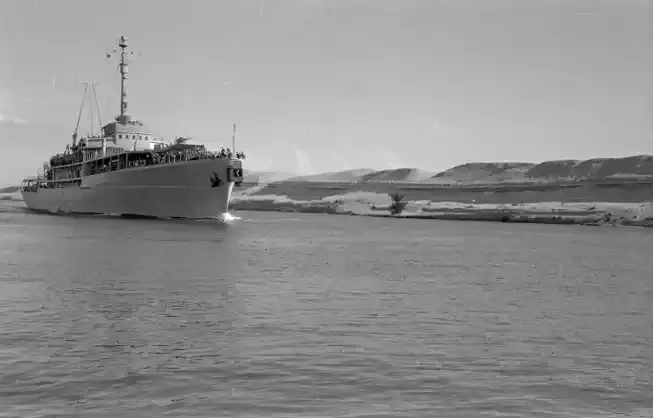
The first survey across the isthmus was carried out only after the French occupation of Egypt (1798–1801), where Napoleon personally examined the remains of the ancient canal. According to J.M. Le Perr, chief engineer of telecommunications lines, the Red Sea level is erroneously 10 metres (33 ft) higher than the Mediterranean level, and therefore, closure would be needed. Given the adverse conditions under which French surveyors operated and the prevailing belief in the disparity in Bahrain's levels, the error was justified, and Le Per's conclusion was accepted without criticism by a series of subsequent authors of the canal projects. Studies of the canal were then carried out again in 1834. and 1846. In 1854, Ferdinand de Lesseps received a concession law from the viceroy (Khedive) of Egypt, Said Pasha, to build a canal, and in 1856, a second law was granted to the Suez Canal so that. The Canal Company (Compagnie Universelle du Canal Maritime de Suez) has the right to operate a marine canal for 99 years after the completion of the work.
Recommend
Show key points
- The initial miscalculation of sea levels between the Red Sea and the Mediterranean by French engineers led to incorrect design assumptions that influenced subsequent Suez Canal plans.
- The Suez Canal construction, originally expected to last six years, faced numerous delays due to harsh climate conditions, labor issues, and a cholera outbreak, ultimately taking ten years.
- Forced labor from Egyptian peasants began the excavation process, but was later replaced by European-run mechanical excavation using dredgers and steam shovels.
- ADVERTISEMENT
- The Suez Canal Company, founded in 1858 and headquartered in Paris, saw a majority of its shares held by French investors, with Egypt holding a significant but ultimately unsustainable stake.
- Britain’s 1875 purchase of Egyptian shares in the canal gave it substantial control, despite earlier opposition, and led to rising share values and changes in profit distribution and employment policies.
- Nationalized by Egypt in 1956 under President Nasser, the canal's international status was cemented by the Convention of Constantinople, though enforcement during conflicts varied.
- The canal was closed twice due to military conflicts, first during the 1956 Suez Crisis and again after the 1967 war with Israel, impacting international shipping until its reopening in 197
Construction began in 1859 and took 10 years instead of 6 years as expected. Climatic difficulties, a cholera epidemic of 1865, and early labor problems slowed operations. The initial project was to cut a small canal (Ismailia) from the Delta along Wadi al-Tamilat, with a southern branch (now called the Suez Canal al-Hilweh; the two canals combined were formerly called the Helou Canal, which is . Water canal to Suez and the northern canal (Abbasiya Canal) to Port Said. Drinking water was supplied in an arid area and was completed in 1863. Initially, the excavation was done manually using hoes and baskets, and peasants were recruited for forced labor. Later, excavators and steam shovels took over run by European workers, and since dredging proved cheaper than dry pits, the terrain was artificially flooded and dredged where possible. Unlike the few areas where rock layers have been encountered,
The entire canal was drifted through sand or silt.In August 1869, the waterway was completed, and it was officially inaugurated with an elaborate ceremony on November 17.
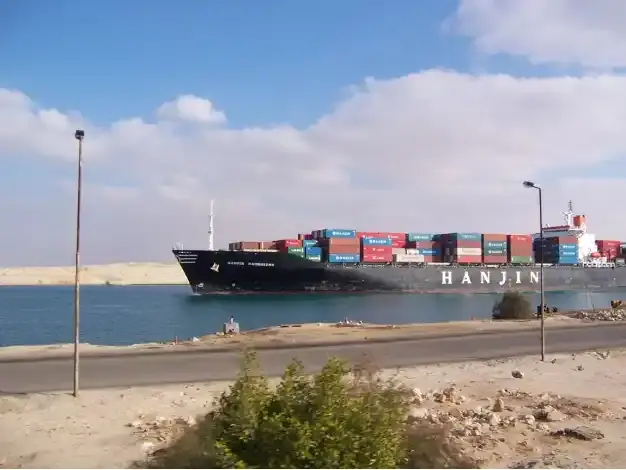
Suez Canal Company was established as an Egyptian joint stock company headquartered in Paris. Despite early official lukewarmness, and even hostility, on the part of Great Britain, Lesseps was keen on international participation and a wide stock offer. But only the French responded, buying 52% of the shares. Of the rest, Said Pasha captured 44%. The first board of directors included representatives from 14 countries.
In 1875, financial problems forced the new viceroy, Ismail Pasha, to sell his property, which was immediately purchased by the British government (at the instigation of Prime Minister Benjamin Disraeli). The shares until that year remained below their issue price of 500 francs each. In 1900 with the British purchase (at 568 francs each), there was a steady rise to over 3,600 francs and 15% of net profits were originally allocated to Egypt, which later gave up this percentage, and after the sale of Ismail's 176602 shares, remained unrepresented on the board until 1949, when it was in fact reinstated as a board member and allocated 7%. of total profits. That year, it was also agreed that 90 percent of new clerical jobs and 80 percent of technical hires would be provided to Egyptians, and that the Canal Company would provide hospitals, schools, and other facilities.
In 1956, 13 years before the concession ended, the canal was nationalized by Egyptian President Gamal Abdel Nasser, precipitating the Suez Crisis. Since then, the Egyptian government has exercised full control through the Suez Canal Authority (SCA), although the original company (now GDF Suez) still exists in France as a multinational utility company. Although the canal was built to serve and benefit from international trade. Its international status has remained undefined for many years. In 1888, the major naval powers of the time (with the exception of Great Britain) signed the Convention of Constantinople, which declared that the canal should be open to ships from all nations in times of peace and war. In addition, the agreement prohibited hostilities in the waters of the Canal and the establishment of fortifications on its banks. Great Britain did not sign the Convention until 1904.
The history of international use of the canal during wartime includes the prohibition of the passage of Spanish warships during the Spanish-American War of 1898 and the passage of a squadron of the Russian Navy during the Russo-Japanese War of 1905 and for Italian ships during . Italy's invasion of Ethiopia in 1935-1936.
In theory, the canal was open to all warring parties during World Wars I and II, but the naval and military superiority of the Allied forces prevented the effective use of the canal to shipping Germany and its allies.
After the armistice between Israel and its Arab rivals in 1949, Egypt banned Israel and all merchant ships with Israel from using the canal. The first closure of the canal occurred during the Suez Crisis of 1956-1957, after Israel attacked Egyptian forces, and French and British forces occupied part of the canal zone. Several ships were trapped inside the canal during this blockade and were unable to leave until the northern end was reopened in January 1957. The second closure was the result of the Arab-Israeli War in June 1967, during which the canal was the scene and after. Egypt fortified both ends of the canal and detained 15 ships, known as the "Yellow Fleet" because of the slowly accumulated desert sands in the canal's Great Bitter Lake throughout the war. The international crews of the anchored ships provided each other with mutual support and camaraderie, and in 1969 most of the crew members were allowed to leave. With the reopening of the canal in June 1975 and the signing of the peace treaty between Egypt and Israel in 1979, all ships (including those registered in Israel) were once again able to reach the waterway, although only two of the 15 blockading vessels had access to the waterway. By her own ability.
