


Intensive Microwave Course: What happens when your device gets punctured?



If you enjoy hot food and can't afford meals that are less hot than steamed, you're definitely a human being, as very few other species worry about the temperature of their food as much as we humans. Second, you probably have a microwave oven, which is arguably the best kitchen appliance for preparing food quickly.
Show key points
- Microwave ovens use electromagnetic waves generated by a magnetron to heat food by energizing water molecules within it.
- For microwaves to escape the oven, a hole needs to be theoretically at least
- 7 inches wide, although smaller holes can still cause leakage.
- ADVERTISEMENT
- Leaked microwaves aren't radioactive, but they can interfere with nearby electronic devices by emitting radiation similar to those used in Wi-Fi and mobile networks.
- A
- 7-inch hole in a microwave can disrupt wireless signals, especially Wi-Fi routers that operate near the
- 45 GHz frequency used by microwaves.
- Prolonged exposure to leaking microwave radiation can harm human health, potentially causing tissue burns and damage to sensitive organs like eyes and testicles.
- Mobile phones placed near a leaking microwave may lose signal or, in extreme cases, catch fire due to similar frequency interference.
- Historical studies by Russian scientists have linked microwave exposure to various health effects, including fatigue, headaches, and cardiovascular irregularities.
However, what if a hole occurs in your favorite microwave somewhere in its structure? Will microwaves escape the frame of the device and cause chaos in your home? Or will it negatively affect your health? Sure, we'll tell you about these things right away, but before that we need a basic understanding of how a microwave oven works.
How does a microwave oven work?
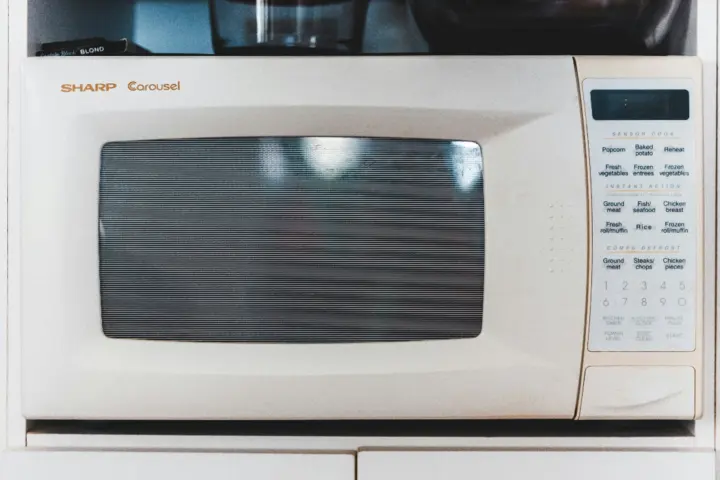
As with visible light (light that we can see with the naked eye), micromicrowaves (which are waves found in microwave ovens) are also a type of electromagnetic wave. Although they are waves, these microwaves do not need any medium in order to travel, meaning they can travel through vacuum.
Recommend
At the heart of the microwave oven is an object called a magnetron. This magnetron is the product of microwaves. It generates them, whenever electricity is passed, and these microwaves are then released inside the oven to heat the food. One component of the oven, called a waveguide, directs these waves to the main compartment of the oven, the space where you place pizza (and other foods). Waves have a lot of energy, so when they hit the inner surface of the oven, they reflect and move quickly to hit another face of that surface.
The waves continue to bounce back and forth continuously. When these waves hit the object inside the oven that you are trying to heat, they irritate the water (or moisture) molecules in the body, thus heating the food or the body.
What if there is a hole in the microwave oven?

If your microwave oven has a hole, will the microwaves constantly bouncing back and forth on the walls of the oven come out from inside the oven and leak into the kitchen?
As we've just discussed, microwaves are a type of electromagnetic radiation, and since they are wave-natured, there must be a "wavelength" associated with them.
The wavelength of microwaves in the furnace is about 12 cm or 4.7 inches. So for any microwave to completely escape from inside the oven, the hole must be at least 4.7 inches in diameter.
While 4.7 inches seems like a pretty big gap, this figure is only theoretical. In practice, even a hole smaller than that would cause some leakage. Although this leakage of radio waves is not a "radioactivity emission," many people mistakenly assume that it is like walking near Chernobyl.
When microwaves exit the magnetron inside the furnace, their strength diminishes with distance. Microwaves are subject to the law of inverse square, which means they lose energy significantly with distance. So when you're a few feet away from the magnetron, microwaves are barely able to do any heating. However, microwave leakage from a 4.7-inch hole can significantly tamper with the electronic devices in its vicinity. Let's see what a hole wide enough can do!
Will disable WiFi connection
The device most vulnerable to microwave susceptibility is your Wi-Fi router, as conventional wireless modems operate in the ISM (industrial, scientific and medical) 2.4 GHz band, which is very close to the operating frequency range of microwaves (about 2.45 GHz). So if your Wi-Fi router is only a few inches away from the microwave with a 4.7-inch hole, you can be sure that your wireless internet will break down, as similar electromagnetic waves will mix and disrupt each other!
Will hinder the work of the mobile network
Another device that can be highly vulnerable to microwave leakage is the mobile phone. Mobile phones also use radiofrequency waves (between 0.9 GHz and 1.8 GHz), which is close to the frequency band over which microwave ovens operate. Placing the mobile phone next to the hole with the microwave turned on is likely to cause the mobile phone to lose network coverage completely. But in the worst-case scenario, when the irradiation period is long from a powerful and intense microwave oven, it can cause your phone to catch fire! For this reason, it is dangerous to keep a mobile phone or flammable object near a microwave oven in a turned on state with a hole or leak.
Will interfere with other electronic devices

Besides Wi-Fi routers and mobile phones, a large hole in the microwave oven would mess with other electronic gadgets and devices, especially those that are remotely controlled. There have been numerous reports of leaks from microwave ovens that have triggered intruder alarms, flashes on TV screens and computers, and even turned on and off tube lights!
It will have bad effects on your health

According to a study published in the American Journal of Emergency Medicine, about 20 people are admitted to emergency rooms in the United States every day for microwave oven injury or related condition. Although most of these cases are due to high water temperature or bursting eggs, this statistic suggests that microwave ovens should be handled with caution. Even the U.S. Food and Drug Administration has warned that exposure to intense microwave radiation can burn body tissue, just as it heats food. Thus, standing just a few centimeters from the oven with a large enough opening in it, can cause tissue burns.
There are two areas of the body that are particularly vulnerable to microwaves: the eyes and testicles. This is because blood flow to these areas is relatively less than others in order to get rid of heat. In addition, when it comes to the eyes, the lens is particularly sensitive to heat. Various studies have indicated that prolonged exposure to leaky microwaves can cause cataracts.
It is interesting that Russian scientists tried to study the harmful effects of microwave radiation during World War II. To put it better to illustrate, commercial microwaves did not come into existence until after the seventies! Studies of these scientists have found close links between microwave exposure and headaches, fatigue, drowsiness, memory loss and even changes in the normal functioning of the heart and blood vessels.
