


Colonialism in the XXI century: there are countries still under foreign domination!



Are you wondering why English and Spanish are two of the most important languages to learn? Or why are they the two most spoken languages in the world?
Show key points
- English and Spanish are among the most widely spoken languages today primarily due to the historical impact of colonialism.
- Colonialism allowed European powers to dominate, exploit, and reshape the cultures, economies, and policies of their colonies worldwide.
- European colonizers justified their invasions by portraying indigenous peoples as uncivilized, often using religion as a moral cover for their actions.
- ADVERTISEMENT
- Despite some infrastructural and institutional developments, colonialism led to widespread violence, slavery, racism, and psychological damage.
- Many territories, especially in Africa, Asia, and Oceania, were colonized during the Age of Exploration driven by Europe’s desire for global dominance.
- Although most countries gained independence in the 20th century, around 17 territories today remain under colonial rule by powerful nations.
- The legacy of colonialism lingers not only in global geopolitics but also in the mindset and identity of formerly colonized people.
The answer is colonialism
According to UN data, worldwide there are about 17 Non-Self-Governing Territories, where just under two million people still live under colonial rule.
Colonialism is like a high school globally.

Colonialism, with its domination and exploitation of one country, had a profound impact on the entire globe. At some point in history, almost every country in the world had colonies in different parts of the world, including Spain, Portugal, Belgium, Germany, Italy, and Japan. This has left a lasting impact on their cultures, economies and policies.
Recommend
To understand what colonialism is and how deeply it affects human history, imagine that you are back in high school. There's always a great group in the classroom, and everything they do is important; the rest just try to follow in that group's footsteps to be "cool."
If a clumsy person has something important to offer, the rest of the class doesn't consider it important unless the "cool" group likes it.
Colonialism is like a high school globally.
And here Europe is the wonderful group.
The group or nation that dominates others is called a colonial or imperial power, while an oppressed nation becomes a colony. This power game used by colonial Powers to exploit other States for their own benefit, to impose their culture, religion and way of education, to use the resources of those States and, perhaps, even for the actual settlement of the populations there, is colonialism.
How did the colonial powers colonize other countries in the beginning?

By 1914, Europe had colonized most of the world. The primary motivation was to become a planet-wide superpower and dominate the entire world. Many European countries, such as Italy, Portugal, Greece, Spain, England and Germany, began to acquire colonies, leading to the colonial division of the world.
As such, most countries in Asia and Africa at that time became colonies. Australia became a settlement colony, where British officials could settle and use it as a prison, where no one could escape the island nation.
It all started during the Age of Exploration, when European countries began to search for new trade routes; Christopher Columbus and Vasco da Gama discovered new lands. These Europeans were able to acquire these lands, because the indigenous tribes did not believe in owning land as the Europeans did.
Europeans considered the indigenous tribes savage, cannibal, and barbarian; under the guise of trade, Europeans began to conquer these new lands and claim their ownership.
The religious justification of seeking to make these savages civilized was used to skillfully conceal the invasions, as if it were Europe's moral responsibility to do so, and this may have sometimes helped spread Christianity.
After the worship of the elements of nature for thousands of years, the semi-compulsory religious conversion of indigenous tribes in America and Africa, where they converted to Christianity, relatively increased the number of adherents to this important religion in the world.
Was colonialism a curse or a blessing?

Let's start by talking about the positives, they are not so many given the barbaric and ridiculous behavior of the colonizers. The colonizers invested in the infrastructure, trade, medical facilities, and technological advances of their colonies, and helped establish democratic systems of government and spread literacy.
But under the guise of religion, a great deal of military action was carried out against the indigenous tribes. So the number of the people of Hispaniola decreased from 250,000 to 15,000 under Spanish rule. Similar acts of war were seen in Africa and in other colonies that attempted to revolt against colonialism.
We are all aware of the slavery of blacks and the years of racism, slavery and dehumanization that these people have suffered.
Aborigines were sold as slaves to "whites" or taken as soldiers to fight battles, especially in world wars. White culture, education, and religion were also imposed on people of color.
Colonialism also had a profound psychological impact, not only on the colonizers' lands but also on their minds. The colonizers felt like an inferior race compared to the "whites," destroying their self-esteem and poisoning their culture.
Are some areas still colonized?
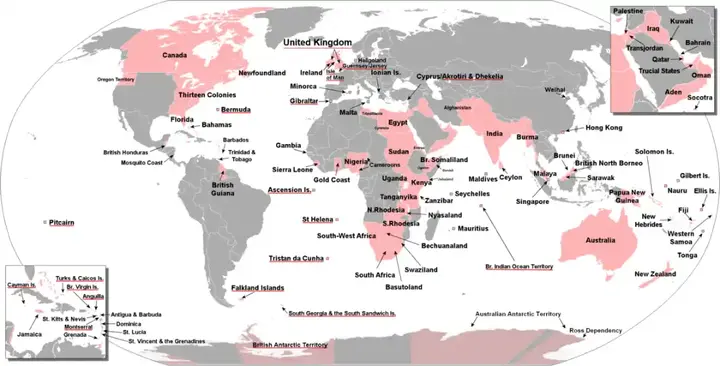
After countless wars between colonizers and colonies, a wave of decolonization swept the world in the twentieth century, and most countries were liberated from colonial rule and established their independent identity. After the founding of the United Nations in 1945, there was a political revolution to protect the territory of all nations and to maintain international peace.
However, there are still 55 colonies with 17 territories around the world. These colonies are maintained by eight countries: Australia, Denmark, the Netherlands, France, New Zealand, Norway, the United Kingdom and the United States, placing about two million people under colonial rule.
The UK has the largest number of colonies, with a total of 14 overseas territories.
These territories include: Anguilla, Bermuda, British Indian Ocean Territory, British Virgin Islands, Cayman Islands, Falkland Islands, Gibraltar, Montserrat, Pitcairn Islands, Saint Helena, Ascension and Tristan da Cunha, South Georgia and the South Sandwich Islands, Turks and Caicos Islands, British Antarctic Territory, and base areas under the sovereignty of the United Kingdom (Akrotiri and Dekelia). There are also local dependencies of the United Kingdom, namely Guernsey, Jersey, and the Isle of Man.
These areas are not just small markers on the world map but are actually of great economic importance to the colonists. The Cayman Islands and Bermuda are in the top ten based on GDP per capita, and Guam provides an important regional security position. Gibraltar and the Falkland Islands are diplomatically disputed, so it is difficult to decolonize them.

Colonialism is nothing more than a game of evil and greedy power. Besides physically and effectively decolonization, ending it from the minds of the colonies is also important, as colonialism continues to affect the memory and moral attitudes of victims, and many find it difficult to get rid of the effects of the atrocities that have resulted from it.
