Why So Many Mediterranean Villages Cling to the Slope

These villages climbed the hillside not because their builders were chasing pretty views, but because the flatter ground below was often too valuable to bury under houses. That is the plain old account-book truth behind many Mediterranean settlements: beauty came later, after the practical sums had been worked out.
عرض النقاط الرئيسية
- Many Mediterranean villages were built on hillsides to preserve fertile flat land below for crops, grazing, and essential food production.
- Hilltop and slope settlements often improved safety by offering better visibility over roads, fields, and approaching threats.
- Terraces were functional structures built to hold soil, reduce erosion, and make steep land usable for cultivation.
- ADVERTISEMENT
- Compact stone houses on slopes helped manage heat, create shade, and maintain more stable indoor temperatures.
- Building on slightly elevated ground improved drainage by moving rainwater away from walls, lanes, and thresholds.
- Village features such as bell towers, clustered homes, and central churches served practical community needs beyond their visual appeal.
- Although reasons varied by location, enduring hill villages usually survived because they solved several problems at once with efficient design.
You can verify the first part easily enough. In vernacular architecture research across the Mediterranean, one repeated point is that settlement often occupied less productive ground while the best soil was kept for crops. Paul Oliver’s Encyclopedia of Vernacular Architecture of the World, published by Cambridge University Press in 1997, describes this basic logic in many regions: people built with a hard eye on soil, water, climate, and defense, not on scenery alone. Put simply, if a family needed wheat, vines, olives, beans, and a bit of grazing, the valley floor had a job already.
قراءة مقترحة
The prettiest choice was often the stingiest one
Start with the first entry in the hillside ledger: arable land. Flat ground is easier to plow, easier to irrigate, easier to harvest, and usually deeper in soil. In much of southern Europe, where usable farmland could be limited by rock, slope, and summer dryness, covering that good ground with houses would have been like roofing over your pantry.
That is why so many old villages seem to perch rather than sprawl. The homes, lanes, church, and storehouses cluster on the slope or on a rocky shoulder, while terraces and fields step away below and around them. What looks charming to a visitor can be read more soberly as a refusal to waste productive earth.
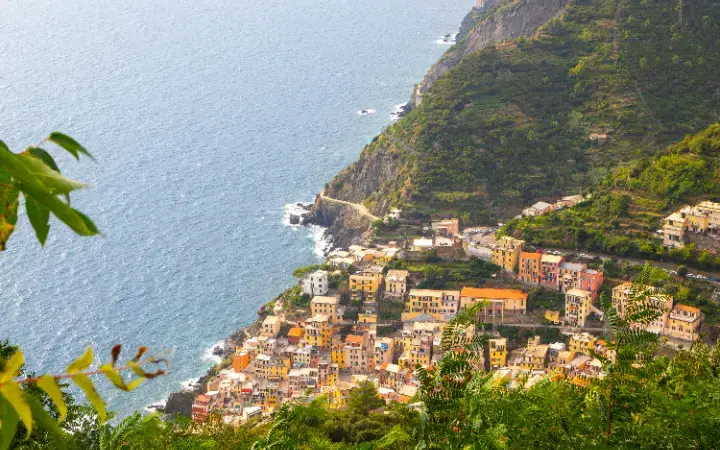
A good real-world example is found in Italy’s Cinque Terre, where the National Park and UNESCO both point to centuries of terracing and careful use of steep ground for cultivation and settlement. The famous terraces did not appear because people enjoyed hard labor for its own sake. They were built because land was scarce, slopes had to be stabilized, and every workable strip mattered.
Then comes the second entry: safety. Higher ground gave warning. A village set a little above the plain or coast could watch roads, fields, and approaches. Across the Mediterranean, from inland hill towns in Italy to perched villages in Provence and parts of Greece, elevation often offered time to see trouble before trouble reached the door.
No need to turn this into a war chronicle. Think instead of ordinary caution. If raiders, rival bands, tax collectors, or even unfamiliar travelers appeared, a place with a better line of sight gave the bell tower, the church steps, or the upper lane a use beyond ceremony. You could look out. You could signal. You could gather people fast.
The church tower in the middle of such a village is a good clue. We like to read it as a picturesque centerpoint, and of course it became that, but a tower is also height organized into a community tool. Bells mark worship, yes, but they also mark fire, danger, death, weather, labor, and assembly. The central church and the clustered houses around it make more sense when you imagine not a postcard, but a settlement trying to keep itself coordinated.
The third entry is water, or rather what rain does once it lands. Building on a slope can be awkward for feet and carts, but it helps move runoff away. Traditional builders learned quickly that a house sitting in a damp hollow rots, cracks, molds, and chills the body. Slight elevation, stone paving, and narrow sloping lanes could guide water downward instead of letting it pool around walls and thresholds.
This is one of those things older people in village places rarely treated as theory. They just knew which corner stayed wet after a storm, which wall needed breathing room, and which lane carried water cleanly. Beauty had to answer to winter leakage.
The fourth entry is heat. Thick stone walls, compact forms, and houses pressed close together on the slope could help blunt summer sun and hold steadier temperatures. The International Energy Agency’s 2019 report on vernacular and traditional architecture in the Mediterranean notes what builders had long practiced without engineering jargon: local materials and compact settlement patterns reduced heat gain and improved thermal comfort. Shade from neighboring houses, small openings, and orientation mattered as much as the wall itself.
So the old arithmetic runs like this: flat land for crops. Slope for houses. Higher ground for watching. Stone for cooling. Runoff away from walls. Once you see that chain, the village stops looking accidental.
When the postcard settles, the logic appears
Would you build your house on a slope if the flat land below looked easier?
If your family lived by grain, olives, a kitchen garden, a few animals, and whatever rain the year agreed to give, the answer becomes clearer. Easier for building is not the same as wiser for living. The flat patch is tempting only until you ask what else it must do for you.
That is the little aha hidden in many hill villages. The part we now call picturesque may once have been the least sentimental choice available. Building uphill protected the ground that could feed you.
What people forget about the bell tower and the terraces
Once you read the village this way, each feature starts behaving like evidence. Terraces are not decorative steps; they are labor made visible, built to hold soil, slow erosion, and squeeze crops from awkward ground. The central tower is not only symbolic; it helps organize a settlement that depends on shared timing and shared notice. The close-packed houses are not merely quaint; they save space, share walls, and make shade.
There is a good body of scholarship behind that common sense. J. B. Jackson, writing on vernacular settlement, and Paul Oliver, in the 1997 encyclopedia, both return to the same broad point from different angles: ordinary building tends to answer ordinary pressures first. People settle where life can be maintained, then over time those workable arrangements begin to look beautiful because they fit their ground so well.
A village under rocky heights and above cultivated strips can therefore be read almost like a family ledger. Up top or along the slope: rockier ground, less useful for plowing, better for walls and watchfulness. Below: the soil that earns its keep. Between them: paths, retaining walls, cisterns, ovens, chapels, and the little adjustments by which people made a hard place habitable.
Try the self-check for yourself. If you had to protect grain, olives, grazing, and your children at once, which ground would you build on, and which ground would you refuse to cover with stone? Most people, once they put survival back into the picture, choose the slope very quickly.
Not every hill village was born for the same reason
Now, an honest limit. Not every Mediterranean hill village formed for exactly this mix of reasons, and it would be sloppy to pretend otherwise. In some places the deciding factor was a spring or cistern site. Elsewhere it was geology, a trade route, feudal authority, taxation, or a defensible outcrop that mattered more than preserving cropland.
There are also villages that stayed high partly because habit is strong. Once streets, kin networks, churches, walls, storehouses, and burial grounds are in place, people do not casually move downhill just because a later century feels safer. Tradition often keeps a practical choice alive long after the original threat has faded.
Still, the broad rule holds well enough to teach your eye something useful: where a settlement remained on the slope for generations, it usually solved several problems at once. That is why these places endured. Not because one reason was pretty, but because several reasons agreed.
Why the old villages feel wiser than they first appear
So when you see houses clinging to a hillside, with the church at the center and terraces stepping away below, you are not looking at scenery that just happened. You are looking at decisions made under pressure: keep the good soil free, see what is coming, stay drier in storms, stay cooler in heat, hold the community tight enough to function.
That is why these villages satisfy the eye so deeply. Their shape was argued out by weather, work, and caution before it ever pleased a painter or a traveler. The order you sense is not decoration. It is use, settled into form.
Old places carry memory in stone, but not only memory of weddings and bells. They also keep the memory of hard-headed choices that let people eat, endure summer, and sleep a little safer above the fields. Once you learn to read them that way, their beauty feels less accidental and more like stored practical wisdom, which is a comforting kind of beauty to walk beside.