


Alhambra.. The story of judgment and blood



Andalusia and Granada were ruled by Muslims for more than 700 years and the last to impose control over the Iberian Peninsula of the Muslim Arabs was a family called "Banu Nasr" or "Banu al-Ahmar" and they were attributed to the founder of this state "Muhammad bin Yusuf bin Nasr bin al-Ahmar", the state that ruled Andalusia and Granada for more than two centuries and lasted until Andalusia fell into the hands of King Ferdinand of Aragon and his wife Queen of Castile Queen "Isabella".
Show key points
- The Alhambra Palace was constructed during the reign of Sultan Muhammad bin Yusuf bin Nasr bin al-Ahmar, founder of the Banu Nasr dynasty that ruled Granada and Andalusia.
- Located south of modern-day Madrid, the Alhambra took around 150 years to complete and stands as a marvel of Islamic architecture.
- The phrase “There is no victor but God,” adopted by bin al-Ahmar upon entering the Red Kasbah, became the enduring motto of his state and is still visible throughout the Alhambra.
- ADVERTISEMENT
- Historians differ on why the palace is called the Alhambra, with theories ranging from its founder's red beard to the reddish soil of the construction site.
- The Alhambra includes three distinct parts: a royal residence, a military fort, and a full administrative city for governance and service operations.
- Its detailed structure features grand halls like the Hall of the Two Sisters and the Lion Fountain Court, impressive gates such as the Sharia Gate, and 37 fortified towers.
- The Alhambra’s gardens, including the Dar Aisha Garden and the Alhambra Courtyard, blend natural beauty with architectural mastery, making the site a top tourist destination even more popular than the nearby palace of Charles V.
The story of the construction of the Alhambra Palace.
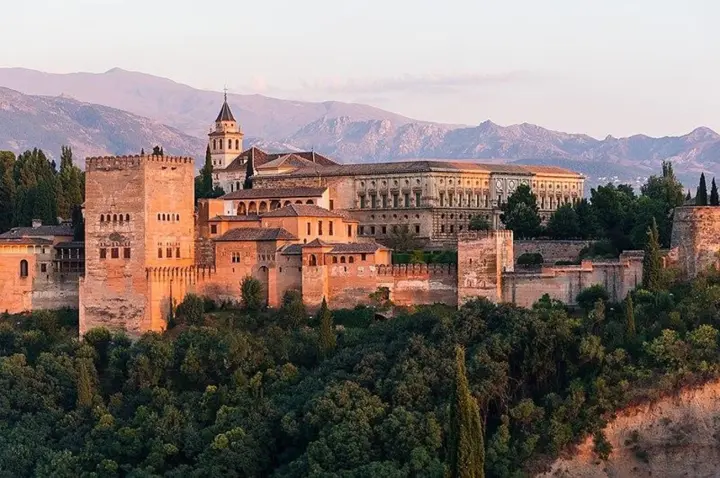
The Alhambra was built during the reign of the founder of the state of Bani al-Ahmar himself, Sultan "Muhammad bin Nasr bin al-Ahmar" in Granada and its location relative to the current map of the contemporary Spanish kingdom is south of the capital "Madrid".
Recommend
"Bin Al-Ahmar" began to lay the first stones of this architectural masterpiece in the fourth century AH and mentions that it took about a century and a half to be worked on to appear after it in the appearance that we know today.
"Ben al-Ahmar" took the decision to build the palace after the fall of the Almohad state and entered the "Red Kasbah" upper plateau, which will later choose to become the center of governance of his state, which took its slogan from the short conversation that took place between "Ben al-Ahmar" and the people of the "Kasbah" after he entered it victorious, they welcomed him, saying: "Welcome to you, O victor," and "Ben al-Ahmar" responded to them, saying: "There is no winner but God" and this sentence that he said became the slogan of the state for nearly two centuries over the course of its continuity and is written on Most corners of the Alhambra to this day, and millions of tourists flock annually to see it and see with it the beauty of Islamic architecture and its inner beauty, even more than the number of tourists who come to visit the palace of "Charles V" located in the same area where the Alhambra was built. The aim of building the palace of "Charles V" from the ground up was to cover the Alhambra and confirm the fall of the state of "Banu al-Ahmar" in all its aspects, even artistic and architectural, not only their control in government.
Why is the Alhambra so named?
Stories differ about the origin of the name of the Alhambra by this name, some believe that it took this name from the name of the place itself, i.e. the plateau on which the palace was built and was called "the Red Kasbah", while there is another opinion that mentions that he took his name from the name of the founder of the state himself, "Muhammad bin Al-Ahmar", who had a red beard and endowed him with this name. As for the view that the palace took its name from the color of the land on which it was built, because it is also red, it is not favored by many historians.
There is another opinion that it was called the Alhambra in relation to and commemorate the blood that was shed for this victory and the establishment of the state of Bani al-Ahmar themselves, although this opinion is weak and appears as if it is legendary to give this heroic character more than being real, which is the reason for the name already.
The Alhambra is a magical combination of architectural creativity and the magic of nature
The Alhambra consists of many courtyards, halls, towers and doors and is surrounded from the outside by a huge wall that protects the palace's buildings all on the plateau.
The region consists of three main parts:
Royal Palace: It is located in the middle of this group of buildings with the aim of becoming protected and away from the dangers that may target it.
It has the lobby of the seventh, the most luxurious and famous wings of the Alhambra ever, which was named because of the fountain surrounded by lions (seven).
Military Fort: It is the second part of the Alhambra, which is the military wing of the protection of the state of Banu al-Ahmar, and soldiers and military divisions were stationed there.
Al-Hamra Al-Olaya: It is the third and final part of the palace, which is a complete city of rule and not only a royal palace.
This part included the accommodation of servants and workers working in the palace, in addition to the ambassadors' lobby, the hall of the two sisters and other very important parts of the palace.
As for the outer wall, it includes four main doors, the basis of which is the "Sharia Gate", which was the main door in the palace.
The wall has 37 giant military protection towers.
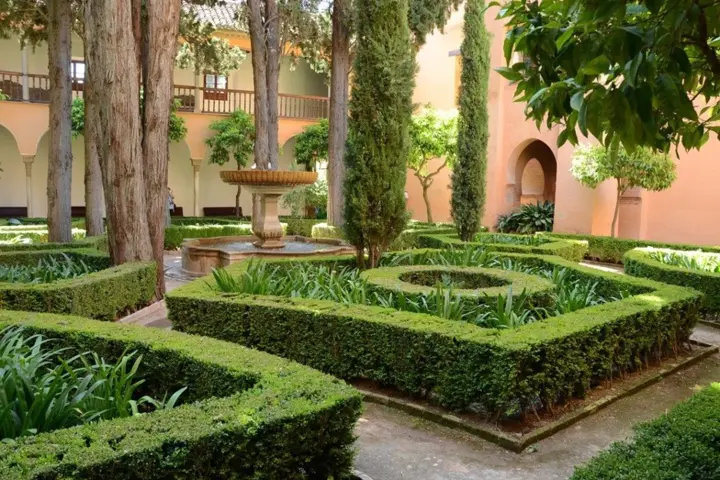
As for the gardens within the palace walls, they are the most beautiful of all, including those in the "Alhambra Courtyard", "Dar Aisha Garden", "Landrakha Lobby" and other gardens that make the palace a masterpiece between the beauty of architecture and the creativity of engineers and the splendor and blending of nature.
