Uqba Ibn Nafi Mosque in Kairouan: an architectural masterpiece and a prominent historical and tourist landmark

Show key points
- The Uqba Ibn Nafi Mosque, built in 670 CE by the companion Uqba ibn Nafi’, is the oldest mosque in North Africa and a significant Islamic architectural and religious monument.
- Over the centuries, the mosque underwent numerous renovations under different dynasties like the Umayyads, Abbasids, Fatimids, and Hafsids, each adding unique architectural and decorative elements.
- The mosque's interior is divided into arcades, a courtyard, and a prayer hall, with the latter being its most magnificent section, accommodating around 9,000 worshippers.
- ADVERTISEMENT
- Featuring remarkable decorations such as intricate woodwork, floral and geometric motifs, and stunning marble mihrab carvings, the mosque showcases the richness of Islamic art.
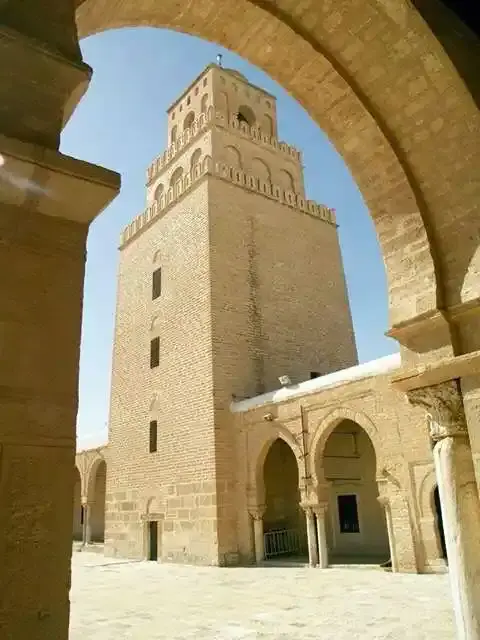
- Its iconic minaret, distinguished by a three-tiered square structure and a lobed dome, inspired the design of many later Maghrebi minarets.
- Historically, the mosque served not only for worship but also as a center for education, scholarship, cultural exchange, and launching Islamic conquests in the Maghreb and Andalusia.
- Today, the mosque remains a symbol of Kairouan’s heritage, significantly contributing to the city's cultural tourism and economic growth.
The Great Mosque of Kairouan (Uqba ibn Nafi Mosque) is the oldest mosque in Tunisia and in North Africa, and is regarded as one of the world’s most important Islamic landmarks. It stands in the city of Kairouan, which was founded in 50 AH / 670 CE by the companion Uqba ibn Nafi, the commander of the Islamic army that conquered Ifriqiya.
The mosque contains architectural, artistic and historical elements that reflect the many eras and civilizations Kairouan has experienced. In this article we explore the mosque’s construction history, its magnificent decorations, and its interior, and we assess its importance, beauty and grandeur as a unique Islamic landmark.
The history of the construction of the Uqba ibn Nafi Mosque
Recommend
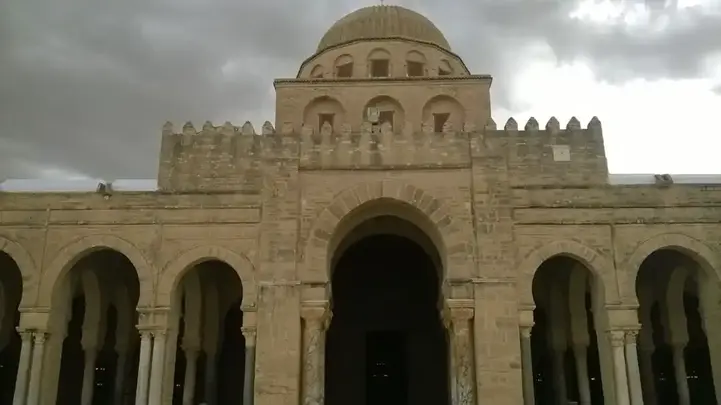
The mosque dates to the time of the companion Uqba ibn Nafi, who founded it in 50 AH / 670 CE as a place for prayer, da'wah and education. Its original form was simple: an open courtyard and a prayer hall roofed with straw and timber. During the Umayyad period the mosque was enlarged and a minaret, domes, gates and doors were added.
Under the Abbasids the mosque was renovated and adorned with columns, muqarnas, inscriptions and other decorations. During the subsequent periods the mosque was reinforced and fortified with towers and even cannon emplacements. In the Fatimid period the mihrab and minbar were altered and a loggia and silo were added.
During the Senhaji period the mosque was restored and improved with wooden ceilings, canopies, chandeliers and lamps. In the Hafsid era it gained cisterns, waterworks, a library, a school, tombs and shrines. Over the centuries the mosque underwent many changes and developments, becoming a living witness to the history and civilization of Islam in North Africa.
Decorations of the Uqba ibn Nafi Mosque
The mosque is notable for its rich and varied decoration, which reflects the creativity and beauty of Islamic art. From the outside it appears fortified and imposing, like a castle. High, sturdy walls surround it, punctuated by towers, domes, doors and symmetrically arranged windows.
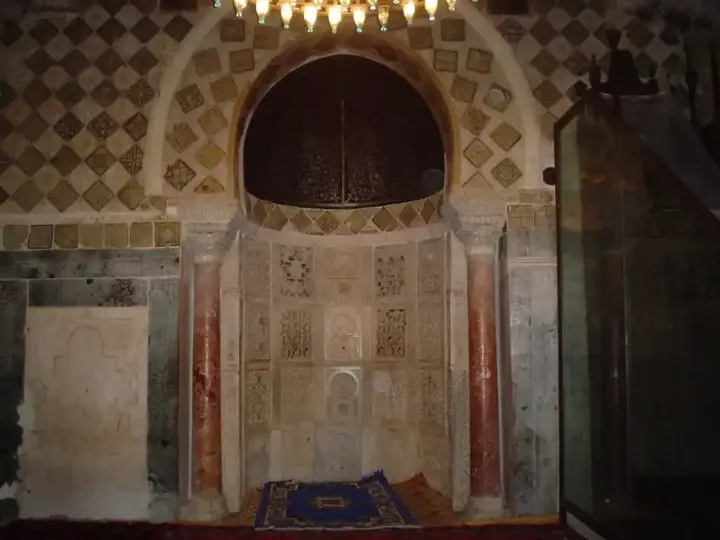
Among the mosque’s finest features are the mihrab and its dome. The mihrab is set with finely carved marble motifs that lend it a distinctive artistic character. These motifs are carefully composed and executed with delicate detail.
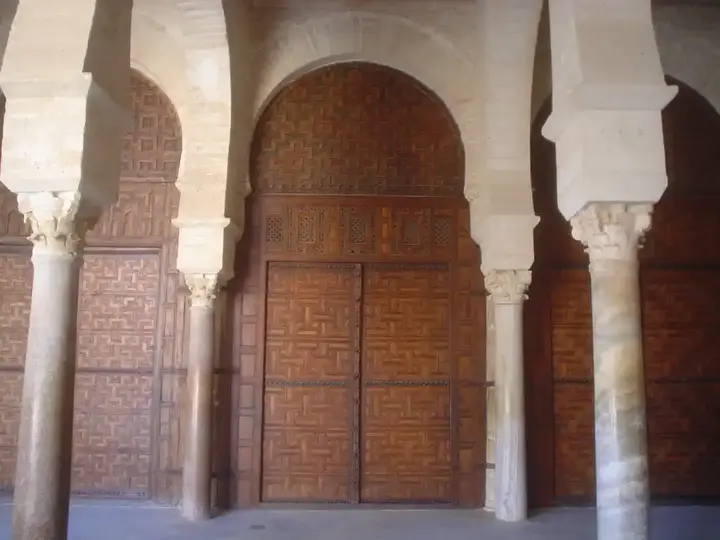
The dome is covered with floral patterns—stylized branches and vine-like motifs from which clusters of grapes hang—giving the dome a unique visual appeal. The minbar is an exceptional work of carved wood, rich with geometric and floral ornamentation that embodies the authenticity of Islamic craft.
Description of the Great Mosque of Kairouan from the inside
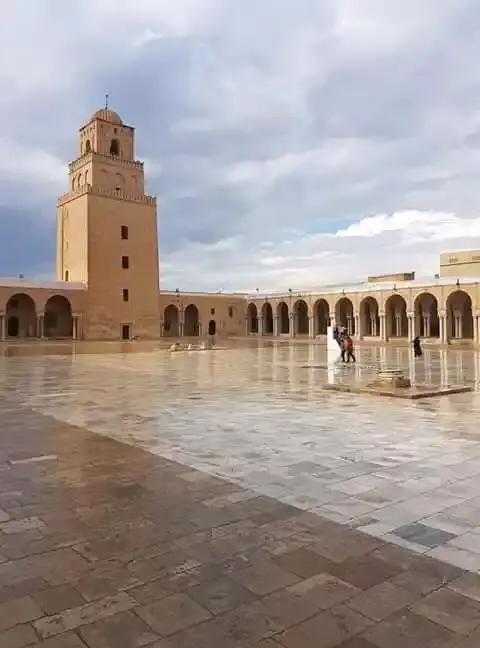
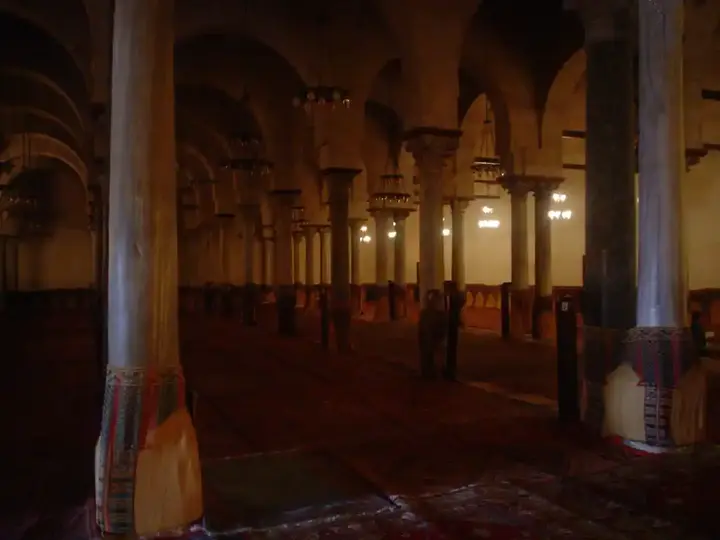
Inside, the mosque is divided into three main parts: the arcades, the courtyard and the prayer hall. The arcades are covered corridors that enclose the courtyard on three sides and contain columns, muqarnas, mashrabiya screens and inscriptions.
The nave is an open space used for prayer, teaching and gatherings, and is decorated with trees, palms, flowers and fountains. The prayer hall is the largest and most important section of the mosque; it can accommodate about 9,000 worshippers and houses important artistic and historical elements such as the mihrab, the minbar, the Mu'adhin’s booth and the minaret.
Prayer hall:
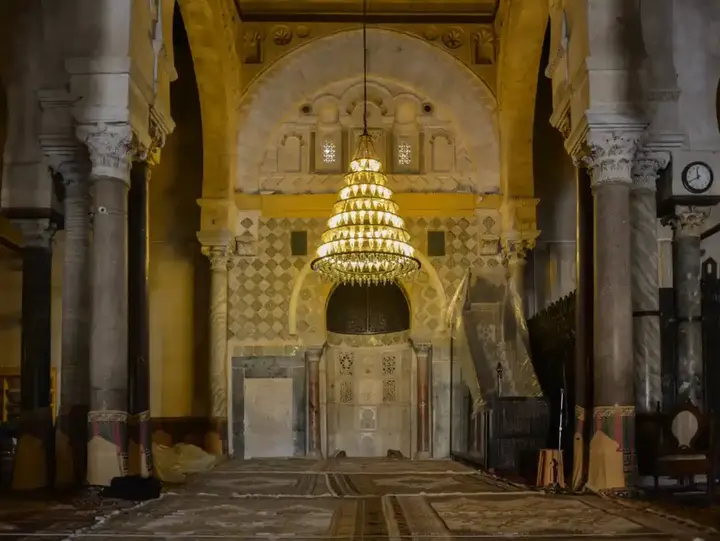
The prayer hall is the mosque’s most beautiful and magnificent part and merits a detailed description. It consists of 17 parallel aisles intersecting 15 cross aisles, forming a grid of 415 rectangular bays, each covered by a square wooden ceiling. The wooden ceilings are among the mosque’s finest artistic achievements and are decorated with geometric, floral and calligraphic motifs in a variety of colors and patterns.
Canopies:
The canopies are hanging awnings placed above the wooden ceilings to protect them from dust, heat and humidity. Chandeliers, lamps, mirrors and carpets are other elements that contribute to the prayer hall’s beauty and elegance.
Mihrab:
The mihrab is a niche in the wall that indicates the qibla and is embellished with inscriptions and ornamentation.
Pulpit:
The pulpit is a raised wooden platform used for delivering the sermon.
Mu'adhin’s booth:
The Mu'adhin’s booth is an enclosed wooden cabin that was used for the call to prayer for the Fatimid Caliph al-Mu'izz li-Din Allah.
Minaret:
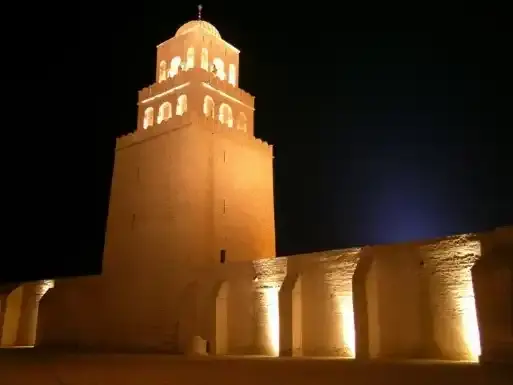
The minaret of the Great Mosque of Kairouan is among the oldest and most beautiful minarets built by Muslims in Africa. Its form and history inspired many subsequent minarets in the Maghreb.
Later minarets in the region followed a similar design, differing only in minor details. Examples that show this similarity include the minaret of the Sfax Mosque and the minarets of mosques in Tlemcen, Agadir, Rabat and the Al-Qarawiyyin Mosque.
The minaret of the Great Mosque consists of three stages, each with a square plan. The second stage is slightly smaller than the first, and the third is slightly smaller than the second. A lobed dome crowns the three tiers. The minaret reaches a height of 31.5 meters, underlining the splendor and uniqueness of this Islamic architectural achievement.
The importance of the Great Mosque of Kairouan in Islamic history
The Great Mosque of Kairouan is not only an architectural, historical and tourist landmark; it is also evidence of the role Islam played in spreading science, culture and civilization across North Africa, the Maghreb and Andalusia. The mosque served as a center for preaching, education, research and the transmission of knowledge in many fields.
The mosque hosted numerous companions, followers, scholars, thinkers, writers, jurists, reformers and mystics.
The mosque experienced a remarkable cultural florescence; it was a focus for education, jurisprudence, hadith studies and Sufism. Many scholars, imams and renewers passed through its halls, including Imam Sahnun, Ibn Rashiq al-Qayrawani, Ibn Sharaf and Ibn al-Jazzar. The influence of these figures extended far beyond their own eras and continued to shape Islamic thought and history.
The mosque also served as a starting point for Islamic campaigns in the Maghreb, Andalusia and Sicily. From here Muslim armies set out and helped spread Islam, justice and civilization in those regions.
It was a vital center for preachers and those engaged in jihad; many exerted great effort in teaching and promoting Islam. The mosque witnessed numerous battles and victories that have been preserved in historical memory.
The importance of the Great Mosque of Kairouan to the city of Kairouan
The Great Mosque of Kairouan is not only a symbol of Islamic history and civilization in North Africa; it is also a major factor in the development of Kairouan and in the city’s cultural and tourist economy. The mosque attracts visitors and enthusiasts from around the world who come to admire its scale, beauty and artistry and to experience its heritage.
The mosque supports economic and social activity in Kairouan, benefiting sectors such as transport, accommodation, trade, crafts and services. In this way it provides income and supports prosperity for the city’s residents and visitors.
This tour of Kairouan has introduced the Great Mosque of Kairouan—a masterpiece of architecture and a prominent historical and tourist landmark. We have outlined the mosque’s construction history, its magnificent decorations and its interior, and emphasized its importance, beauty and grandeur as a unique Islamic site. The mosque ranks among the world’s most important Islamic monuments and is well worth visiting and exploring. We hope this article was useful and interesting to you.