


Secrets of Irbid Archaeology: Explore Jordan's Successive Civilizations



In the heart of Irbid, the story of an ancient civilization rooted through the ages beats. Located in northern Jordan, Irbid is a city full of ruins that witness the succession of multiple civilizations, from the Romans and Greeks to the Arabs and Ottomans. In this article, we will travel through time to explore the most important monuments of Irbid, which embody the rich story of this city, and shed light on how these civilizations affect the cultural and architectural fabric of the city. Through the silent stones and majestic ruins, we discover how Irbid is not just an archaeological site, but a living chapter of the history book, telling the stories of nations that lived and left their mark on this good land.
Recommend
Show key points
- Irbid, located in northern Jordan, is a historically rich city that showcases layers of civilizations through its ancient ruins and architecture.
- Beit Ras, also known as Capitolias, is a significant Roman site in Irbid, featuring a well-preserved theater and a variety of archaeological remnants that reflect Roman cultural and social life.
- The ancient city of Um Qais, formerly known as Jadara, embodies a fusion of Greek, Roman, and Umayyad heritage and served as a key military and trade hub in the region.
- ADVERTISEMENT
- Jerash stands as a prime example of Hellenistic and Roman urban planning, boasting remarkable landmarks like the Oval Plaza, Roman theaters, and the Temple of Artemis.
- Abela (Quilba) reflects the continuity of urban and cultural development through the Islamic periods, with structures such as mosques, schools, and aqueducts illustrating its vibrant Islamic identity.
- Tell Zara'a reveals a timeline of human habitation dating back to the fourth millennium BC, emphasizing Irbid’s role in connecting ancient Syrian and Palestinian cultures.
- Today, Irbid acts as a living museum, where preserving its rich archaeological heritage not only honors the past but also promotes cultural tourism and economic development.
Irbid in the Roman Era: Beit Ras and its Archaeological Importance
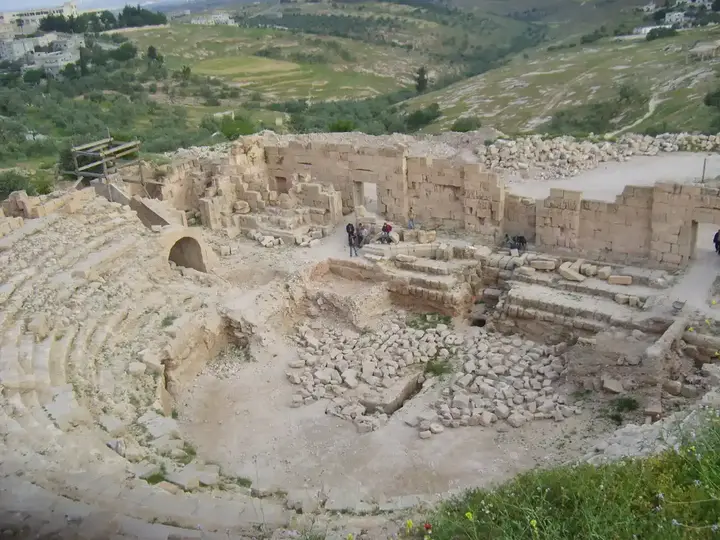
Irbid is one of the most prominent cities that tell the stories of the Roman era in Jordan, and it is famous for its strategic location, which was a meeting point for several civilizations. In Roman times, Irbid was part of the Decapolis Pact, a federation of ten cities that enjoyed autonomy and a distinct Hellenistic-Roman culture.
One of the most important archaeological sites in Irbid is Beit Ras, which is located in the north of the city. Beit Ras, or Capitolias as it was known in Roman times, is located on a hill overlooking the Hauran plain and the northern plateau of Jordan. This site was a vital center and witnessed many important historical events.
The Roman Theatre in Beit Ras is one of the surviving testaments to the greatness of this city. The Roman theater unveiled in Beit Ras shows the cultural and social significance of the city of that era. Roman theatres were not only for entertainment, but reflected the power, wealth, and cultural sophistication of the city that embraced them.
In addition to the theater, Beit Ras is famous for the presence of many other Roman monuments, such as churches, tombs and contemporaries, which signify the daily and religious life of the ancient inhabitants of the city. These monuments are a rich source of information about the architecture, art, and traditions of the period.
These monuments are an integral part of the cultural identity of Irbid and Jordan in general, and they form a bridge linking the past with the present, and enhance the value of Irbid as a cultural and historical tourist destination.
Greco-Umayyad walls: um Qais and its role in history
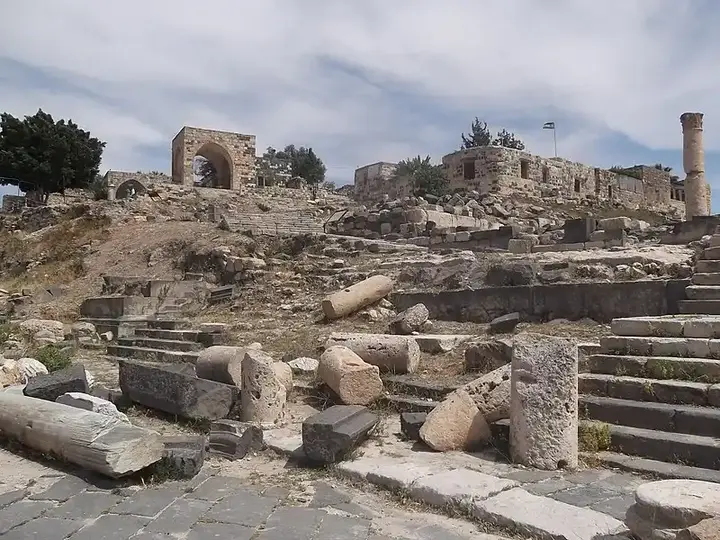
um Qais stands tall as a witness to the ancient history of the Umayyad Greek city of Jadara, perched on a high hill in northern Jordan. This ancient city overlooks the Sea of Galilee and the Golan Heights, and is one of the most prominent tourist sites in Jordan. um Qais is famous for its Greek and Roman terraces and buildings, which are organizationally affiliated with the Bani Kinanah Brigade near the city of Irbid.
um Qais is known to have been part of the Ten Cities Alliance known as the Decapolis, which was conceived in the Hellenistic Greek era. This city was a border point with a military function and high economic and commercial value, as it was associated with the collection of excise tax due to its strategic location, which made it a major location for trade routes linking cities in Jordan and Palestine and their coasts with the cities of Bosra, Hauran and southern Syria.
The city of um Qais has a rich Hellenistic and Roman heritage, with the ancient Western Theatre, the octagonal central church, the domed markets, the Nymphaeum fountain and the collection of ancient Roman baths. These ruins are located in an area extending on a plain 378 meters above sea level, with Hellenistic and Roman remains found in the western part of the site, while Byzantine monuments such as the church and square are located in other parts of it.
Today, um Qais is a center of civilizational and cultural radiation, attracting tourists and researchers to explore its rich history and enjoy its natural and archaeological beauty. This city shows how Greek civilization has left its deep mark on the region, and how these monuments have continued to tell stories from the past that tell about the greatness and development of the civilizations that went through it.
The Roman city of Jerash
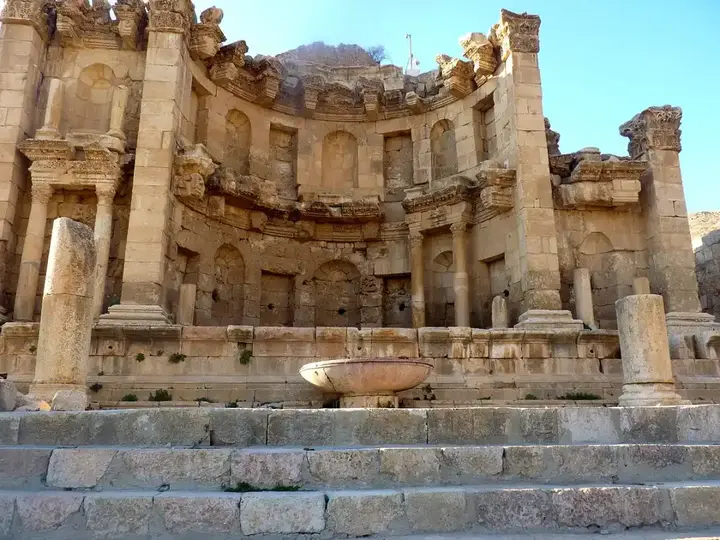
Jerash was founded in the Hellenistic era and reached the peak of its prosperity in the second century AD, as it was considered one of the richest and most cosmopolitan cities in the ancient Near East. The city is characterized by its paved and baptismal streets, its high temples on hilltops, theaters, squares, baths and fountains, reflecting a special modular architecture that combines the Roman and Greek worlds.
Among the most prominent archaeological landmarks of Jerash:
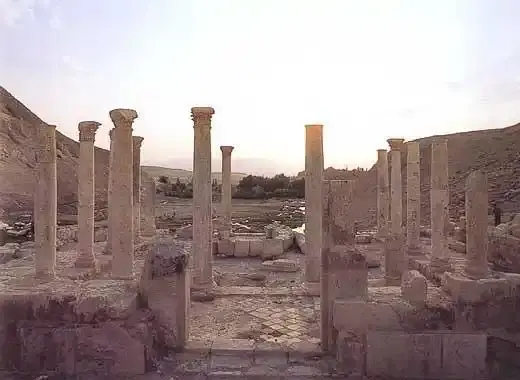
Oval Square: It is one of the most famous landmarks in Jerash and one of the most important monuments of Irbid, characterized by its wonderful view and unique design.
Columns Street: Also known as Card Maximus, it is a main street surrounded by long and well-crafted columns.
Two Roman theaters: Jerash has two theaters, one larger and the other smaller, used for performances and events.
Arc de Triomphe: It serves as a majestic gate to the city and shows Roman architecture.
Artemis Temple: It is one of the most important temples in Jerash and shows the religious importance of the city in the Roman era.
Today, Jerash is a center of civilizational and cultural radiation, attracting tourists and researchers to explore its rich history and enjoy its natural and archaeological beauty. This city shows how Roman civilization has left its deep mark on the region, and how these monuments have continued to tell stories from the past that tell about the greatness and development of the civilizations it has undergone.
Abela: Greco-Byzantine and Islamic Era
Abela, or Quilba as it is known locally, is one of the important ancient cities that tells the story of Islamic civilization in Irbid. It is located 13 kilometers from Irbid governorate, within the boundaries of the municipality of Hartha of the Bani Kinanah Brigade, near the Yarmouk River. The city is known for its Roman and Byzantine ruins, but it is also distinguished by its rich Islamic history.
During the Islamic era, Abella continued to flourish and urbanize, and the Umayyad and Abbasid periods left architectural and artistic traces showing the civilizational development of the city. Among these monuments stand out the aqueducts used to collect rainwater, mosques and schools that are a testament to scientific and religious activity in the city.
Islamic monuments in Irbid show how the city has been a center for cultural and scientific exchange, and how it has been able to maintain its status as a vibrant city through the ages. These monuments are an integral part of the city's cultural identity and contribute to attracting tourists and researchers interested in Islamic history and heritage.
Tell Zara'a: a unique geographical location
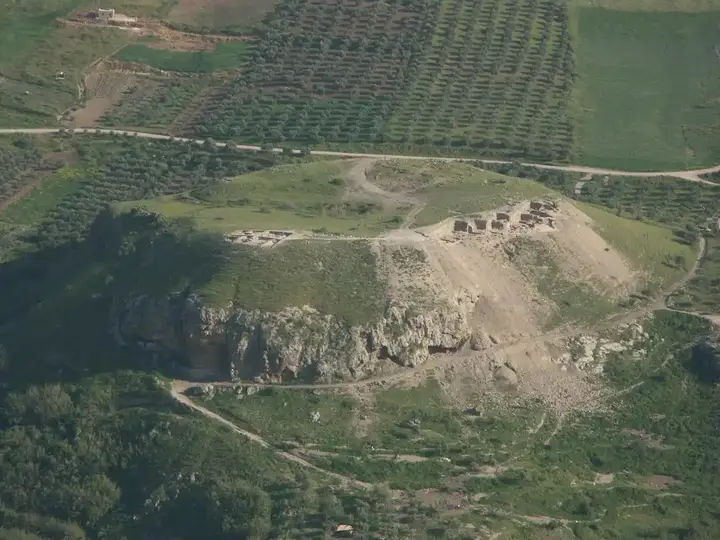
Tell Zara'a in Irbid is an archaeological site that tells stories from bygone eras, located south of the ancient city of um Qais and dates back to the fourth millennium BC. Tell Zaraa is a testament to the continuity of human settlement in the area, where the cultural layers accumulated over more than 5,000 years appear with almost no cultural gaps.
The site is characterized by its unique geographical location at the confluence of Wadi Al-Arab and Wadi Al-Zahar, and is one of the important sites that show the interaction between the Syrian and Palestinian cultural fields. The hill is surrounded by steep rock gradients, and at its center is an artesian well that used to provide abundant water, but has dried up in recent years.
Excavations at Tell Zara'a uncovered a huge fortification wall dating back to the Early Bronze Age, and the remains of residential buildings dating back to the Middle Bronze Age. A paved floor of a Roman villa was also found showing the historical significance of the site in later periods.
Today, Tell Zara'a is a site that attracts researchers and those interested in ancient history, and is an example of how humans interact with the environment and how settlement has evolved through the ages in the Irbid area.
At the end of our journey through time and history throughout Irbid, we pause for a moment to contemplate the greatness of this city, which has witnessed successive civilizations and great events. Together we traveled through the ages, from Roman to Islamic, from Byzantine to Ottoman, to discover how every stone in Irbid tells a story, and every relic tells a history.
Today, Irbid, with its majestic monuments and archaeological sites, stands as a witness to a rich history and cultural heritage that deserves to be celebrated and preserved. The preservation of these monuments is not only a responsibility towards the past, it is an investment in the future; it strengthens cultural identity and contributes to the development of tourism and the economy.
We invite you to visit Irbid, a city that embraces the sky with its ruins and tells the stories of time with its streets and alleys. See with your own eyes the beauty of this ancient city, and breathe the fragrance of history that fills its corners. Irbid is not just a tourist destination, it is an invitation to reflect and inspire, and a beacon of science and culture. We invite you to experience the warm hospitality of Jordan and enjoy an unforgettable experience in the lap of history.
