


The stories behind the inexpressive static faces: how to understand the absence of smiles in old photos?



When looking at portraits from the past, you may notice a common trend, as the first portraits often present adults and children looking serious and not smiling, and this can be seen even in wedding and celebration photos where you expect happiness and joy.
Show key points
- Early portrait photos often feature subjects with serious expressions due to the long exposure times required by early cameras.
- Holding a smile for 20 minutes was uncomfortable, so people naturally opted for a relaxed, neutral face.
- Cultural beliefs of the time equated smiling with foolishness and associated seriousness with dignity and class.
- ADVERTISEMENT
- Portrait photography was initially regarded as a solemn art form, inheriting the seriousness of painted portraits.
- The Victorian era's practice of photographing the dead further contributed to the somber tone of early photographs.
- Even as camera technology improved by the early 1900s, the tradition of serious portraiture lingered due to cultural inertia.
- Ultimately, a mix of technical limitations and social norms led to the absence of smiles in most 19th-century photographs.
You will notice this mostly in portraits taken in the late eighteenth century and throughout the nineteenth century.
But why weren't people smiling in front of the camera? There are many theories and ideas about why people lack expressions of joy in photos.
Taking pictures for older cameras was difficult.
One of the most common reasons behind this is that the images used to take a long time to view. The first cameras weren't as immediate as taking a picture with your phone today. The view of the photos was time-consuming, which meant that the subject of the photo had to remain stationary for a long time.
Recommend
On average, the first cameras took about 20 minutes to take the picture. So the subject had to stay as static as possible to get the highest quality image, as the movement would blur the image and keep the target person out of focus.
Therefore, sitting with a relaxed face instead of smiling for 20 minutes was easier.
But this was not the only factor, as the quality of the camera improved over the years, and by 1900 the cameras were very advanced at the time. By the twentieth century, cameras were able to take a picture in about 20 seconds.
The introduction of a Brownie camera and other cameras reduced exposure times, meaning people could smile.
Cameras were slow by today's standards but fast by the standards of that past time.
Portrait photography was initially seen as an alternative art form to painting.
There are also links with the idea that portraits represent a special moment in order to document a person's existence.
Before the cameras, it was possible to draw the person by hand, which would have taken hours.
The idea of portraiture was associated with a special occasion, whether it was a birthday commemoration, an achievement, or a celebration.
The idea of the picture was to spend some time in order to capture the important moment. This tradition was transmitted even when cameras appeared.
It is believed that people at the time carried this mentality as portraiture as a serious and important moment even when photography was introduced and invented.
Victorian obsession with images of the dead.
The Victorian tradition of taking pictures of the deceased may be another reason why people look serious.
Cameras have made the ability to take pictures more accessible and more manageable.
In the Victorian era, depictions of the dead became increasingly common, because, unlike today, images were seen as a way to capture someone's "frozen presentation," as opposed to today's ideas that associate photography with using it to capture a moment in time.
In the past, once a family member dies, he is dressed in black and placed upright to take pictures of him. This was a process of documentation to some extent, and was seen as a passage to immortality.
These photos are often thought to be the reason why people associate some of the first personal portraits with seriousness.
However, these photos were just a method of taking portraits.
The smile was rejected from 1800 until the beginning of the twentieth century.
In addition to their unusual interest in photographing the dead, Victorians and Edwardians refused to smile. At the time, a smile was considered a stupid act referring to the lower class, while seriousness and keeping a straight face thought were the strongest and most elegant facial expressions.
Although there is no way to prove this theory, it can be recognized through historical texts and documents.
This theory can be a very reasonable hypothesis because no one in the past has smiled while taking pictures.
Smiling was seen as a kind of foolishness, so serious looks were important in portraits.
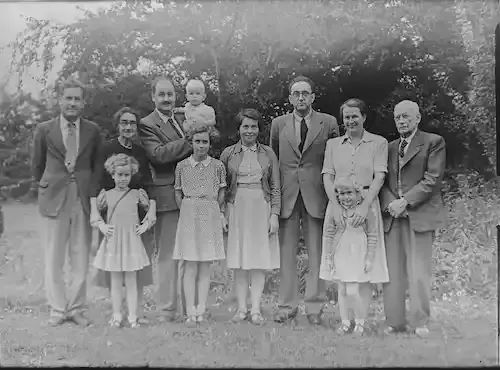
In general, people never smile in old photos for various reasons. The prevailing trend at the time was related to what was acceptable at the time and to technical barriers.
Smiling in photography and portraits was difficult at first due to the time it took to take the photo.
Apart from the technical aspect, another factor is the standards and ideals of the time. For example, a smile was looked down on as inappropriate.
Smiling portraits from that era are almost impossible to find, which is why we are curious in this article.
