Innovative Cooling System to Enhance Solar Panel Efficiency

Solar energy has become one of the most promising renewable energy sources of the 21st century. Its clean, sustainable nature and wide availability make it essential for meeting global energy needs and cutting carbon emissions. A persistent challenge for photovoltaic (PV) technology is reduced efficiency at high temperatures. Recent innovations have introduced advanced cooling systems designed to improve solar panel efficiency and extend their service life. This article examines the basics of solar panels, their efficiency and limitations, and the pioneering role of innovative cooling systems in transforming solar energy production.
Show key points
- Solar energy is a renewable, clean, and widely available power source.
- Solar panels convert sunlight into electricity using photovoltaic cells.
- Panels are composed of essential components such as cells, glass, and encapsulation.
-
- Panel technology has evolved to increase efficiency from 6% to over 24%.
- Different types of panels include monocrystalline, polycrystalline, and thin-film panels.
- Innovative cooling systems reduce the impact of heat on efficiency.
- The future of cooling systems includes smart technologies and nanomaterials to enhance performance.
1. Definition and Concept of Solar Panel.
A solar panel is a device that converts sunlight into electricity using photovoltaic cells. It is designed to absorb photons and produce direct current (DC) electricity, which can be converted to alternating current (AC) for use in homes, industry, and the grid.
Recommend
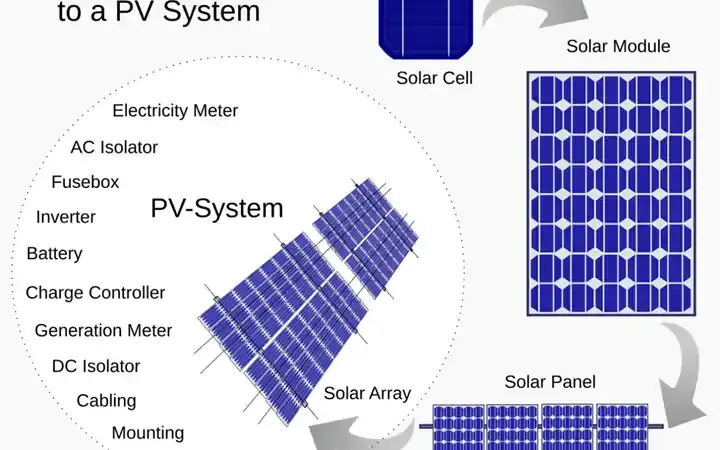
From a solar cell to a photovoltaic system: diagram of potential components of a photovoltaic system
2. Main Components of a Solar Panel.
A. Photovoltaic Cells - The basic unit that absorbs sunlight and generates electricity.
B. Glass Layer - Provides protection against weather.
C. Encapsulation Layer - Ensures durability and electrical insulation.
D. Back Sheet - Prevents mechanical damage and moisture ingress.
E. Frame - Typically aluminum, provides structural support.
F. Junction Box - Connects the solar panel to external circuits.
3. Function and Role of Each Component in the Solar Panel.
1. Cells: Convert light into electricity.
2. Glass: Protects against debris and UV damage.
3. Encapsulation: Holds cells together and prevents degradation.
4. Back Sheet: Provides electrical isolation and protection.
5. Frame: Ensures installation durability and ease.
6. Junction Box: Facilitates electrical connections and safety.
3. Evolution and Development of the Solar Panel.
Solar panels have evolved from the first silicon-based photovoltaic cells developed in 1954 at Bell Labs to today’s high-efficiency monocrystalline modules. Efficiency has risen from under 6% in early cells to more than 24% in modern modules. Emerging technologies such as perovskite cells promise efficiencies above 30%.
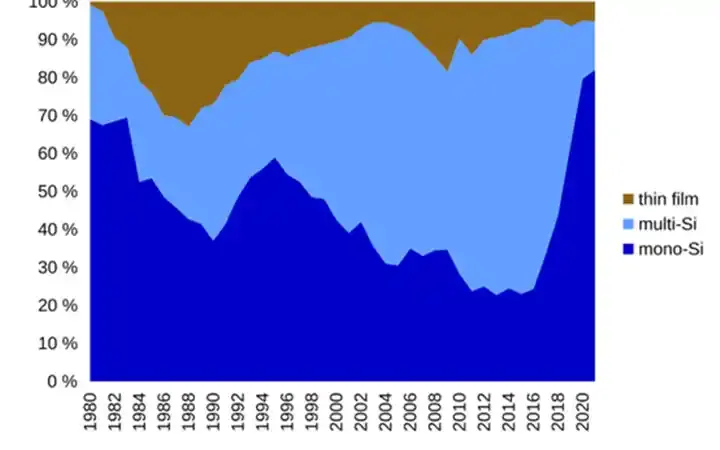
Global market share by photovoltaic technology from 1980 to 2021, in terms of annual global production. Includes monocrystalline silicon (mono-Si), polycrystalline silicon (multi-Si), and thin-film technologies
4. Types and Brands of Solar Panels.
A. Monocrystalline Panels - High efficiency (19-24%), long lifespan.
B. Polycrystalline Panels - Moderate efficiency (15-18%), cost-effective.
C. Thin-Film Panels - Lightweight, flexible, lower efficiency (10-12%).
D. Bifacial Panels - Capture light from both sides, increasing output.
Major manufacturers include LONGi, JinkoSolar, Trina Solar, and Canadian Solar.
5. Operating Principle of the Solar Panel.
Solar panels operate on the photovoltaic effect: photons strike a semiconductor (usually silicon), exciting electrons and producing an electric current. An internal electric field guides the flow of electrons, creating usable DC power.
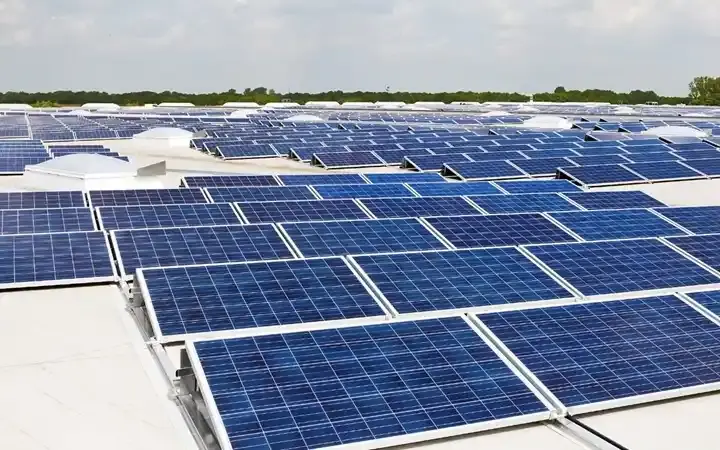
Solar array mounted on a home rooftop
6. Specifications of a Good Solar Panel.
1. High efficiency (greater than 20%).
2. Low temperature coefficient.
3. Long lifespan (greater than 25 years).
4. Long warranty (25-30 years).
5. High weather durability.
7. Limitations of Solar Panels.
1. Temperature sensitivity: efficiency decreases by 0.3–0.5% per degree above 25°C.
2. Intermittent generation: output depends on weather and sunlight.
3. Land use: large-scale farms require extensive area.
4. Degradation: panels lose about 0.5% efficiency annually.
8. Definition of Solar Panel Efficiency.
Efficiency is the ratio of electrical output from the panel to the incoming solar energy on its surface. Typical commercial panels achieve efficiencies around 17–24%.
9. Key Methods to Enhance Solar Panel Efficiency.
1. Use of advanced materials (perovskites, tandem cells).
2. Light-trapping designs.
3. Anti-reflective coatings.
4. Bifacial technology.
5. Active and passive cooling systems.
10. Innovative Cooling System to Increase Solar Panel Efficiency.
High temperatures significantly reduce solar panel performance. Innovative cooling systems—such as water-based systems, phase change materials (PCMs), and photovoltaic-thermal (PVT) hybrid systems—have been developed to address this. These systems dissipate excess heat and keep panels closer to optimal operating temperatures.
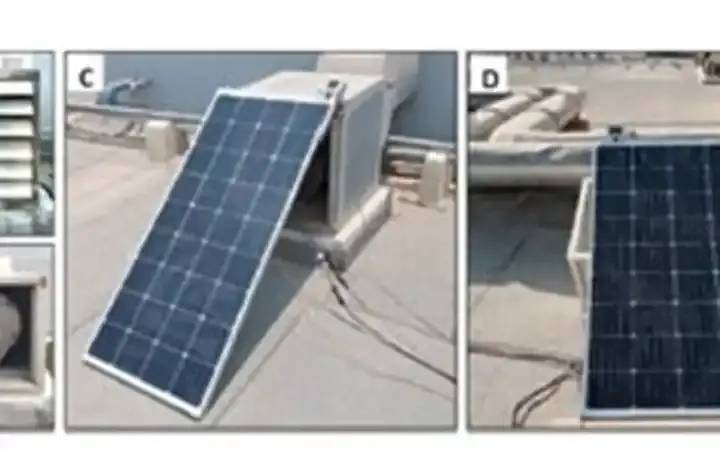
Diagrammatic setup for experimental and prototype models: (A) standard exhaust, (B) exhaust without fins, (C) photovoltaic panel with exhaust air back cooling, (D) reference solar panel without cooling
11. Inventors and Components of the Innovative Cooling System.
Research institutions such as MIT, Stanford University, and the Fraunhofer Institute have led cooling innovations. Startups in Europe and Asia have introduced new cooling mechanisms, including nano-based cooling and integrated circulation systems.
A. Coolant (water or nano-fluids).
B. Heat exchanger or cooling plate.
C. Pumps and flow system.
D. Storage tank (for photovoltaic-thermal systems).
E. Control system (sensors and thermostats).
12. Operating Principle, Benefits, and Gains of the Cooling System.
The cooling system removes excess heat from solar cells through conduction and convection. Heat-absorbing fluids circulate to carry heat away, and in hybrid systems the recovered heat can be reused for heating applications.
1. Increased efficiency: cooling can boost output by 5–15%.
2. Extended lifespan: reduced thermal stress improves durability.
3. Dual output (in PVT): provides both electricity and useful heat.
4. Economic savings: higher energy yields shorten payback periods.
13. Expected Outcomes and Impacts of the Cooling System on Commercially Available Solar Panels.
1. Improved energy output per panel.
2. Reduced land requirements for a given energy output.
3. Lower energy costs over the panel's lifecycle.
Adopting cooling systems can make current PV technologies more competitive, potentially reducing the levelized cost of electricity (LCOE) by 10–20%. Integration of cooling could enable hybrid energy solutions for residential and industrial use.
14. Future of Innovative Cooling Systems and the Solar Panel Market.
Future cooling systems will incorporate smart controls, advanced nanomaterials, and AI-based optimization. Expect wider integration with building materials (such as solar facades) and deployment across large-scale solar farms.
By 2030, the global solar energy market is expected to exceed 3 TW of installed capacity. Cooling innovations are likely to play a key role in lowering costs and improving adoption in hot climates, especially in Asia, the Middle East, and Africa.
Conclusion.
Solar panels are central to the global shift toward renewable energy, but higher temperatures reduce their efficiency. Innovative cooling systems offer a practical solution: they raise efficiency, extend panel life, and improve overall performance. Continued research and deployment of these systems can reshape the solar market, making PV technologies more viable and cost-effective.