There Are More Giraffe Species Than You Think

The giraffe is an African ruminant, long-necked, hoofed mammal, characterized by long legs and fur with an irregular brown blotch pattern on a light background. Giraffes are the tallest land animals; males may exceed 5.5 meters (18 feet) in height, while the tallest females reach about 4.5 meters. Using tongues nearly half a meter long, giraffes can browse foliage nearly 6 meters off the ground. The genus Giraffe comprises the northern giraffe (G. camelopardalis), the southern giraffe (G. giraffa), the Masai giraffe (G. tippelskirchi), and the reticulated giraffe (G. reticulata).
Growth and Unique Anatomy
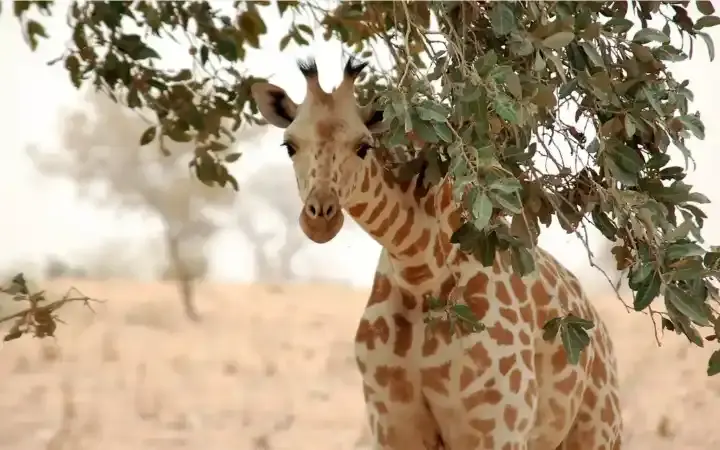
Giraffes grow to nearly their full height around the age of four, but they gain weight until they reach seven or eight. Males weigh up to 1,930 kg, and females up to 1,180 kg. The tail can reach a meter in length and has a long black tuft at the end; there is also a short black mane. Both sexes have a pair of horns, although males have additional bony protuberances on the skull. The back slopes down toward the hindquarters, and this silhouette is due primarily to the large muscles that support the neck; these muscles are attached to long spines on the vertebrae of the upper back. The neck (cervical) vertebrae contain only seven, but they are elongated. The thick-walled arteries in the neck have additional valves to resist gravity when the head is raised; and when the giraffe lowers its head toward the ground, special blood vessels at the base of the brain control blood pressure.
Recommend
Giraffe Social Behavior and Lifestyle
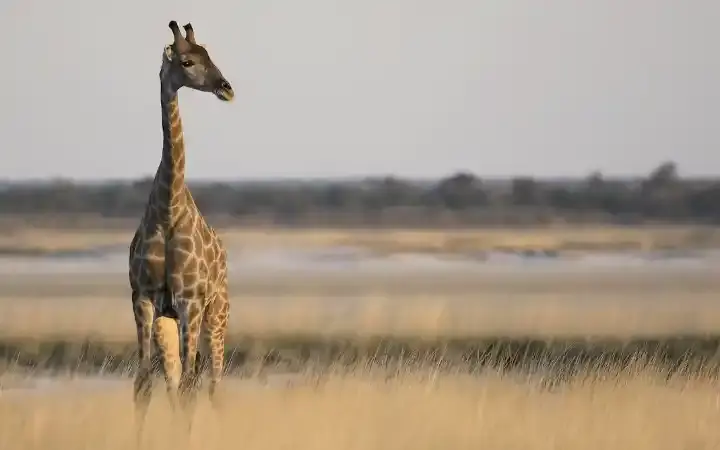
The giraffe's gait is a stride (both legs on one side move together). When running, it pushes off with its hind legs, lowering its front legs almost parallel to each other, but its hooves do not touch the ground simultaneously. The neck is flexed to maintain balance. A speed of 50 km (31 miles) per hour can be maintained for several kilometers, but 60 km (37 miles) per hour can be reached for short distances. Giraffes live in non-territorial groups of up to 20 individuals. Their habitat ranges from 85 square kilometers in wet areas to 1,500 square kilometers in dry areas. These animals are characterized by their social behavior, which apparently allows them to be more vigilant for predators. Giraffes have excellent eyesight; when a giraffe stares at a lion from a kilometer away, for example, other giraffes look in the same direction as well. Giraffes live up to 26 years in the wild and slightly longer in captivity. Giraffes prefer to eat new shoots and leaves, especially from the thorny acacia tree. Females, in particular, prefer high-energy, low-fiber foods. They are omnivorous, and a giraffe grasps the leaves with its prehensile lips or tongue and pulls them into its mouth. If the leaves aren't thorny, the giraffe "combs" the leaves from the stem by pulling them with its lower canines and incisors. Giraffes get most of their water from their food, although they drink at least every three days in the dry season. They must spread their front legs to reach the ground with their heads.
Reproduction and Genetic Diversity of Giraffes
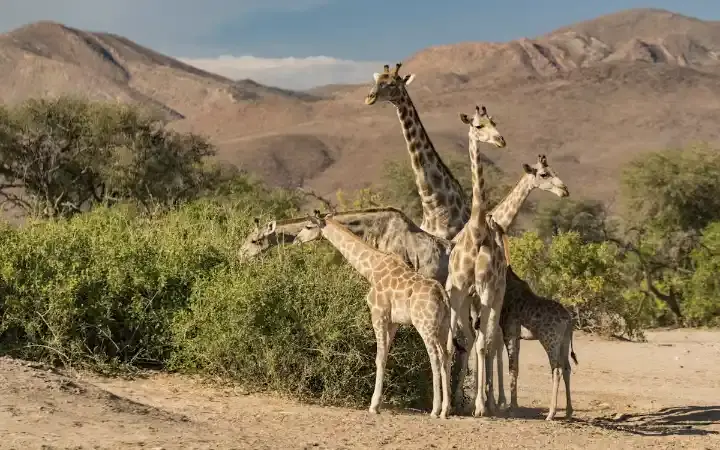
Females breed for the first time at four or five years of age. Gestation lasts 15 months, and although most young are born during the dry months in some areas, births can occur any month of the year. Each calf is about two meters long and weighs 100 kg. The mother licks and caresses its calf in isolation for a week. After that, the calf joins a "nursery group" of young of the same age, while the mothers forage at varying distances for food. If lions or hyenas attack, the mother sometimes stands over her calf, kicking it. Females need food and water, which can keep them away from the nursery group for hours at a time, and lions and hyenas kill about half of all very young calves. The calves begin to taste plants at three weeks of age, but they nurse for 18 to 22 months. For a long time, people believed there was only one species of giraffe. But DNA studies prove this wrong. How many species of giraffe are there? This may surprise you, but over the decades, some people have thought about it and concluded that there is only one species, Giraffa camelopardalis. However, research published in the journal BMC Biology conclusively proves that giraffes are actually made up of at least six, and possibly as many as eleven, separate species, rather than just one, as previously thought. According to the results published by a research team led by David Brown, a geneticist at the University of California, Los Angeles (UCLA), these giraffe species live in different regions of sub-Saharan Africa and exhibit clear and easily observable differences in their patchy markings—differences so significant that these groups were previously classified as separate subspecies. However, analyses of mitochondrial DNA (mtDNA) and nuclear microarray DNA from six of the nine subspecies reveal that these groups are more distinct than previously thought. For example, the reticulated giraffe (Giraffa camelopardalis reticulata) of northern Kenya, with its circular reddish spots; The Maasai giraffe (Giraffa camelopardalis tippelskirchi) in southern Kenya—which separated genetically from each other between 0.5 and 1.5 million years ago. “Using molecular techniques, we found that giraffes can be classified into six reproductively isolated populations that do not interbreed in the wild,” says Brown. A biological species is defined as a group of organisms capable of interbreeding and producing fertile offspring. However, because this definition is imprecise, other, more precise concepts of species exist. With the advent of modern techniques, more precise definitions have been formulated based on similarities in DNA, appearance, song, or a combination of these definitions.