Mathematics In The Arab world: A Journey Through The Golden Age Of Knowledge

The Arab world played a pivotal role in the development of mathematics during the Islamic Golden Age, a period that stretched from the eighth to the thirteenth centuries CE. This era saw an unprecedented flowering of science, philosophy, and culture driven by the translation and preservation of ancient knowledge and by original, groundbreaking contributions. Mathematics became a cornerstone of intellectual achievement as Arab scholars built on the work of Greek, Indian, and Persian predecessors while introducing new ideas that shaped the future of the discipline. This article explores that rich legacy, highlighting key figures, discoveries, and their lasting impact.
Show key points
- The Islamic Golden Age saw a fusion of Greek, Indian, and Persian knowledge with original Arab contributions in mathematics.
- The House of Wisdom in Baghdad was central to this intellectual flourishing.
- Al-Khwarizmi is known as the Father of Algebra and introduced systematic methods for solving equations.
-
- Ibn al-Haytham contributed significantly to geometry and optics, advancing understanding of conic sections and vision.
- Arab mathematicians developed trigonometric functions like sine, cosine, and tangent, essential for astronomy.
- The decimal system and number theory were advanced by Arab scholars, who also transmitted these concepts to Europe.
- Arab contributions profoundly influenced European scholars and set standards for scientific methods during the Middle Ages.
Foundations of the Golden Age:
Recommend
The rise of the Islamic Empire in the seventh century created a vast, interconnected civilization stretching from Spain to Central Asia. This expansion encouraged the exchange of ideas and knowledge across diverse cultures. The Abbasid Caliphate, in particular, became a center of learning, with Baghdad emerging as the intellectual capital of the world. Under the patronage of caliphs such as Harun al-Rashid and al-Ma'mun, scholars were encouraged to translate and study ancient works. The House of Wisdom, founded in Baghdad in the ninth century, served as a beacon of learning, housing a large library and functioning as a center for translation, research, and teaching. Greek texts by Euclid, Archimedes, and Ptolemy, along with Indian and Persian works, were translated into Arabic, preserving and spreading knowledge that might otherwise have been lost. This synthesis of traditions laid the groundwork for mathematical achievements across the Arab world.
Major Contributions to Mathematics:
Arab mathematicians made important advances in algebra, geometry, trigonometry, and number theory. Their work not only preserved earlier knowledge but also expanded it, introducing new concepts and methods that influenced later European scholars during the Renaissance.
1- Algebra - The Legacy of Al-Khwarizmi:
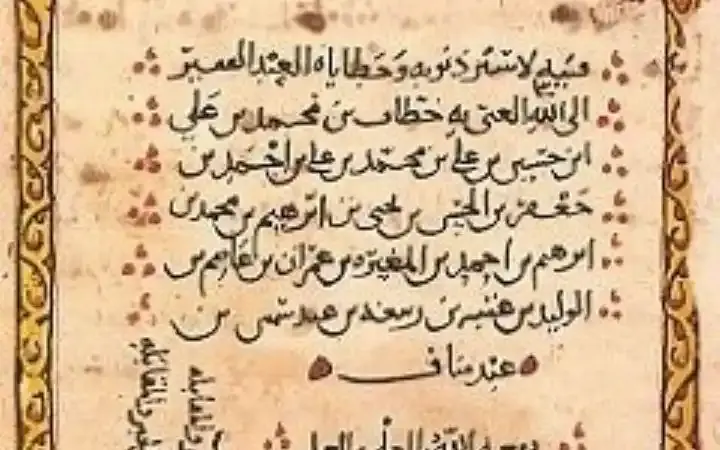
Muhammad ibn Musa al-Khwarizmi (c. 780–850) is one of the most influential figures in the history of mathematics. Often called the "father of algebra," al-Khwarizmi wrote Kitab al-Jabr wa'l-Muqabala, commonly rendered in English as The Compendious Book on Calculation by Completion and Balancing, which set out systematic methods for solving linear and quadratic equations. The word "algebra" in many languages derives from the Arabic al-jabr, meaning "restoration" or "completion." Al-Khwarizmi's work established algebra as a distinct branch of mathematics. He also introduced procedures that gave rise to the term "algorithm" (from his name) and made significant contributions to arithmetic, astronomy, and geography. His methods for solving equations were revolutionary and remained influential for centuries.
2- Geometry and Trigonometry - Ibn al-Haytham's Works:
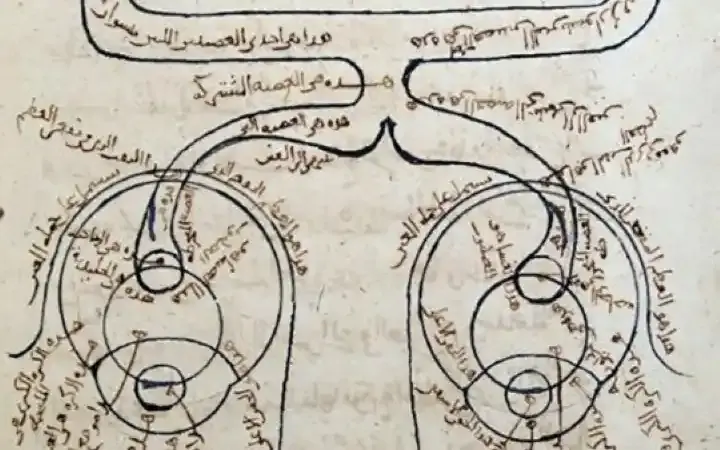
Ibn al-Haytham (965–1040) was a polymath who made pioneering contributions to optics, astronomy, and mathematics. In geometry, he investigated the properties of conic sections (what we now call secants) and developed methods for calculating the areas and volumes of complex shapes. His work in optics applied advanced geometric principles to explain the behavior of light and the process of vision in the eye.
In trigonometry, Arab mathematicians built on Greek and Indian work to develop and use the sine, cosine, and tangent functions. Al-Battani (858–929) made major advances in spherical trigonometry, crucial for astronomical calculations. These developments helped lay the foundation for later European figures such as Copernicus and Kepler.
3- Number Theory and the Decimal System:
Arab mathematicians played a central role in the development of number theory and in the spread of the decimal system. Al-Kindi (c. 801–873) wrote extensively on cryptography and frequency analysis, while Thabit ibn Qurra (c. 826–901) made notable contributions to the study of amicable numbers and the theory of ratios. The Arab world was also instrumental in transmitting the Hindu numeral system and the concept of zero to Europe. The numeral system now used worldwide as Arabic numerals transformed mathematics by simplifying calculations and enabling more advanced arithmetic and algebra.

4- Astronomy and Applied Mathematics:
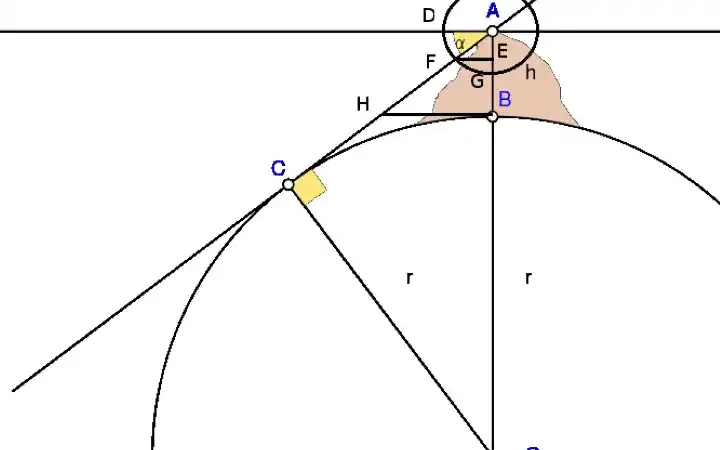
Mathematics was closely linked to astronomy in the Arab world as scholars sought to understand celestial motion and improve navigation and timekeeping. Omar Khayyam (c. 1048–1131) is best known for his poetry, but he was also a brilliant mathematician who made important contributions to solving cubic equations and to reforming the Persian calendar. Al-Biruni (c. 973–1048) applied mathematical methods to geography, astronomy, and physics, calculating the Earth's radius with remarkable accuracy. His multidisciplinary approach exemplified the spirit of inquiry that defined the Golden Age.
The Legacy of Arab Mathematics:
The contributions of Arab mathematicians had a profound and lasting effect worldwide. During the Middle Ages, their works were translated into Latin and formed the basis of European mathematics and science. Figures such as Fibonacci, who helped introduce the Hindu-Arabic numeral system to Europe, and later Renaissance scholars like Descartes and Newton drew on ideas developed during the Islamic Golden Age. The Arab world's focus on empirical observation, rigorous proof, and interdisciplinary study set standards for scientific methodology. The legacy of the period lies not only in specific discoveries but also in the spirit of intellectual curiosity and collaboration that defined it.
Conclusion:
The Golden Age of Arab mathematics was a time of extraordinary creativity and discovery. By preserving and expanding the knowledge of earlier civilizations, Arab scholars laid the foundations for modern mathematics and science. Their work in algebra, geometry, trigonometry, and number theory transformed the discipline and influenced generations of thinkers. Today, as we continue to explore the secrets of the universe, we owe a debt of gratitude to the mathematicians of the Arab world, whose brilliance helped illuminate the path to knowledge.