The Long Arms That Let Gibbons Fly Through Forest Canopies

It looks like climbing, but it is closer to a form of travel that can almost read as flight; when a gibbon moves below branches, its body is not hauling itself upward so much as passing momentum from one grasp to the next. You can hear the proof in the dry, quick rustle of branches knocking lightly together above the ground.
عرض النقاط الرئيسية
- Gibbons specialize in brachiation, a form of arm-swinging travel beneath branches rather than ordinary climbing.
- Their movement depends on conserving and redirecting momentum so each grasp flows into the next swing.
- Long forelimbs and highly mobile shoulders give gibbons an efficient overhead range of motion.
-
- Their curved, grasping hands help them make quick, precise catches on flexible branches.
- This locomotion evolved as an adaptation to canopy life, where speed, control, and energy efficiency mattered.
- Gibbon movement can vary with branch spacing, age, species, behavior, and captive versus wild environments.
- The key distinction is that brachiation uses suspended forward motion, while climbing mainly works against gravity on fixed holds.
That sound matters because the supports are not firm ladders. They bend, shift, and answer back. A gibbon moving through them is not scrambling with brute force. It is placing each reach with the timing of something built for suspended motion.
What you are seeing is not ordinary climbing
Biologists call the signature movement brachiation: arm-swinging travel beneath supports. In plain language, the animal hangs below branches and moves forward in repeated arcs, catching the next hold before the swing dies away. Gibbons are the living specialists of this style among primates.
قراءة مقترحة
Slow it down for a moment. One hand releases. The body drops very slightly, not as a mistake but as part of the swing. The free arm reaches long ahead, the torso stretches through the arc, and then the hand closes on the next branch at just the right instant, when forward speed can be turned into the next sweep.
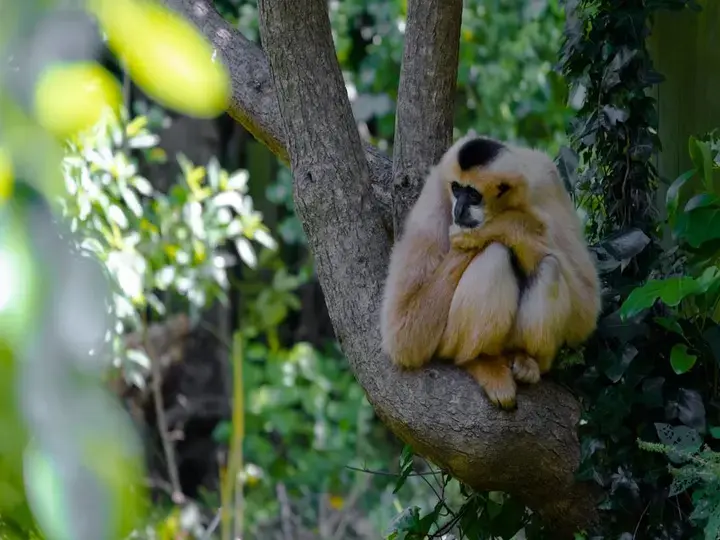
If you watch closely, the body is not bobbing upward like a climber working against gravity step by step. It is traveling forward like a pendulum with opinions. The grasp is brief, the arc is clean, and much of the work is done by conserving and redirecting motion rather than restarting from a halt each time.
Researchers have measured just how committed gibbons are to this way of getting around. A classic review by C. Owen Lovejoy in 1981, drawing together comparative primate locomotion anatomy, placed hylobatids among the clearest specialists for forelimb-dominated suspension. Later biomechanical work by Susan G. Larson in the 1990s on hominoid shoulders and upper limbs helped explain why: gibbons have shoulder joints and upper-body proportions that allow an unusually wide, efficient overhead range of motion for life below branches.
That broad pattern is easy to see even without a lab. Long forelimbs lengthen the swing. Highly mobile shoulders let the arm travel overhead without the whole body twisting into awkward shapes. The hands act almost like hooks in motion, curling over a support so the next release can come quickly.
The tiny hand-grab where the whole trick happens
The lovely part is the contact itself. For a split second, all that moving weight narrows to one hand on one branch. If the timing is off, the swing stutters. If the branch bends more than expected, the body must adjust at once. When it works, the catch is so neat that your eye can miss how exact it was.
And there, in that instant, the story suddenly gets much older. The quick reach and closing hand are not just a clever move by one animal in one tree. They are the visible edge of millions of years of life in the canopy, where food, safety, and travel favored bodies that could move below branches with speed, control, and less wasted effort.
Now the pieces stack up fast. Long arms increase the length of each pendulum arc. Mobile shoulders let the limbs cycle overhead again and again. A relatively light body helps keep the swing economical. Curved, grasping hands make fast catches easier. Momentum carries forward into the next reach instead of being spent and rebuilt from scratch.
That is the aha, really: a gibbon is not merely good at climbing. It is built to travel under branches in repeated swinging arcs so specialized and efficient that the motion can look almost like flight.
Why this does not always look exactly the same
It is fair to say not every gibbon movement looks identical. Branch spacing matters. So do age, species, speed, and whether the animal is traveling steadily, feeding, playing, or crossing an awkward gap. In captivity, where supports can differ from a natural forest canopy, the pattern may look altered too.
But variation does not blur the main point. The signature remains suspended travel that reuses swing and timing. That is different from simply climbing up, down, and around whatever is nearest.
Here is a good little self-check for the next time you watch one move. Ask yourself: is it pulling its body upward like a climber on fixed holds, or is it letting forward swing carry the body into the next reach like a pendulum? Once you see that distinction, you cannot quite unsee it.
So is it just climbing with extra flair?
Not really. Climbing, in the ordinary sense, is mostly about supporting weight against gravity while gaining height or holding position on relatively fixed points. Brachiation is suspended travel beneath supports, with momentum doing a large share of the work and anatomy tuned for repeated overhead motion.
A climber often looks as though each hold begins the effort anew. A brachiating gibbon looks as though one hold finishes a sentence the previous hold began. That is why the movement feels so graceful. The body is not improvising its way through the branches. It is using a travel system shaped for that exact job.
The next swing will look different now
Once you know what to look for, a gibbon’s reach stops being a blur and becomes a readable piece of engineering in motion. You will notice the moment the body moves forward before the hand closes, and you will see that the branch is not merely something to cling to but something to borrow motion from.
So the next time a gibbon swings overhead, watch for the airborne handshake: the brief catch, the carried momentum, the next reach already on its way. It is a fine thing to recognize that you are not just watching an animal climb, but an old canopy specialist doing what its body was shaped to do.