How Did Music Notation Begin?

Whether it was communal singing to boost mood and feelings of social inclusion, or crafting musical instruments for ceremonial and military use, musical rituals have existed since the dawn of history. Some of the oldest musical instruments still around today are flutes aged 50,000 years, carved from bones. We have been making and listening to music for millennia - but when did we start notating it?
Show key points
- Musical rituals trace back to ancient times, used for ceremonial and military purposes to strengthen social bonds.
- Ancient Greeks contributed to music theory with concepts like musical intervals and tetrachords.
- In the Middle Ages, Boethius transmitted Pythagorean musical concepts to Western Europe through his influential book.
-
- The first music notation system, called "neumes," was developed by Saint Isidore to address the forgetting of melodies.
- Guido d'Arezzo made significant advances in music notation by creating the system of musical scales and solfège.
- Modern notation evolved gradually to include note durations, dynamics, and expressive instructions.
- Music notation continues to evolve today with forms like graphic notation, which combines art with music.
It all began with the ancient Greeks.
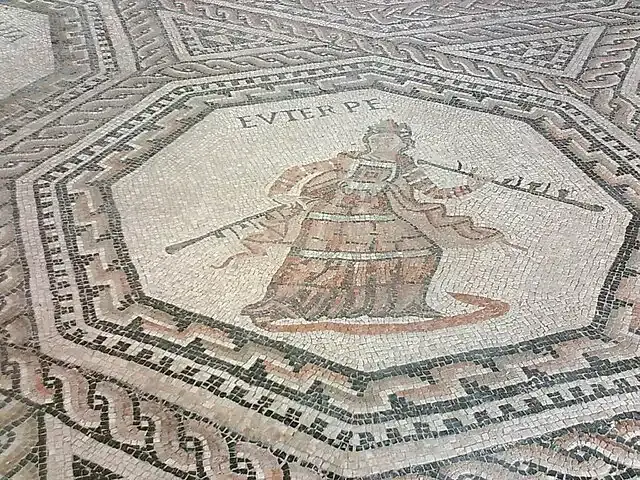
There are very few remaining examples of written music from ancient Greece. However, we know that the Greeks were crucial in laying the foundation for music theory. Pythagoras, who lived from around 570 to 500 BCE, was among the Greek theorists who explored the mathematics of music. Together, Pythagoras and his disciples first conceptualized the "ideal" intervals of the octave, fifth, and fourth, pioneering the concept of the musical interval that has become integral to our musical language today. The Greeks also invented the tetrachord, which describes a series of four tones within a musical scale.
Recommend
A thousand years later, their interest spread to Western Europe.
In the sixth century, Boethius, a member of the Roman Senate, wrote the influential book De Institutione Musica (The Principles of Music), thereby transmitting Pythagorean mathematics and music understanding to medieval Western Europe. A few decades later, Pope Gregory, credited with inventing Gregorian chant, founded the first music school in Europe: Schola Cantorum. By this time, learning music became quite common. Melodies were often learned and passed on by ear, as there was no formal way to notate tunes yet. This situation called for an updated system of music notation. Saint Isidore of Seville, tired of forgetting music all the time, said, "Unless sounds are held in a person's memory, they perish, for they cannot be recorded." In 650 CE, Saint Isidore developed a new system of writing music using notation called "neumes." Vocal chants, which were popular music at the time, were written on parchment with text, and above it, notational markings were placed to indicate the contour of the melody.
After 350 years, Guido d'Arezzo introduced a new system.
Around 1000 CE, Italian music theorist Guido d'Arezzo saw people struggling to learn chants from "neumes" and thought there must be a more precise notational system. He created a system of music scales with four lines (an early version of the five-line staff we use today) and organized the tones into groups known as "hexachords." He also added time signatures and invented solfège, the framework we recognize today as "do, re, mi, fa, sol, la, ti, do." However, music notation still lacked something: note durations.
Around 1250, Franco of Cologne invented a system of symbols for different note durations, mostly comprising black square or diamond-shaped note heads without stems. In 1320, Philippe de Vitry built on this idea, creating a system of standard time signatures for short musical pieces and extending it further. By 1450, white note heads began to dominate over black ones, and most note values were written with white note heads—as if you were composing shorter or shorter musical pieces. Then in the 17th century, note values began to look more complete. Music notation continued to develop throughout the 17th century, aligning with the music of Renaissance and Baroque composers. As instrumental music surpassed vocal music in popularity, notations needed adjustment. Instrumentalists still used Guido d'Arezzo's system of scales and notation, albeit in a slightly modernized version. Yet they found there was still not enough direction in the written music. Therefore, composers started introducing bar lines and performance directions, including dynamics, rhythm, and temperament.
Modern music staff notation
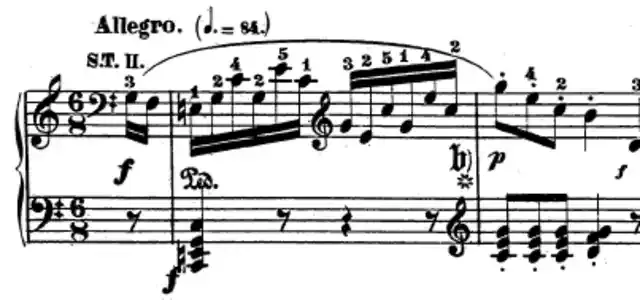
Modern music notation is used by musicians across many musical genres worldwide. The staff (or stave, in British English) consists of 5 parallel horizontal lines serving as a framework through which notes are indicated by placing oval note heads on (crossing) the staff lines, between lines (in the spaces), or above and below the staff using small additional lines called ledger lines. Music notation is read from left to right, making setting music to texts right-to-left challenging.
The pitch of the note is determined by the vertical position of the note head within the staff and can be modified by accidentals. The duration (length or note value) is indicated by the shape of the note head or by adding note stems along with beams or flags. A hollow oval without a stem is a whole note or semibreve, while a rectangular hollow or an oval without a stem with one or two vertical lines on either side is a double whole note or breve. A hollow oval with a stem is a half note or minim. Solid oval shapes always have stems and can indicate quarter notes (crotchets) or, with beams or flags added, smaller subdivisions. Additional symbols like dots and ties can lengthen the note duration.
Is music notation still evolving?
The 1950s saw the invention of graphic notation, combining art with music in the form of a musical map, providing the performer with a guide, rather than stringent instructions, on how to play the music. As such, graphic notation is often interpreted as a reaction against the highly detailed notations of the 20th and 21st centuries. So, what might notation look like in the year 3000? It could revert entirely to basics again, leaving it all up to the performer to interpret the music as they see fit. Or it could become even more artistic.