What is the shape of the universe?

While determining the shapes of planets, moons, and galaxies is relatively easy, measuring the shape of the universe is much more complex. In fact, this question has a counterintuitive answer. When we think of the shape of something, we might imagine it as an object seen from the outside. We shouldn't think of the universe in the same way. The universe has no external surroundings, and there is nothing outside of it, because there is no external surroundings. By definition, the universe is everything in existence, so nothing can exist outside of it. However, recent theories such as chaotic inflation, the membrane theory, and parallel reality have blurred this definition.
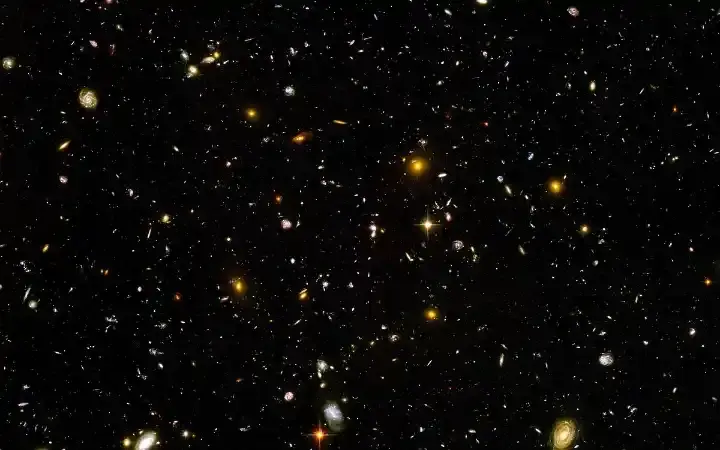
How to Measure the Shape of the Universe
Recommend
The geometry of the universe is determined by the density of matter within it. Albert Einstein's theory of general relativity describes how matter can curve space, and thus the density of matter can control the curvature and geometry of space on the largest scales. The key value is the "critical density," symbolized by the Greek letter omega (γ). A universe has a critical density if it contains, on average, six hydrogen atoms per cubic meter. But matter is not evenly distributed throughout the universe. We know this because we see it concentrated within galaxies and absent in the gaps between them. There is also dark matter, which we can only infer from its gravitational effects, but we know that it accounts for about 85% of the total matter in the universe. Understanding the amount of dark matter in the universe is crucial to understanding its geometry and fate. Let's explore three possible geometries: open, closed, or flat. If the density of matter in the universe is greater than the critical density, we say our universe is closed and has positive curvature. In a closed universe, you could set out on a journey through space, traveling in a straight line, and eventually turn around and return to your starting point. Positive curvature is convex, not concave, meaning the universe is shaped like the surface of a sphere. On a sphere, two parallel lines won't stay parallel forever; they will first diverge, then converge, return to their starting point, and intersect. If the matter density in the universe is less than a critical density, the geometry of the universe is described as open and negatively curved, like the concave shape of a saddle, and possibly infinite in extent. But if the universe is perfectly balanced so that the matter density equals the critical density, the geometry of the universe is described as flat. Flat geometry is Euclidean geometry, named after the ancient Greek mathematician Euclid, in which parallel lines remain parallel, and the angles of a triangle add up to 180 degrees. Which is correct? NASA's Wilkinson Microwave Anisotropy Probe (WMAP) and the European Space Agency's Planck mission have measured the matter and energy density of the universe, and both found that the omega density equals the critical density. In other words, the universe appears to have a flat geometry.
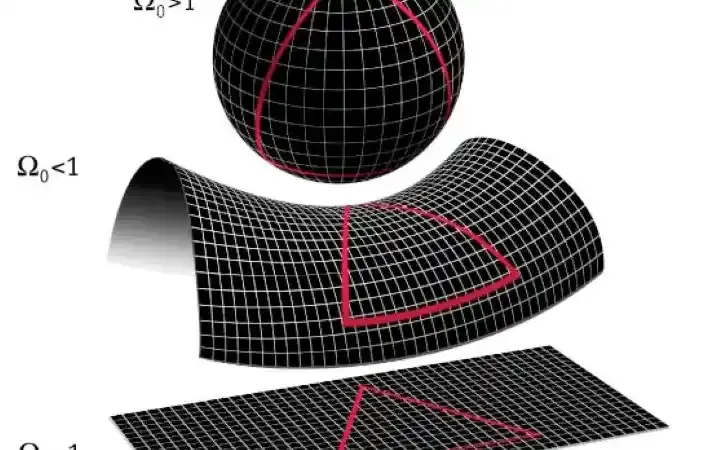
What are some possible shapes for our universe?
WMAP and Planck have measured Omega with high precision, and cosmologists are very confident that the universe is flat. This prediction, as we have seen, is based on critical density and general relativity. However, an international team called the Collaboration for Observations, Models, and Predictions of Cosmic Anomalies and Topology (COMPACT) has found that a flat universe doesn't necessarily rule out complex shapes. They focused their research on a shape known as the "triangular torus." A one-dimensional circle is known as a 1-dimensional torus. A 2-dimensional torus is shaped like a doughnut. Theoretically, triangular torus, or some other exotic shape, could result from quantum effects that occurred during the Big Bang and shaped how the universe subsequently evolved. So how do we know if we live inside a triangular torus universe? The way space curves back on itself means we would see repeated images of the same part of the universe in different parts of the sky as light traveled through the different paths of this complex torus. It would be like living in a cosmic hall of mirrors. All we need to do is identify these repeating images. The COMPACT team studied the cosmic microwave background (CMB) radiation—the leftover radiation from the Big Bang—for any patterns. They didn't find any, but there are two caveats. One possibility is that the size of the triple ring may be so large that light traveling around one of its rings hasn't had time to reach us yet. Another possibility is that while a standard triple ring can be ruled out if the length scale is small enough, twisted versions of it at 90 and 180 degrees have not yet been ruled out. This is because they distort the repeating images, making them more difficult to identify, and a comprehensive search for such twisted repeating patterns in the CMB has not been conducted.
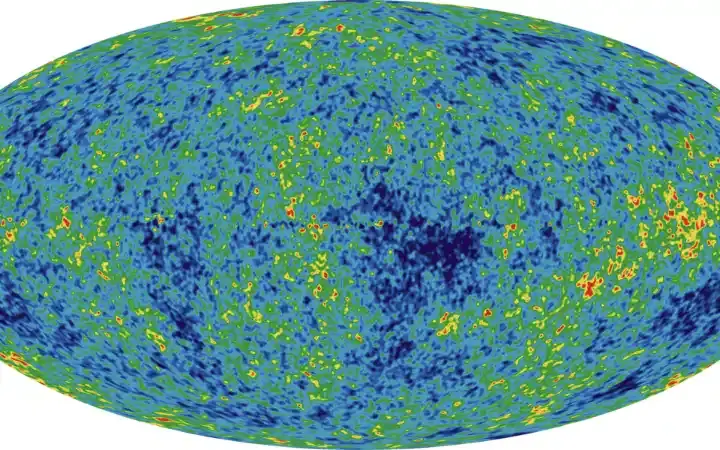
The Shape of the Universe in Multidimensional Space
According to some theories—for which we have no conclusive evidence—there is something outside our universe. This something is a multidimensional hyperspace, sometimes called an "object." Within this object, the theory says, is our four-dimensional universe (three physical dimensions, plus time), anchored by a membrane ("brane") within the object's higher-dimensional space. The number of dimensions in the object varies depending on the model—some say five, some say seven, and some say many more. Regardless, our universe will take the shape of this membrane as seen from inside the object. Other membranes may also exist within the object, each with its own independent universes. Occasionally, these membranes may collide, triggering a new Big Bang. This cyclic model of membrane collisions is called the "averaged averaging theory." Another model is the chaotic, or eternal, inflation model, which extends the inflation theory developed by Alan Guth in the early 1980s. Cosmic inflation was proposed to explain the similarity of different parts of the universe, despite their extreme distances from each other, preventing any causal connection—that is, there was not enough time for light and information to travel between them. Cosmic inflation suggests that at the moment of the Big Bang, these regions were close enough to share properties, and then a very brief but powerful inflationary wave expanded the nascent universe rapidly enough to separate them.