How Ancient Egyptian Temple Columns Carried More Than a Roof

Contrary to what many visitors first assume, these columns were not only holding up a roof; they were also carrying a message, and the proof is visible in the carved bands of hieroglyphs, traces of paint that once sharpened every sign and figure, and the places these columns occupy inside temples at Luxor.
If you have ever stood before one and thought, old stone, that is a very normal first glance. But Egyptian temple builders did not leave these shafts plain and then add a little ornament. They turned them into surfaces that spoke about kingship, gods, ritual, and order.
Recommend
Why your eye should stop on the column, not just pass between them
Start with what you can actually point to. Many columns at Luxor Temple and Karnak carry vertical or horizontal bands of hieroglyphs naming the king who built, restored, or claimed that part of the temple. Those signs are not random filler. They repeat royal names and titles in a form meant to be seen again and again as people moved through the space.
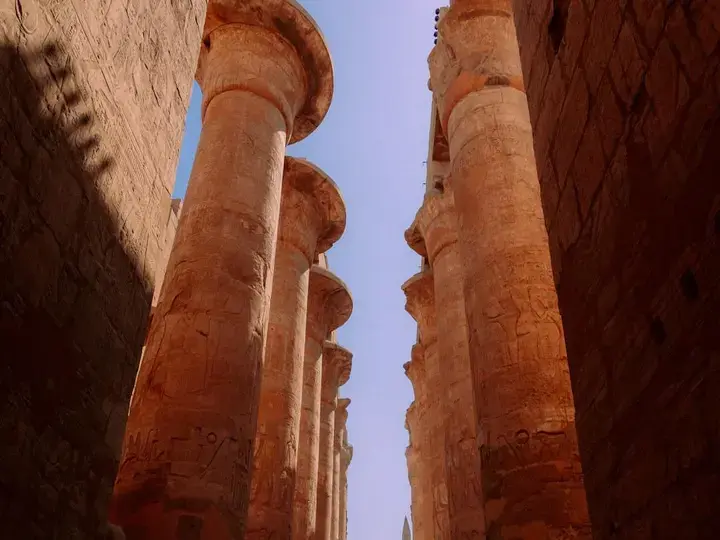
Then look for figures. On temple columns, you often find the king in the presence of a god, making an offering or receiving life and authority. Museum and Egyptological interpretations have long treated such reliefs and inscriptions as part of temple ritual language: the walls, gateways, and columns together set out who was acting, before which god, and in what ordered relationship.
Color mattered too. Many surviving columns in Egypt preserve at least traces of red, blue, green, yellow, or black pigment in cut relief and carved signs. Even where the paint is patchy now, it tells you the surfaces were once easier to read from a distance. A carved name is one thing; a carved name picked out in color is a public statement.
And scale does its own work. A papyrus-bundle column with a broad capital does support weight, yes, but it also makes the sacred setting feel ordered and repeated. When the same forms and inscriptions march down a hall, the effect is not casual decoration. It is insistence.
If you want a quick self-check, imagine standing before one column and noticing three things in order.
A quick way to read a temple column
Find the text bands
Look for vertical or horizontal hieroglyphic bands that name the king or repeat royal titles.
Find the figures
Notice whether the king appears before a god, making an offering or receiving life and authority.
Check the column's place
Ask where the column stands in the route through the temple, because position helps complete its meaning.
If all three are working together, you are not looking at mere surface embellishment. You are looking at a message surface.
What placement inside the temple was doing all along
Placement is the part many people miss, because it is less obvious than carving. Egyptian temples were arranged in zones, moving from more public outer areas toward more restricted inner ones. Columns along processional paths did not just fill space. They marked movement, framed what came next, and repeated the temple’s official claims as priests, rulers, and festival processions passed by.
At Luxor Temple, for example, the great colonnade built under Amenhotep III and later inscribed and reworked under Tutankhamun and Horemheb sits in a route shaped by ceremony. Relief scenes in that zone are tied to festival movement, especially the Opet Festival, when divine barques and ritual actors traveled between Karnak and Luxor. In plain terms: these were not columns in a lobby. They stood where important sacred movement happened.
That matters because meaning in Egyptian temples was often built through repetition in motion. A king’s name once is a label. A king’s name repeated on columns, walls, gateways, and statues along a ceremonial route becomes a claim to rightful rule under divine approval.
Not every carved column in Egypt served exactly the same program, and surviving relief and paint are uneven. Some surfaces were recut, reused, or damaged over centuries. So the safest reading stays close to what remains visible on each column and where it stands.
Still, the broad pattern is well established. Institutions such as the Metropolitan Museum of Art and the British Museum routinely explain temple inscriptions and divine images as active parts of ritual communication, not spare decoration. In Egyptian temples, architecture and writing were designed to work together.
The moment the "just supports" idea stops working
There is, of course, a commonsense objection. A column is a column. It stands there because roofs are heavy, stone is heavy, and halls need supports. That part is true.
But once those supports are covered with royal titulary, divine scenes, carved signs laid out to be legible, and set in places where ritual movement passes them in sequence, they are doing more than engineering. They are carrying political and sacred meaning at full height. The structure does not disappear; it becomes load-bearing meaning.
Now the evidence begins to stack quickly.
What turns a support into a message surface
The argument works because several visible features reinforce each other at once.
Height and scale
The column’s size makes the message hard to ignore.
Repeated inscriptions
Names and roles recur until they settle into memory.
Divine scenes
Reliefs identify the king’s bond with the gods.
Paint and visibility
Color helped carved signs stand out more clearly.
Processional placement
Position along ritual routes ties the column to sacred action.
Sightlines across the hall
Each shaft becomes part of a larger visual script written through the space.
That is the real shift. You were never meant to read a temple column the way you read a label in a case, standing still and taking in everything at once. You were meant to read it while moving through a controlled sacred setting, with one carved claim after another confirming who ruled, which god mattered here, and what order held the place together.
Slow down at one column and it starts talking
Take one representative case from Luxor’s temple world: a column in or near a colonnaded processional space where the king’s names appear in cartouches, the oval rings that mark royal names, and nearby relief shows the ruler before a god. Do not rush past the whole hall. Stay with one shaft.
First, the cartouche. It is not decoration in the loose sense of a floral border. It isolates a royal name and gives it visual authority. Repeating that oval over and over on a column turns the king’s identity into a constant presence, almost impossible to separate from the stone itself.
Then the scene beside it. When a king offers to Amun, or receives signs of life from a god, the relief is making a statement about proper order. The ruler is not shown as a private person. He appears in a fixed relationship to divine power, and the temple column helps publish that relationship inside sacred space.
Now notice how the carving is organized vertically. A column shaft is perfect for tall, ordered bands of signs and figures. It makes writing rise. On a wall, a scene can spread sideways. On a column, the same message climbs, wraps, and repeats, so the support itself becomes a standing declaration.
If any color survives in the grooves, that is your extra clue. The column was once easier to read than it is today. Ancient viewers did not meet the same worn surface you do. They met sharper contrast, clearer signs, and a stronger visual link between text, image, and ritual setting.
But does decoration always mean communication?
No, and it is worth saying that plainly. Not every carved surface is a message in the same rich sense, and not every viewer in ancient Egypt read every sign. Some people would have grasped the overall display more than the exact wording.
Yet this is where the combination matters. Repeated royal names, standard divine pairings, offering scenes, ceremonial placement, and monumental size together go beyond making stone look finished. They announce authority, stage ritual relationships, and keep those claims in front of anyone allowed into the space.
That is also why columns matter so much in Luxor. They stand where movement happens. A wall can be looked at from one position. A line of columns can pace your experience, interrupt it, repeat it, and direct it as you pass. Their message is architectural because it depends on where your body is allowed to go.
A simple way to read one on your own
The most useful habit is also the simplest. Do not start by asking what style of column it is. Start by asking what evidence on the surface links the column to a king, a god, and a place in the temple route.
Look low and high. Find a cartouche or band of hieroglyphs. Find a human or divine figure, even if the relief is worn. Then step back just enough to see whether that column stands in a hall, at a threshold, or along a procession path. That sequence will tell you more than a quick glance at the capital alone.
Once you see columns this way, the old idea falls away. They were not just supports that happened to be carved; they were stone surfaces built to speak as people moved among them.