The Empire State Building Isn’t Even New York’s Tallest Tower

You probably still picture the Empire State Building as the top of New York, but from this wider Manhattan view One World Trade Center has already changed the ranking. The Empire State Building rises 1,250 feet to its roof in Midtown, while One World Trade Center reaches 1,776 feet to its architectural tip in Lower Manhattan, farther south on the island.
عرض النقاط الرئيسية
- Many people still assume the Empire State Building is New York’s tallest tower because it dominated the skyline and public imagination for decades.
- The Empire State Building rises 1,250 feet to its roof, while One World Trade Center reaches 1,776 feet to its architectural tip.
- Confusion persists because Midtown and Lower Manhattan are separate skyline clusters that often get visually blended together.
- ADVERTISEMENT
- Official skyscraper rankings count architectural height, which includes a permanent spire but not a temporary antenna.
- By the standard used by the Council on Tall Buildings and Urban Habitat, One World Trade Center is the tallest building in New York City.
- The Empire State Building remains the stronger cultural symbol because of its Midtown location, iconic shape, and long history.
- The clearest way to understand Manhattan’s skyline is to read it by neighborhood and era rather than by one familiar landmark.
That sounds like a technical correction, but it changes how you read the whole city. If your mental map still puts the Empire State Building at the summit, you are carrying around an older New York.
Why your brain still crowns the Empire State Building
Now, don’t feel bad about it. Plenty of people, even people who have been here, still treat the Empire State Building as the city’s high point because for a long stretch it really was the one that set the terms.
قراءة مقترحة
When it opened in 1931, it did not just edge past the field. It blew past it. For decades, if you wanted one building to stand in for New York ambition, there it was, planted in Midtown where the city’s commercial center was already thick with attention. Put one tall needle in the middle of the action and it sticks in the public mind.
That memory got reinforced every which way: postcards, news footage, classroom posters, holiday broadcasts, the basic tourist shorthand of New York. You did not need to know street grids or districts. You just needed that one profile, the way you can recognize a person from across the avenue by the cut of a coat.
And there is a geographic reason the building stayed lodged there. Midtown sits in the middle of Manhattan, so the Empire State Building often reads as the center of the skyline story, not just one tower among others. It is the old visual boss because it occupied the part of town most people learned first.
The part of the skyline most people never re-sorted
Here is where the rearview mirror needs adjusting. Manhattan does not have one single wall of towers. It has clusters. Midtown is one cluster. Lower Manhattan is another. If you blur them together, old rank and new rank get mixed up.
The Empire State Building stands in Midtown, around 34th Street. One World Trade Center stands far downtown in the Financial District, near the southern tip of Manhattan. In your head, put them in the same frame: Midtown in the middle of the island, Lower Manhattan below it, with a gap of distance that matters more than many skyline photos make obvious.
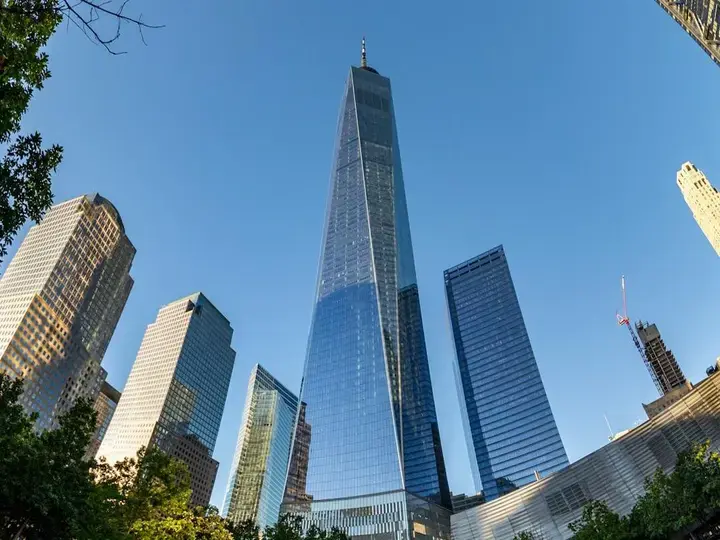
Next time you see a Manhattan skyline photo, first find Midtown, then look south for the single tapering tower that quietly broke the old mental map. That one is One World Trade Center. Once you separate the two districts, the old hierarchy starts to fall apart fast.
You still think the Empire State Building is the top of New York. It isn’t.
One World Trade Center is taller. Old symbol, yes. Taller tower, no. Midtown icon, yes. City champion, no.
So what counts as “tallest,” exactly?
This is the part where people get suspicious, and fair enough. Height can mean different things depending on what you count: the roof, the highest occupied floor, or the architectural top, which includes a permanent spire but not a temporary antenna.
The standard most often used in official skyscraper rankings comes from the Council on Tall Buildings and Urban Habitat. By that standard, One World Trade Center is 1,776 feet tall because its spire counts as part of the building’s architecture. The Empire State Building’s roof is 1,250 feet, and its total height to tip with antenna is higher than that, but antennas do not carry the same ranking weight as an architectural spire.
So if someone says, “Wait, depends what you mean by tallest,” they are not wrong. But under the common official standard, the title goes to One World Trade Center. That is the cleanest way to say it without playing games.
Why losing the crown didn’t knock the Empire State Building off its throne
Here is the funny part about New York. Physical height and cultural height are not the same thing. The Empire State Building lost the height crown, but it kept the bigger share of the city’s symbolic weight.
That is partly age and partly placement. The building sits in Midtown, in the part of Manhattan many people meet first and remember best. It also has a shape that reads fast. You do not need a caption. Your eye finds it, names it, and moves on. That kind of recognition is hard to beat.
One World Trade Center matters in a different way. It marks a rebuilt Lower Manhattan and a later chapter of the skyline. In plain sight, the two towers tell different eras of the city: the Empire State Building from the age when Midtown became the world’s office capital, One World Trade Center from the downtown rebuild that reset the southern skyline.
That is the real update. The Empire State Building is still central, just no longer supreme. Once you see that, Manhattan stops being one frozen postcard and turns back into a place that kept building while you were busy living your life.
The easiest way to read Manhattan right the next time
Do one simple thing. Stop hunting for a single winner and start looking for skyline eras. Midtown gives you the older, famous vertical grammar. Lower Manhattan gives you the newer correction.
The Empire State Building still feels like New York because it earned that feeling over generations, and no ruler can take that away. But if you want to see the city clearly now, read the skyline by neighborhood and by era, not just by the one landmark you learned first. Then the whole island snaps into place, and you are oriented instead of corrected.