The Mountain-Road Mistake Drivers Make at 'Safe' Speeds

The mistake that causes trouble on mountain roads often happens not when a driver is obviously pushing too hard, but when they enter a blind curve at a pace they would honestly call careful. Most people think danger starts with speeding; on a mountain road, it often starts with a speed that feels calm until the bend, the slope, and the sightline tighten all at once.
عرض النقاط الرئيسية
- A speed that feels careful can still be too fast on a blind mountain curve when sightline, slope, and curve shape tighten together.
- The safe entry speed is the one that lets you stop within the distance you can actually see in your own lane.
- Downhill grades reduce braking margin, so drivers should slow more before the curve begins while the car is still straight.
- ADVERTISEMENT
- Blind curves can tighten unexpectedly, which means the first visible section should be treated as incomplete information.
- Braking hard while turning uses the same limited tire grip, increasing the chance of trouble on steeper or tighter bends.
- Oncoming vehicles are part of the risk on mountain roads, so drivers should hold a clean line well inside their lane.
- Speed limits and advisory signs are not guarantees for every hidden bend, making extra caution essential even on familiar roads.
That matters because mountain-road risk is usually ordinary. No showing off. No late-night racing. Just a driver who feels settled, stays below the posted limit, and finds out a second too late that the road ahead is asking for more margin than the car has left.
Why “careful” can still be too fast
Start with sightline. On a blind curve, the safe speed is not the speed that feels reasonable on entry. It is the speed that lets you stop within the stretch of road you can actually see in your own lane.
قراءة مقترحة
The U.S. Federal Highway Administration has said this plainly for years in its curve-safety guidance: horizontal curves raise crash risk because drivers often approach too fast for the available sight distance and the curve sharpness ahead. Put that into plain language and it means this: if the road hides what comes next, your speed has to answer to the hidden part, not your comfort level.
One immediate adjustment: before a blind bend, choose your speed based on visible pavement, not the posted number you saw half a mile back.
Then grade changes the math. On a downhill, gravity keeps helping the car move even while you are trying to slow it. That does not sound dramatic, but it steals braking room.
The National Highway Traffic Safety Administration uses a perception-reaction time of 1.5 seconds in many safety discussions. At 40 mph, a car travels about 88 feet each second, so in 1.5 seconds you have already used roughly 132 feet before braking fully begins. On a downhill blind curve, that borrowed distance disappears fast.
One immediate adjustment: do more of your slowing before the curve starts, while the car is still straight and the tires are not also being asked to turn.
Now curve radius. That is the engineer’s term for how tight the bend really is. Two curves can look similar at entry and still behave very differently once you are committed. A curve that tightens halfway through asks more from tire grip than the opening view suggested.
Less sightline. More downhill load. Less braking margin. Tighter turn. Smaller escape space.
One immediate adjustment: treat the first glimpse of a blind mountain curve as incomplete information, not a promise that the rest of the bend will stay that open.
Braking margin is where many ordinary mistakes turn into close calls. Tires only have so much grip to share. If you are braking hard and turning hard at the same time, you are spending from the same small account. On dry pavement you may still get away with it. On a steeper or tighter curve than expected, that margin can vanish before the car feels out of control.
Could you stop, in your own lane, before the part of the road you cannot yet see?
That is the real test. Not whether you feel smooth. Not whether you are under the limit. Not whether the road was empty five minutes ago.
On a mountain road, the drop in your stomach on a blind downhill curve arrives before your brain has finished calculating why. You feel the road tightening first. Then you notice the grade. Then the guardrail seems closer. Then the space left to work with gets small in a hurry.
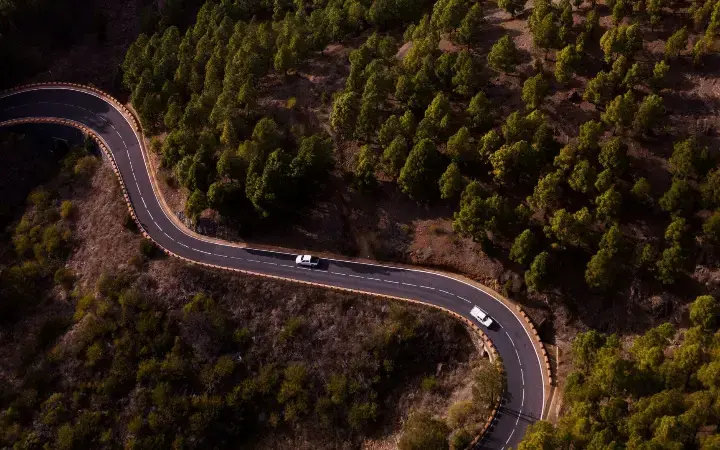
That bodily jolt is useful if you respect it. It often marks the gap between how fast the road is changing and how fast the brain, eyes, and feet can catch up.
One immediate adjustment: if a blind downhill bend gives you that quick internal warning, do not wait for certainty. Ease off earlier next time and enter with extra room already saved.
The part many careful drivers forget: the other lane is part of your risk
After sightline, grade, curve shape, and braking room comes the last squeeze: oncoming-lane risk. Mountain roads leave less spare width for everyone. A driver coming the other way may be wide because they misread the curve, not because they are reckless.
The Federal Highway Administration’s 2019 Proven Safety Countermeasures material points to lane departure as a major source of serious crashes on rural roads, including curves. You do not need the full engineering report to use the lesson. Your lane is not just where you belong; it is the only space you can count on.
One immediate adjustment: set up early so you can hold a clean line well inside your lane, without drifting toward the center on entry or exit.
Picture a common version of this. A driver starts down a familiar pass on a dry afternoon. They are below the speed limit, hands at the wheel, no phone, no drama. The first half of the bend looks gentle enough.
Then the turn tightens a little more than expected. A pickup appears with one tire near the centerline. Nothing outrageous has happened, but now the driver is braking while cornering downhill, with less visible road than they thought they had. This is how ordinary trouble begins.
Not every mountain road, car, tire, or weather condition behaves the same way. A loaded SUV, a small hatchback, fresh tires, worn tires, warm pavement, polished pavement in shade: each changes grip and stopping distance. Even experienced local drivers can still be wrong about a given curve on a given day.
That uncertainty is exactly why “I know this road” is not enough. Familiarity helps with confidence more than it helps with physics.
Why the speed limit is not the promise people think it is
A fair objection is this: if I am below the speed limit and not driving aggressively, I am already being safe. On an open, predictable road, that is often close enough. On a blind downhill mountain curve, it is not.
Speed limits are broad guidance for a stretch of road, not a guarantee for every hidden bend inside it. The safer number in that moment depends on what you can see, how steep the road falls away, how tight the curve becomes, how much grip your tires have, and whether you can stay fully in your lane if someone else makes a small mistake.
One immediate adjustment: read the advisory curve signs as warnings about geometry, not suggestions for sporty drivers. If the bend is blind or downhill, give yourself more margin than the sign alone seems to demand.
What to do on the very next blind curve
You do not need advanced skills to get safer here. You need a steadier rule. Slow before the blind curve until you could stop within the distance you can see, in your lane, without asking the tires to save you halfway through.
That means braking early while the car is straight, entering a little slower than pride likes, and keeping enough lane space for an oncoming driver who is not as tidy as they should be. It also means giving a familiar road the same respect you would give an unfamiliar one.
The good news is plain: because this mistake is so ordinary, the fix is ordinary too. Take a little more speed off before the blind downhill bend than feels strictly necessary, and the road usually gives that margin back to you as calm. It is one of the simplest habits a mountain road will ever reward.