The Rock Tower That Isn’t Built to Last

The biggest thing here is also the one already being taken apart. A sea stack looks like a stone monument, but geologists treat it as a temporary stage in coastal erosion, not a finished object.
عرض النقاط الرئيسية
- A sea stack is not a permanent monument but a temporary stage in the erosion of a coastal headland.
- Waves exploit natural cracks and joints in rocks like limestone and chalk, gradually turning cliffs into caves, arches, and stacks.
- Stacks are often less stable than the cliffs they came from because water and weather attack more of their surface.
- ADVERTISEMENT
- Famous examples such as Durdle Door, Old Harry Rocks, and the collapsed Azure Window show different stages of this erosion sequence.
- Coastal erosion usually works slowly through repeated wave action, salt growth, weathering, and occasional storms rather than constant dramatic events.
- Cracks in rock, undercut cliff bases, and fresh fallen stone are three clear signs that a coast is actively changing.
- Seeing a sea stack as part of an ongoing collapse makes the landscape more fascinating by revealing how much change is hidden in a calm view.
The British Geological Survey explains it plainly: waves find cracks in a headland, widen them into caves, sometimes cut through to make an arch, and when the arch roof collapses, a stack is left standing apart. What seems like endurance is often the proof that the coast has already broken more than once.
Why the grandest rock is the least secure
That is the first trick a sea stack plays on the eye. It stands alone, cleanly outlined, and so your mind files it under permanent. But the isolated pillar is usually less secure than the cliff it came from, because it has water working around more of its base and weather opening more of its cracks.
قراءة مقترحة
This is especially easy to see on limestone and chalk coasts. Those rocks often contain joints, which are natural fracture lines. Waves do not need to smash a solid wall from nothing; they use the weaknesses already there.
The U.S. National Park Service describes the same pattern on rocky coasts in simple terms: wave action attacks weak zones first, then erosion enlarges openings stage by stage. A stack is not a failure of erosion. It is evidence that erosion has already succeeded multiple times.
How a cliff turns into a tower, one weakness at a time
Start with a headland. Not a separate tower yet, just a part of the cliff line that juts into the sea and takes more wave energy than the bays beside it.
If that headland is limestone, as many famous coasts are, it often carries vertical cracks and bedding planes. Salt can grow in those spaces. Rain can seep in. Repeated wetting and drying, along with the sea's abrasion, helps prise the rock open a little more.
Then waves get a better grip. They throw sand, pebbles, and broken stone against the weak point, grinding it much like sandpaper that never gets tired. A notch forms, then a cave.
Keep going long enough and a cave can cut through the headland to form an arch. This is not rare folklore geology; it is the standard sequence taught by coastal geomorphologists. On the Jurassic Coast in southern England, Durdle Door is a well-known limestone arch showing one stage of that process in public view.
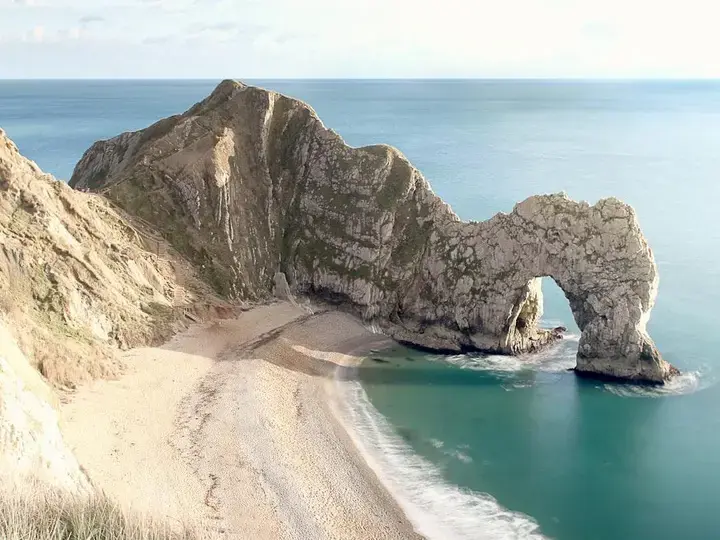
But an arch carries a problem inside its beauty. The roof still has to hold its own weight while waves attack the sides and weather works from above. When the roof can no longer do that, it falls, and the detached remnant becomes a stack.
Old Harry Rocks in Dorset offers a good real-world chain of stages in chalk: headland, caves, arches, stacks, and eventually stumps. Chalk and limestone differ, but the reading lesson is much the same. Weakness first, opening second, isolation after that.
Stand still a moment and listen to the soft, irregular hush of waves at the base. It does not sound like demolition. It sounds almost patient, which is exactly the point: coasts are often worn down not only by rare dramatic blows, but by repetition so steady you can miss it while looking straight at it.
The calm view is lying to you about time
Now cut away the postcard sense of the place. Put back the thousands of winters, the salt growing in tiny cracks, the storm surges, the quieter days, the pebbles dragged back and forth, the freeze-thaw in colder coasts, the simple force of water returning again and again.
That is the real scene. Not one afternoon. Not one storm. A demolition sequence running in slow motion across a very long clock.
Crack opens. Water enters. Pressure works. Fragments loosen. The base narrows. The stack stands alone. The stack falls.
After that, if enough rock remains above sea level, a stump may linger. If not, the sea takes the shape down another step and the eye loses the monument entirely.
No one can predict the exact season a stack will fail; erosion speeds depend on rock type, fractures, storms, and sea conditions. That uncertainty matters. Coastal change is often episodic, with long periods that seem almost still, followed by a collapse that looks sudden only because the preparation was hidden.
You might fairly say, but cliffs like this can look unchanged for generations, so is all this a bit alarmist? Not really. Coastal geomorphologists have long pointed out that erosion is uneven in time. Years of small wear weaken the rock, then one event reveals the change in a day.
A famous example sits in the same Dorset coast story. The limestone arch known as Azure Window on Gozo, in Malta, collapsed in 2017 after years of natural erosion had weakened it. The fall looked abrupt in the news. The making of that fall took far longer.
Three clues that tell you a coast is mid-collapse
The useful part, if you enjoy places like this, is that you can learn to read them. You do not need a geology degree. You need to know where to rest your attention.
1. Look for cracks running through the cliff or stack. In limestone, these fracture lines are often the opening move. If the sea has a line to work with, it already has a plan.
2. Look for undercut bases. When the lower part of a cliff is eaten back more than the upper part, the rock above is carrying weight over emptying space. That is borrowed time made visible.
3. Look for detached blocks and fresh fallen stone near the foot of the cliff. Those pieces tell you the tidy shape above is being edited bit by bit, even if the main outline still seems unchanged.
If you notice those three clues together, you are not looking at a permanent feature that happens to be near the sea. You are looking at a coast in the middle of becoming something else.
What makes the view richer, not sadder
Once you see a sea stack this way, the coast gets more interesting, not less. The grandeur is real, and so is the loss. They are the same story told at different speeds.
Next time you stop by a cliff and an offshore tower of rock, give it a better look: check the cracks, the undercut base, and the fallen blocks before you decide it is timeless. Paying attention like that does not spoil the wonder; it gives you the deeper kind, the one that knows the stone is alive with change.