The Design Trick That Makes Ronda’s Bridge Look Part of the Canyon
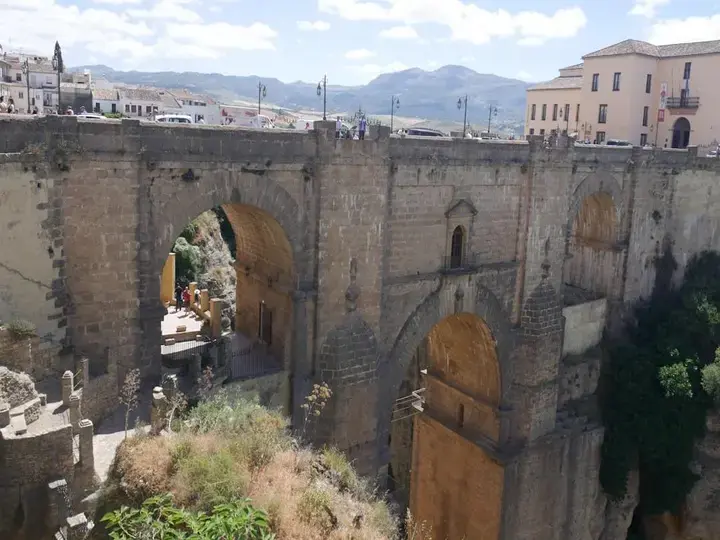
Puente Nuevo feels natural not because it hides in Ronda’s famous gorge, but because it repeats the gorge’s own shapes and color so boldly that your eye accepts it as belonging. Most people assume harmony comes from blending in. Here, the trick is easier to test than to say, and once you see it, you cannot quite unsee it.
عرض النقاط الرئيسية
- Puente Nuevo feels natural in Ronda because its warm stone tones closely match the cliffs of El Tajo.
- Its thick masonry and vertical mass echo the gorge’s sheer walls instead of interrupting them.
- The bridge’s central arch mirrors the canyon’s opening, making the structure feel visually connected to the landscape.
- ADVERTISEMENT
- Shadow beneath the bridge preserves the ravine’s carved depth rather than flattening the view.
- Completed in 1793, the bridge is associated with José Martín de Aldehuela and reflects a lasting human response to the gorge.
- The site is memorable because geological time and human craftsmanship produce the same visual language of stone, weight, and void.
- Puente Nuevo proves that harmony in architecture can come from boldly repeating a landscape’s forms rather than blending into them.
Stand a moment with the view and let the body register it first: sun-warmed stone, a hard drop through El Tajo, cliff faces cut almost straight down, and then that heavy bridge lodged between them as if it came from the same mineral stock. The place can hit you first as height, or even vertigo. Fair enough. But if geometry gets a chance, it explains why the shock settles into something stranger than prettiness.
قراءة مقترحة
This is Puente Nuevo, the bridge over the El Tajo gorge in Ronda, completed in 1793 and associated with José Martín de Aldehuela. It is not a shy structure. It is huge, blocky, and impossible to miss. So the usual idea—that beautiful building and beautiful setting work because the building disappears—does not hold up here.
The eye catches the color before it understands the form
Start with the simplest thing: the stone is close in tone to the gorge itself. Not identical, and that matters. The bridge does stand apart. But its warm, sandy-brown masonry answers the cliff walls instead of fighting them, so the contrast feels like kinship, not collision.
Then look at the vertical weight. The gorge is not soft country. It is all edge, drop, and abrupt face. A delicate iron span would read as an interruption here. Puente Nuevo answers those cliff walls with thick vertical supports and stacked masonry mass, which is why its heaviness feels right.
Now do the little self-check that makes the whole thing plain. Trace one cliff edge with your eye. Then trace one of the bridge’s tall walls down toward the arch. You are following the same kind of force: a sheer line, a hard descent, a clean cut.
The arch matters too. People often talk about it as a window, and that is close enough. The gorge is itself a giant opening cut through stone. The bridge places a smaller opening inside that larger split, so the central void does not deny the canyon gap. It echoes it.
Shadow helps finish the trick. Under the bridge, darkness pools in a way that resembles the gorge’s own depth and recesses. The bridge does not flatten the ravine into a postcard surface. It keeps the sense of carved depth alive.
That is the aha point: the bridge does not vanish into the canyon. It stands out by repeating the canyon’s forms and tones so precisely that boldness reads as belonging. Big difference.
And then, just when the eye thinks it solved the matter in a second, the timescale opens up. The first glance says: it grew out of the rock. The truth is slower and more stubborn than that.
What looks instant was made by centuries and then by decades
El Tajo was cut by water over a very long span, leaving those steep rock faces that make Ronda feel split in two. Much later, human builders answered that cut with masonry. The bridge you see today was completed in 1793, after earlier efforts to cross the gorge, and the work is tied to José Martín de Aldehuela, whose name stays with the structure because he gave the crossing its lasting form.
That is the decelerating part, and it is worth lingering over. The gorge was shaped by erosion and weather over ages no visitor can feel in a single visit. The bridge was shaped by quarrying, hauling, cutting, and setting stone over years of labor. One timescale is geological, one human, but both leave the same visual answer: weight held in stone, edge against void, warm rock against warm rock.
This is why the place sticks in memory. You are not only seeing a bridge over a gap. You are seeing human construction speak in the same rough grammar as the gorge.
Maybe it is just huge. But huge is not enough
A fair objection is that Puente Nuevo impresses people simply because it is enormous and perched over a frightening drop. Of course that matters. Height can grab anyone before design does, and some viewers feel the stomach-turn first and the visual logic later.
Still, size alone does not create inevitability. Plenty of large structures over dramatic sites look imposed, as if they were set down there from somewhere else. Puente Nuevo avoids that because its proportions answer the gorge’s proportions, its arch repeats the canyon’s opening, and its stone keeps close company with the cliffs instead of breaking away from them.
That is why the bridge feels less like decoration and more like completion. Not because nature needed finishing, but because the builders paid attention to what was already there: vertical faces, blunt mass, cut space, and a color range drawn from the same ground.
The next time you face a famous view, try this small habit. Do not ask only whether the human structure is pretty. Ask what it is borrowing from the land—its color, its lines, its weight, or its emptiness.
Puente Nuevo stays with people because it turns awe into recognition a second after it hits. Once you see that, you leave Ronda with something better than admiration. You leave knowing a little more about how to look.