How a Domestic Cow Turns Alpine Grass Into Milk and Meat

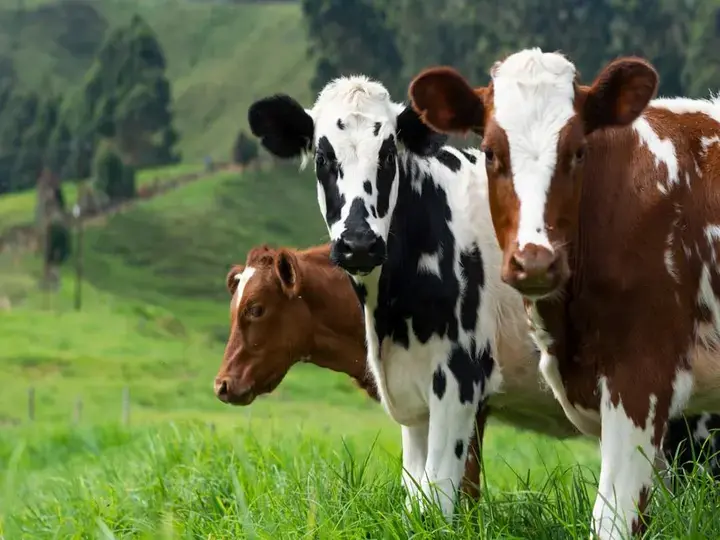
It is easy to look at a cow in a high summer pasture and think: there is a peaceful animal simply eating grass. But that is not quite what is happening. This animal makes food humans cannot eat into food humans can, and one mouthful tells the whole story if you follow it closely enough.
عرض النقاط الرئيسية
- Cows rely on rumen microbes to break down cellulose in grass because neither humans nor cows can digest it effectively on their own.
- Microbial fermentation in the rumen produces volatile fatty acids that the cow uses for energy, milk fat, and body tissue.
- Cows also gain protein by digesting some of the microbes that grow during fermentation later in the digestive tract.
- ADVERTISEMENT
- A single mouthful of alpine grass reflects slow-formed mountain soils, adapted plants, and long-standing seasonal grazing practices.
- In many mountain regions, grazing has helped maintain open meadows on land that is difficult to use for direct crop farming.
- Livestock often consume materials humans cannot eat, showing how ruminants can convert rough forage, residues, and by-products into food.
- The article argues that grazing cows should be seen as biological converters rather than simple ornaments in a pasture.
A small self-check helps. Ask, very plainly, could I eat what this cow is eating right now? If the answer is no—and for tough alpine grass, stems, and fiber, it is—then you are standing at the door of the real fact.
That Quiet Bite Is Busier Than It Looks
Hard cut now, old girl: grass first. What the cow pulls in with her tongue and teeth is full of cellulose, the stiff material that gives plants their structure. Humans can chew it, but we do not have the enzymes to break cellulose apart and get much nourishment from it.
قراءة مقترحة
The cow cannot do it alone either. That is the part many people miss. A 2018 review by Wallace, Sasson, Garnsworthy and others in Journal of Animal Science on rumen microbial metabolism makes the point clearly: the animal depends on a dense community of microbes in the rumen to break down fibrous plant matter that the cow itself could not digest by its own enzymes.
So the bite goes down into the rumen, the large fermentation chamber at the front of the stomach system. There, bacteria, archaea, protozoa, and fungi go to work. They attack the plant fiber. They ferment it. They turn part of that grass into compounds called volatile fatty acids—mainly acetate, propionate, and butyrate—which the cow absorbs through the rumen wall and uses for energy, milk fat, and body tissue.
Grass to rumen. Rumen to microbes. Microbes to fermentation. Fermentation to nutrients. Nutrients to milk and muscle. Once you see the chain in that order, the cow stops looking like a simple grazer and starts looking like a living converter.
There is more. The microbes themselves grow as they feed, and later, farther down the digestive tract, the cow digests some of those microbes too. So the animal is living partly on the products of fermentation and partly on the protein made by its own microbial partners. That is why saying a cow “digests grass like we digest bread” is wrong in the plainest possible way.
Listen a moment, neighbor. There is the slow, wet tear as grass gives way, then the steady chew, chew, chew in the thin alpine air. The sound is unhurried. Inside, though, a fermentation vat is already warming that bite into something entirely different.
The Bite Lasts Seconds. The Mountain Took Centuries.
Here is the turn in the path. That mouthful disappears in seconds, but the ground that grew it did not arrive in a season. Alpine soils are often thin, patchy, and slow to form, built by weathering rock, plant roots, microbes, fungi, freeze-thaw cycles, and the long accumulation of organic matter.
And the pasture itself is not just scenery spread under the animal like a tablecloth. In many mountain regions, seasonal grazing helped shape open meadows over generations. Herders moved animals up in summer and down again, keeping grasslands from being quickly overtaken by shrubs and trees in places where steepness, climate, and short growing seasons make direct crop farming difficult.
So that bite is not only grass. It is soil made slowly, plants adapted to short mountain summers, and human practice repeated year after year until a usable pasture exists at all. The cow is eating the present tense of a very long sentence.
This is where the animal’s body and the mountain meet. Without the microbes, the fiber stays mostly locked. Without the meadow, there is no fiber to unlock. Without patient grazing traditions in many alpine areas, that meadow would often be a different place entirely.
When “Cattle” Means Trouble, What Still Holds True Here?
Now the fair question. Many readers hear “cattle” and think of methane, feedlots, heavy grain feeding, land pressure, or waste. Those concerns are real, and this mechanism does not excuse all cattle production or make every system efficient or kind to the land.
What it does explain is something narrower and true. In a 2017 paper in Global Food Security, Anne Mottet and colleagues at the FAO estimated that livestock consume about 6 billion tonnes of feed dry matter globally each year, and 86% of that is material not edible by humans. That does not mean every kilo of livestock food is a bargain for the planet. It means the basic ruminant trick—turning forage, residues, and by-products into milk and meat—is real, measurable biology.
In mountain grazing systems, that point matters because much of the biomass under the cow’s nose is not bread grain, beans, or salad waiting to be picked for our dinner. It is rough forage from land that is often poorly suited to cropping. The animal is using a kind of food chain humans cannot enter directly.
That is the honest limit and the honest value. Not all cattle systems work this way to the same degree. But a grass-fed cow on upland pasture is not merely competing with people for edible food; often, it is converting plants and places we cannot use directly into nourishment we can.
The Carry-Away Lens for the Next Cow You See
Once you know this, the calm look of a grazing cow changes a little. The animal is still doing the same old work, head down, tearing and chewing. Yet inside that quiet body is a partnership with microbes so old and so effective that it can unlock energy from cellulose and pass it along as milk and muscle.
And behind that one bite stands more than a summer field. There are thin soils made slowly, grasses fitted to hard ground, and generations of mountain people who learned when to move animals and when to let a pasture rest. The mouthful is larger than it looked.
So when you see a grazing cow, think converter, not ornament. There you are, old friend, taking what we cannot eat and patiently making it part of the human table.