The Repeating Arches in This Ornate Vaulted Corridor Are Doing More Than Decorating It

What looks like repeated decoration in a grand corridor is first a piece of structural work. In plain language, arches are there to carry weight by squeezing stone or brick together, not merely to please the eye. Once you know that, the whole passage stops being background pattern and starts behaving like the main character.
عرض النقاط الرئيسية
- Arches primarily exist to carry weight by directing loads in compression down into their supports.
- A repeated row of arches functions as a repeated load path, not just a decorative pattern.
- Stone and brick perform well in compression, which makes arches especially dependable in masonry construction.
- ADVERTISEMENT
- Repetition in arches creates structural order, visual rhythm, and a measured sense of movement through a corridor.
- Arched corridors also shape acoustics by producing softened, prolonged reflections of footsteps and voices.
- Not every visible arch is truly structural, since some later interiors use arches as decorative forms over hidden frames.
- Understanding how arches work makes historic corridors feel more intelligent because their beauty is inseparable from their structural purpose.
Engineers have said this very plainly for a long time. The Institution of Structural Engineers, in its guidance on historic structures, explains that masonry arches work mainly in compression: the load above is directed along the curve and down into the supports at either side. That matters here because a row of arches is not just repeated ornament; it is a repeated load path.
قراءة مقترحة
The Beauty Is Real, But the Work Comes First
Most of us meet a corridor like this with our eyes first. We notice rhythm, symmetry, the calm authority of one opening following another. Fair enough. Architecture is meant to be seen.
But the arch earned that beauty by doing a harder job. Unlike a flat stone laid across a gap, which wants to bend, an arch turns downward weight into compressive force along its curve. The wedge-shaped blocks, or the masonry acting as if it were wedge-shaped, press against one another and send that force into the columns or piers beside them.
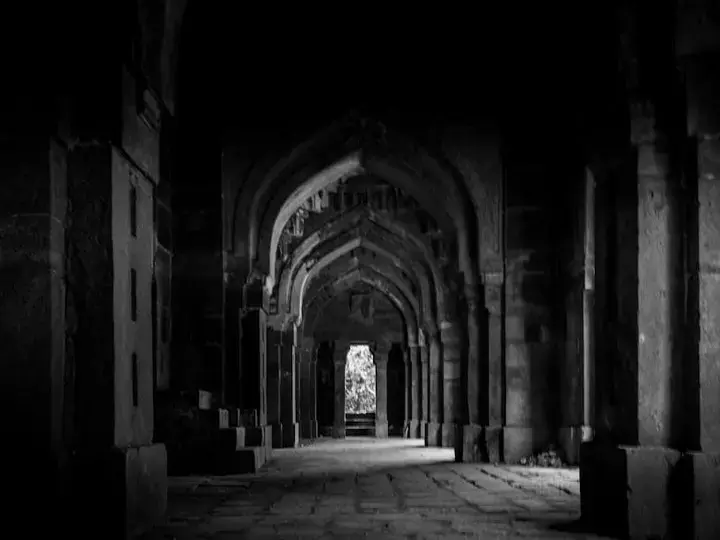
That is why arches became so dependable in long halls, cloisters, arcades, and vaulted passages. They let builders span space in masonry while keeping the material in the sort of stress it handles well. Stone is weak in tension and strong in compression; the arch is the form that takes advantage of that fact.
And repetition changes everything. One arch can carry one opening. A whole run of them shares loads bay by bay, establishes regular support points, and helps a long corridor hold its order instead of feeling like a series of isolated gaps. The grandeur arrives because the structure has already agreed on a rhythm.
You can see this logic in many historic arcades and vaulted walks, from Roman work to later monastery cloisters and civic halls. The exact style changes, the painted surface changes, the lamp fittings change, but the job stays recognizable: take weight, push it outward and downward, gather it into supports, and do it again in the next bay.
That repetition also guides your body. Each arch frames the next one, then the next, so you do not simply stand and admire; you are gently conducted forward. Linear perspective does part of that work, of course, but the repeated spans tighten it. They make movement feel measured, almost counted underfoot.
So the corridor is not only standing up. It is organizing your pace. In that sense, structure and ceremony are not rivals here. The same repeated geometry that manages the loads also manages your attention.
But if the arches vanished tomorrow, what exactly would the corridor lose first: beauty, strength, or silence?
Walk it in your mind for a moment. One arch follows another as pattern, yes, and then you hear the softer fact: footsteps slip under one span and return from the next with a rounded little echo, half a beat later. The space is not only seen. It is sounded out.
The Part Your Ears Notice Before Your Brain Does
Curved and repeated surfaces do not create a concert hall by themselves, but they do affect how sound travels and returns. In a long arched corridor, reflections bounce between hard surfaces and come back in small sequences rather than one blunt slap. That is one reason footsteps, voices, and even a cough can seem softened yet prolonged.
Architectural historian Steen Eiler Rasmussen wrote in Experiencing Architecture that architecture can be heard as well as seen. He was right in the most practical sense. The spacing of bays, the hard masonry, and the curved overhead geometry together give a corridor its particular audible character.
Now the useful self-check. Imagine removing just one repeated bay from the run. What changes first? Support is interrupted because one segment of the load path and one set of side thrust relationships has been altered. Pacing is interrupted because the visual measure stumbles. Echo is interrupted because the regular sequence of reflecting surfaces has been broken.
That is the real update in how to see the place: it would lose structural order before it merely lost prettiness. The repetition is performing load management and spatial organization at the same time. Its grace comes from that double duty.
A Fair Warning: Some Arches Only Look Busy
Here it is worth being honest. Not every visible arch in a later building is truly carrying the loads you think it is. In many interiors, especially from periods that loved historic forms, an arch can be a decorative skin or a shaped opening attached to a hidden frame of steel, timber, or reinforced concrete.
So you should not assume function from shape alone. Look for clues in the mass of the construction, the thickness of the supports, the way the vaulting meets the columns or piers, and whether the whole corridor seems organized around masonry bearing points. In a true load-bearing arcade, the arch, the support, and the overhead structure belong to the same physical argument.
The conservation literature makes this distinction often. Guidance from English Heritage and similar conservation bodies treats arches, vaults, and piers in historic masonry buildings as connected structural systems, not isolated motifs. If the visible arch is only a surface gesture, that old meaning has been borrowed rather than performed.
Still, in a genuinely masonry-built vaulted corridor, the old intelligence is easy to feel once you know where to look. The curve carries. The series distributes. The passage disciplines movement. The hard shell shapes the echo. One form, several jobs, no wasted line.
Why the Corridor Feels Smarter Once You Know This
After years of walking visitors through old buildings, I have found that this is the moment the stone begins to wake up for them. Not because the corridor becomes less beautiful, but because the beauty stops floating free of the building's work. You can sense the loads descending, the sequence of bays steadying the whole run, the air answering under each curve.
So when you next enter a vaulted hall or an arched passage, give the arches a little more credit. See them first as acts of support, then as acts of style. Old buildings often grow more moving, not less, once you understand the mechanics that let their elegance endure.