The 20- and 40-Foot Rule That Built the Modern Container Port

Two ordinary-looking measurements, 20 feet and 40 feet, did as much to build the modern port as any giant crane did. You hear the low harbor horn first, rolling over calm water before dawn, and then, much smaller than you expect, the clack of metal finding its place. That little click is the sound of a global rule working.
عرض النقاط الرئيسية
- Modern container shipping took off after Malcolm McLean’s 1956 voyage proved the value of moving cargo in one sealed box across multiple transport modes.
- The 20-foot container and 40-foot container became the core units of global shipping, with TEU serving as the basic counting system.
- Cranes lift containers using spreaders that lock into standardized corner castings, making handling fast, precise, and repeatable.
- ADVERTISEMENT
- ISO standards created trusted dimensions and fittings, allowing ships, ports, trucks, railcars, and yards to work with the same container system.
- Container vessels, truck chassis, rail well cars, and yard stacks are all designed around shared container sizes and fixed pickup points.
- Standardization reduced repacking and uncertainty, making global trade more efficient and turning investment in port infrastructure into less of a gamble.
- Even with shared standards, containerization did not eliminate limits such as labor disputes, port politics, specialized container types, and infrastructure gaps.
Most people, fairly enough, assume the big machine is the story. The crane is what you can see. But if a box can move from ship to crane to truck to stack without being repacked, what had to be standardized first?
The machine looks like the genius. The box is.
Modern container shipping is commonly traced to Malcolm McLean’s 1956 breakthrough, when a converted tanker called the Ideal X carried truck trailers loaded as containers from New Jersey to Houston. The idea was not that nobody had ever moved cargo in boxes before. The leap was making the box itself the unit of transport, so cargo could stay inside one container across different legs of a trip.
قراءة مقترحة
That system did not appear fully formed overnight. Over the years that followed, shipping lines, ports, railroads, truckers, and standards bodies pushed toward shared dimensions and shared fittings. The International Organization for Standardization, or ISO, helped turn early experimentation into a system other companies and countries could trust.
In plain language, two lengths came to dominate everyday counting: the 20-foot container and the 40-foot container. The 20-foot equivalent unit, or TEU, became the basic arithmetic of shipping. A 20-foot container is 1 TEU. A 40-foot container is usually counted as 2 TEU. That sounds dry until you realize entire ships, terminals, yard plans, and freight prices are built around that logic.
What actually clicks when the crane grabs a container?
The part that picks up the box is called a spreader. Think of it as the crane’s hand, but one built for exact alignment rather than grip strength. A standard container has reinforced corner fittings called corner castings, one at each top corner and one at each bottom corner, and those castings are the reason the whole system can repeat itself all day.
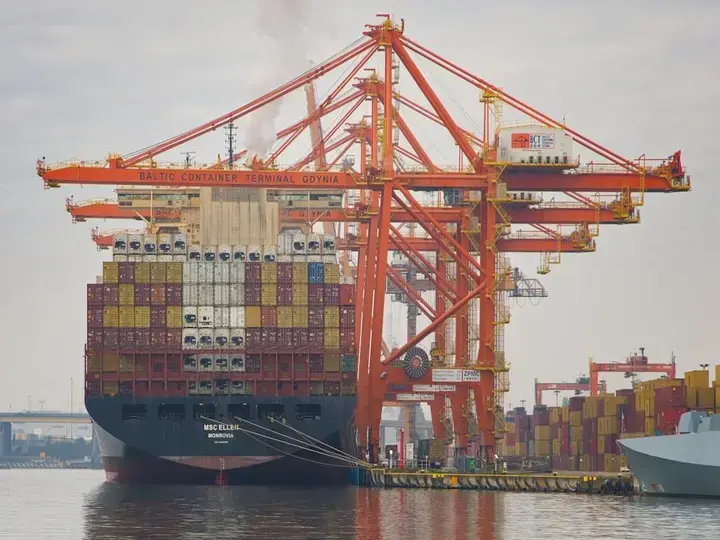
The spreader lowers onto the top four corner castings. Twist-locks on the spreader enter the openings, rotate, and lock. The motion takes seconds. The box is not being pinched from the sides or hugged from underneath; it is being engaged at the points the whole transport system agreed on decades ago.
That is why the movement can seem strangely quiet for something so heavy. The force is huge, but the trick is not brute handling. The trick is that the machine already knows where the box’s pickup points will be.
ISO 668 and related container standards set out the main dimensions and ratings that let this happen at scale, while corner fittings are standardized under separate ISO specifications. Standards language can put you to sleep if you let it, but here it says something simple: if the corners match, the rest of the journey can be designed around them.
If the crane can lift it, what else has to match?
Start with the ship. Container vessels are built with cell guides, vertical rails inside the cargo holds that help containers drop into fixed slots. A box of standard width and length can be planned into the vessel before it ever reaches the berth. The crane operator is not improvising a place to put it. The ship has a grammar, and the container speaks it.
Then the box goes ashore. A truck chassis is built so a container’s corner castings can be secured at known points. Rail well cars are designed around the same unit logic, including common arrangements for 20-foot and 40-foot boxes. Yard stacks depend on it too, because containers are meant to bear loads through their corner posts and fittings, not as random metal shells piled any which way.
Now speed it up. Ship slots. Chassis lengths. Rail wells. Yard rows. Terminal software. Booking systems. Pricing units. The same box dimensions and fittings let one sealed unit move across ship, truck, rail, and yard systems with minimal repacking. That is the aha hiding in plain sight: the crane matters because the box has already been made legible to everything around it.
A few seconds of metal-on-metal, then seventy years of consequences
Here is the hard cut. The spreader locks in a few seconds. The rule that made those seconds reliable took decades.
McLean’s 1956 voyage showed the commercial power of container shipping, but the early years were messy. Different companies used different sizes and systems. Through the 1960s and after, ISO standards helped settle the dimensions and fittings that made wider interoperability possible. Once ports and carriers could trust that a container from one place would fit the equipment in another, investment became less of a gamble.
This is where the century opens up from the click. A standard does not look dramatic. It looks like paperwork, committee meetings, and tolerances measured in inches and millimeters. But once enough of the world agrees, steel gets built to match the rule, software gets written to count the rule, and ordinary goods start arriving because the rule is boringly repeatable.
I grew up thinking harbor machinery was loud power. It is power, yes, but family taught me to notice the quieter truth: on a working waterfront, agreement is what lets weight move.
Why this did not solve everything
It would be too neat to say the 20- and 40-foot box lengths alone created modern trade. They did not. Container sizes were not wholly arbitrary, and standardization never erased labor struggles, port politics, rail bottlenecks, dredging limits, customs rules, or the uneven money different countries could spend on terminals.
Containers are not all identical in every dimension, either. There are high-cube containers, refrigerated boxes, tank containers, and other specialized forms. Ports also differ in depth, crane reach, labor practices, software, and inland links. Standardization gave the system a shared grammar, not a magic wand.
Still, shared grammar matters. It is the reason one shipping line’s equipment can fit into a broader world of ships, ports, truck fleets, railcars, depots, and accounting systems. Without that, every transfer becomes a fresh negotiation between mismatched tools. With it, the transfer becomes routine enough that the box itself almost disappears from notice.
Once you know the rule, the harbor gets less mysterious
So the next time you pass a freight train, a truck yard, or a waterfront, it helps to look past the size of the machinery for a second. Notice the repeated shape, the corner fittings, the way the same unit can be counted, lifted, locked, stacked, and sent onward. TEU is just a bookkeeping term on paper, but in the real world it means thousands of pieces of equipment are expecting the same box.
That is why the port feels bigger than it first appears. You are not just watching cargo move. You are watching a standardized object fit into a chain of other standardized things, with very little room for improvisation and very little need for repacking.
The cranes are less mysterious once you know this, and more impressive. Much of modern life arrives because millions of ordinary-looking clicks happen exactly the same way.