Those Red Mountains Aren't Just Dying Leaves at All
Some of the red spread across these White Mountains slopes is not coming from dying broadleaf leaves alone; from the Conway Scenic Railroad as it crosses the high trestle in Crawford Notch, a whole hillside can read as leaf-red even when several different things are coloring the view at once.
عرض النقاط الرئيسية
- Much of the red seen on White Mountains slopes is true fall foliage, especially from red maples producing anthocyanin pigments as chlorophyll fades.
- Distance flattens the landscape and causes the eye to blend different tree species, colors, and seasonal stages into one broad wash of red and rust.
- Mountain slopes do not change color uniformly because elevation, slope aspect, moisture, and soil conditions all affect timing and intensity.
- ADVERTISEMENT
- Lower wet areas, drier upper slopes, and mixed stands of birch, beech, and aspen can each show different colors at the same moment.
- Some reddish-brown patches on higher slopes may come from stressed or damaged conifer needles rather than deciduous autumn leaves.
- From a train or overlook, haze, sunlight angle, and overlapping forest stands make it difficult to identify every colored patch accurately.
- Understanding these layers does not lessen the beauty of fall foliage; it makes the view sharper, richer, and more interesting.
I used to tell that to first-time riders when I worked these rails, and they’d look at me as if I were taking something away from autumn. I wasn’t. I was giving the hills back their detail.
Because yes, a lot of what you see is fall foliage in the plain old sense. Red maples are a big part of that show, and university extension guides across the Northeast explain the red by pointing to anthocyanins, the pigments produced in autumn as leaves shut down for the season while chlorophyll fades.
قراءة مقترحة
But from a moving train, or from any overlook where distance presses a mountain flat, your eye does a little blending of its own. Separate trees, separate species, even separate stages of the season get compressed into one broad wash of red, orange, bronze, and rust.
Why the whole mountainside looks like one giant fire
When you come north into Crawford Notch, the first impression is simple enough: the hills look as if the hardwoods have all turned together. That is a sensible guess. Broadleaf trees do most of the obvious color work that people come to see.
Still, mountains are poor at doing anything all at once. A lower wet slope may be full of red maple and still hold more color than a drier shoulder above it. A birch stand may be yellow while nearby beech hangs onto copper. An aspen patch can go pale and bright in a hurry, then seem to vanish a few days later.
That matters because timing is not one blanket laid over the range. Elevation changes temperature. Slope aspect changes sun exposure. Wet ground and shallow soil change stress. So one patch can be nearing its brightest week while another is already passing into duller tones.
I’d tell my nephew, look low first, then high. Don’t ask only, “What color is that hill?” Ask, “What kind of trees are holding that color, and why there?” You start seeing not a wall of leaves but a stack of small decisions made by species, weather, and ground.
Then the train eases onto the trestle, and the sound changes before your eyes do. There’s that hollow iron hum under the floor, and the wheel-clatter comes back at you sharper off the steel, the sort of sound you feel in your ribs if you’ve spent enough years aboard.
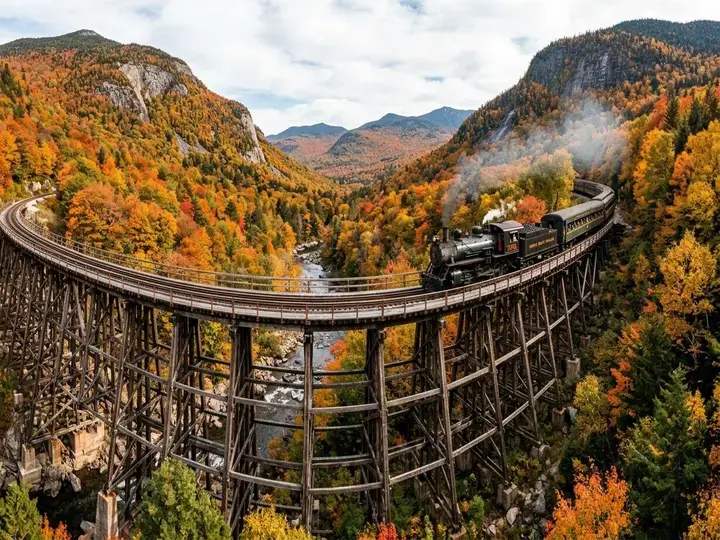
Out there, with the drop under you and the curve of the line ahead, it is easy to take the red below as one giant leaf-fire.
But what if some of that red isn’t autumn at all?
The part your eye blends together from far away
Here is the plain version. Some red on a mountainside is from deciduous leaves making or revealing autumn pigments. Some of it is from which species happen to grow in that band of slope. Some of it can come from stressed or damaged conifer needles, especially higher up, that shift a patch toward reddish-brown from a distance. And then light and distance mash those signals together.
1. The true leaf-red is real. In trees such as red maple, anthocyanins are the red pigments most people are responding to. Extension explanations from the University of New Hampshire and other land-grant schools describe how chlorophyll breaks down in fall, yellow and orange pigments become easier to see, and red pigments can build in some leaves under autumn conditions.
2. The mountain does not turn by one clock. Higher elevations cool sooner. Sheltered lower pockets can lag. So a bright red belt partway down a slope may not match the darker red-brown above it because they are not in the same stage of the season, even if your eye reads them as one color field from the train.
3. Not every rusty patch belongs to broadleaf trees. In the White Mountains, high-elevation conifers can show browning or reddening from stress or injury. Forest-health bulletins from the U.S. Forest Service and state agencies regularly note needle discoloration in conifers after winter injury, drought stress, or insect damage. From far off, a patch of that can mingle visually with genuine foliage color and pass for “more fall red” than it really is.
Short version: species. Slope. Elevation. Stress. Light. Put those together and a single hillside becomes a mixture, not a solid answer.
And I should be honest with you the way I was with riders leaning across for the better window: from a train seat alone, you cannot identify every patch correctly. Distance fools the eye. So does haze, angle of sun, and the simple fact that mixed forest stands overlap each other. Sometimes the best you can say is, “That red is probably not all the same thing.”
No, you’re not overthinking it
A fair complaint is this: isn’t fall red still mostly just leaves? Yes, often it is. Especially in the lower and middle elevations where broadleaf trees carry the show, the main event is still autumn foliage in the ordinary sense, and there is no need to pretend otherwise.
What changes once you know the rest is not the beauty but the resolution. You stop treating the mountain as one painted surface. You begin to notice that the lower wet hollow throwing off a clear red may be red maple, while the darker, duller patch above could be a different species mix, a later stage of the season, or even conifer stress reading red-brown at a distance.
Try a small test next time you’re on an overlook or riding north through the notch. Pick one bright red patch low on a moist slope, then compare it with a darker red-brown patch higher up. Ask three things only: same species, same elevation, same stage of fall? Often the answer will be no at least once, and that is when the hillside starts coming into focus.
What the mountains give back once you know this
After enough seasons on these rails, I stopped thinking of peak foliage as a single moment and started seeing it as a moving argument between trees, weather, and height. That is why the hills never look the same twice, even on the same route a few days apart.
The nice part is that this does not spoil the ride. It improves it. The hills are beautiful not because they are simple, but because they are changing in more ways than one.
So on your next fall pass through Crawford Notch, don’t just admire the sweep of color. Choose one patch and ask what, exactly, is making it look that way. That small habit turns a fine view into a sharper one.
And if you do that while the wheels sing over the trestle, you’ll have learned what every good rider learns sooner or later: how to look out the window a little better.