How a Streetcar Moves Without a Tailpipe

A streetcar does not carry its trip inside a tank the way a bus or car does. What looks like a self-contained vehicle is really being fed as it moves, with no tailpipe because its energy arrives continuously from above. If you want the plain version, it goes like this: wire to roof, roof to controls, controls to motors, motors to wheels.
عرض النقاط الرئيسية
- A tram is powered continuously from overhead wires rather than by stored fuel in a tank.
- The pantograph on the roof maintains contact with the overhead line and draws electricity into the vehicle.
- Modern tram systems commonly use 600 to 750 volt DC overhead electrification.
- ADVERTISEMENT
- Onboard electrical equipment regulates incoming power before sending it to traction motors that turn the wheels.
- Steel wheels on steel rails create low rolling resistance, helping trams move passengers efficiently.
- A tram depends on a wider city system including substations, feeder cables, overhead lines, rails, and maintenance crews.
- Trams produce no tailpipe emissions at street level, but overall environmental impact depends on how the electricity is generated.
That is the part many of us half-see without naming. We notice the rails, the doors, the driver’s cab, maybe the lights. We assume “vehicle,” and our brains quietly add the usual hidden kit: fuel somewhere, engine somewhere, exhaust somewhere. A tram politely breaks that habit.
The small clue hiding in plain hearing
Stand at the stop when one glides in and pause before the doors open. There is often a soft electrical hum overhead, not loud, just a thin live note in the air, the kind of sound city ears file away without discussion. That sound is your first clue that the tram is already touching its power source.
قراءة مقترحة
On the roof sits a pantograph, the spring-loaded arm that presses upward against the overhead contact wire. Transit agencies and rail engineers use that exact word, pantograph, for the collector that keeps electrical contact while the vehicle moves. The wire above many modern tram systems carries direct current, often around 600 to 750 volts; Siemens Mobility and many transit agencies describe that range as standard for urban light rail and tramway overhead electrification.
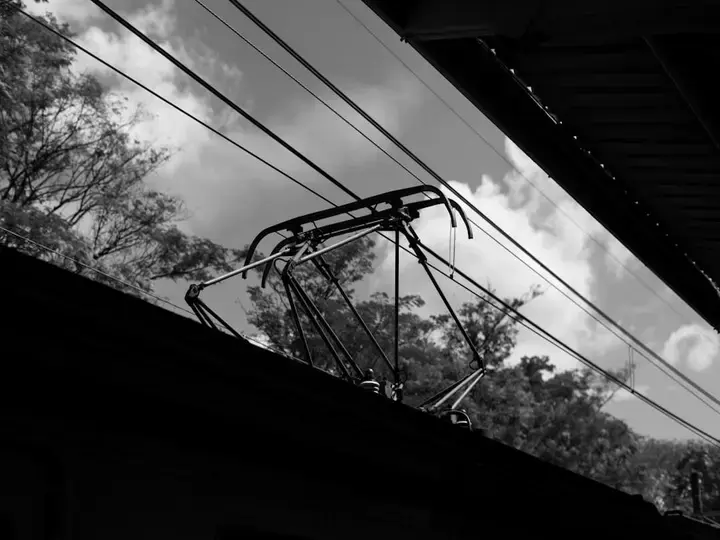
So the tram is not waiting to be “filled up” for the route. It is being supplied in motion. Electricity comes down through the pantograph from the overhead line, enters the vehicle, and is immediately routed to the equipment that can make use of it.
Try a quick self-check. Picture what disappears here: no diesel refill stop during the line’s normal run, no exhaust pipe breathing into the street behind the car. Once you remove those familiar pieces, the logic points upward, because the energy has to be arriving from somewhere.
What happens after the wire touches the roof?
Inside the tram, the incoming electricity does not go straight, raw, to the wheels. First it passes through electrical equipment that protects, meters, and regulates it. On many modern trams, power electronics convert and control the supply so the traction motors get the form of electricity they need, especially when the system uses DC overhead supply but AC motors on the vehicle.
This is the mechanical click-point for most people. The tram is not storing a trip’s worth of fuel and then spending it little by little. It is being fed almost in real time, and onboard equipment turns that incoming flow into controlled motion.
Then come the traction motors. These are electric motors attached to the powered axles or bogies, the wheel assemblies underneath the car. The motors create torque, torque turns the axles, and the steel wheels roll on the steel rails with very little rolling resistance compared with rubber tires on asphalt.
That low rolling resistance is one reason electric rail vehicles can be efficient movers of city passengers. The International Energy Agency has long noted that rail transport tends to be among the more energy-efficient ways to move large numbers of people, especially in busy urban corridors. The simple version at the stop is even easier: less wasted friction, no idling engine, and power delivered when needed.
The hard cut: this one car is attached to a whole city
But here is the part that makes the frame suddenly widen: the tram arriving in front of you is not just one vehicle doing its own neat electric trick. It is the visible fingertip of a city-scale electrical system built so that a moving car can sip power from the air all day.
Look up, then outward. The overhead line is only the street-level face of the system. Behind it are feeder cables carrying electricity to the line, substations that take utility-grid power and convert it to the voltage the tramway uses, section switches, return circuits through the rails, depot charging and maintenance equipment, and crews who keep wire height and tension within working limits.
This is where the hidden circuitry snaps into view. Grid power comes in. A traction substation converts it, often from high-voltage AC from the utility into 600 or 750 volt DC for the tramway. Feeders send that power to the overhead line. The tram takes current from the wire through the pantograph, and the current usually returns through the steel wheels and rails back toward the substation.
Engineers call that the return path. In ordinary language, the circuit has to be completed, and the rails help do that job. The overhead line and the rails are therefore partners: one brings power to the tram, the other helps send it home.
If you want a named example, Transport for London’s tram system in Croydon uses a 750 volt DC overhead line system, and that is standard enough that the agency states it plainly in its technical material. In Melbourne, home to one of the world’s largest tram networks, Yarra Trams operates with 600 volt DC overhead supply across a network that only works because wires, substations, and maintenance are treated as one living system rather than street decoration.
Why “clean” is true nearby, but not the whole story
Now for the honest catch. At street level, an overhead-electric tram is cleaner than a diesel vehicle in one direct, noticeable way: there is no tailpipe exhaust coming out where people walk, wait, and breathe. That matters for local air quality and for the simple lived experience of a stop on a busy street.
But system-wide emissions do not vanish by magic. They depend partly on how the city’s electricity is generated, whether from coal, gas, nuclear, hydro, wind, solar, or some mix. The International Energy Agency and many transit agencies make this distinction all the time: electric transport shifts emissions away from the vehicle itself, while the wider carbon picture depends on the grid feeding it.
There is also the cost of building and maintaining the overhead system. Wires, substations, poles, insulators, control gear, and inspection crews are not cheap. A tram earns that investment best where many riders use the line often enough that fixed infrastructure pays back in capacity, reliability, and cleaner streets.
The next time one arrives, watch the wires first
So when the late tram eases in and that faint hum sits over the stop for a beat before the doors part, you are hearing a public machine already in conversation with its power source. Not a tank being spent. Not an engine coughing through stored fuel. A moving car being fed, regulated, and turned into motion almost as you watch.
The useful thing to notice next time is simple: look up before you look down. The wheels matter, yes, but the real story starts at the wire and the pantograph touching it, then runs through the electronics and motors before it reaches the rails.
That is why a streetcar can arrive with no tailpipe and still keep moving through the night. It is a shared machine, and its quiet motion only exists because a whole city keeps feeding it from above.