A Forest Trail Bike Ride Works Differently Than a Road Ride

A forest trail bike ride can demand more from you than a road ride, even though it looks gentler, because the ground keeps stealing momentum, the bike keeps asking for corrections, and your body never fully gets to relax into a steady line.
عرض النقاط الرئيسية
- Off-pavement riding often feels harder than it looks because soft or loose surfaces absorb energy and increase rolling resistance.
- Trail surfaces demand more steering corrections, braking caution, and line choice than stable pavement.
- Off-road cycling engages the upper body and core more because riders must constantly stabilize against terrain changes.
- ADVERTISEMENT
- The effort on trails often hides in continuous micro-adjustments rather than big, obvious bursts of work.
- A quieter dirt path can feel calmer mentally while becoming more physically demanding for the body.
- Not every trail ride is harder than every road ride, since surface quality, pace, fitness, tire setup, and skill all affect difficulty.
- Riders can feel better off pavement by adjusting expectations, relaxing their posture, using suitable tire pressure, and easing into the first minutes of dirt.
That is the soft-ground trapdoor of riding off pavement. What seems calm at first can turn out to be more work for your legs, hands, core, and attention, even at a lower speed. If you have ever rolled onto dirt expecting an easier spin and felt oddly busy a few minutes later, your body was reading the surface correctly.
Why the quiet path can hit harder than the road
Start with resistance. On pavement, a tire rolls over a surface that barely gives way. On dirt, gravel, or loose trail, some of your effort goes into deforming the ground and the tire, not just moving forward.
قراءة مقترحة
That part is well established. The bicyclerollingresistance.com testing database, widely used by riders and mechanics for controlled tire comparisons, consistently shows much higher rolling resistance on rougher and softer surfaces than on smooth pavement, even with the same tire. The exact number changes with pressure, tread, and surface, but the mechanism is simple enough to feel: softer ground absorbs energy.
Coach Hunter Allen, who has written for Peaks Coaching Group about power and terrain demands, often frames this in plain language: when the surface is less consistent, your power is less efficiently turned into speed. A recreational rider notices that as a stubborn ride. You push, but the bike does not glide the same way.
Then the second mechanism arrives. Loose surface. Energy loss. Steering corrections. Line choice. Braking caution. Body tension. None of these are dramatic on their own, but together they change the cost of the ride.
The bike is not just rolling differently. It is wandering.
On road, stable pavement lets you outsource a lot of balance work to the surface itself. The tires track predictably, small bumps are limited, and you can settle into a rhythm where the bike more or less holds the line you asked for. Off pavement, that outsourcing deal gets canceled.
A useful evidence point comes from work on off-road cycling physiology. In a 2014 study in the Journal of Sports Sciences, Gregory Miller and colleagues compared the demands of mountain biking and road cycling across matched efforts and found that off-road riding produced higher upper-body involvement and intermittent effort because of terrain variability. It was not only about climbing harder. The terrain kept changing what the rider had to do.
For a non-racer, that shows up in small places first. Your hands grip a bit sooner. Your elbows stop hanging loose. Your core firms up to keep your torso from swaying over each irregular patch. You may be riding slower than on the road, but your body is doing more jobs at once.
This is a good place for a quick self-check on your next ride. In the first five minutes after leaving pavement, notice three things without judging them: are your hands more active, is your midsection lightly braced, and has your gaze moved farther ahead to read the ground? If yes, the extra effort is already underway before your breathing fully tells you.
Where the effort really hides: tiny corrections all ride long
Here is the mid-ride change that matters most: the work is often not big, obvious work. It is constant micro-adjustment. A stable road lets you hold one clean intention for a while. A trail keeps editing that intention under you.
You choose a firmer strip of dirt. The front wheel drifts half an inch. You soften your arms. A shallow rut appears. You ease the brake earlier than you would on pavement. A patch of gravel moves under the rear tire, and your hips answer before you form a sentence about it. That stream of small responses has a cost.
Researchers who study dual-tasking and visual attention in cycling have found that handling demands rise when the riding surface becomes less predictable, because riders must spend more attention on steering and stability. The principle is familiar even outside cycling: unstable movement requires more neuromuscular control than stable movement. You are not just making watts. You are managing uncertainty.
This is why a pleasant dirt ride can leave someone surprisingly worked without ever feeling fast. The body is paying in small coins all the time.
You slow a little on the path. The bike wanders just enough that you stop resting on it and start accompanying it. Your shoulders stay quiet, but not loose. Your hips hover ready. Nothing is wrong, yet nothing is entirely on autopilot either.
There is often a brief smell here too: the dry, resinous scent of sun-warmed pine needles and loose dirt lifting after your tire rolls through. It is not decoration. It is a cue that the ride has changed mediums, and your body has changed rhythm with it.
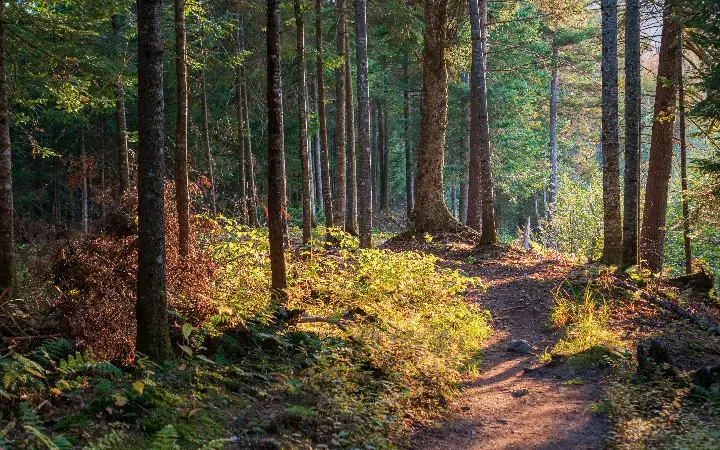
Have you noticed how differently silence feels when tires leave pavement?
That difference is not only emotional. It is mechanical recognition. Road noise falls away, and in that quiet you can sense the little corrections more clearly: the faint hiss of grit, the softer steering, the way your arms and trunk stay awake. The ride feels calmer to the ear while becoming busier to the body.
So is trail riding always harder? Not that simple.
This does not mean every trail ride is harder than every road ride. A smooth rail trail or well-packed gravel path can be easier than a windy road ride with climbs, traffic stress, and long sustained efforts. Fitness, tire width, tire pressure, bike fit, technical skill, and pace all matter.
That honest middle is worth keeping. Road riding can be much more demanding when speed stays high or climbing is constant. The point here is narrower, and more useful: a calm-looking off-pavement ride can hide higher stabilization and resistance costs than you expect from the visual softness of the setting.
A very ordinary rider example makes this plain. Someone rolls out for an hour expecting the dirt option to be a recovery spin because there are no cars and no hard climbs. Twenty minutes later, average speed is down, heart rate may not look alarming, but the forearms feel lightly used, the core feels present, and the legs are doing more stop-start pushing than smooth cruising. That is not poor fitness. That is the surface charging in a different currency.
How to make the ride feel better without turning it into homework
1. Match your expectation to the surface, not the scenery. If you leave pavement, assume your average speed will drop and your effort may spread into more of your body. That one mental adjustment prevents the common mistake of pushing too hard early because the bike is moving slower than your road brain expects.
2. Let the bike move a little under you. Many recreational riders get tired off pavement because they stiffen first and ride second. Softer elbows, a light grip, and a small bend through the knees let the bike track over uneven ground without sending every twitch into your shoulders and lower back.
3. If your setup allows it, use tire pressure appropriate for the surface rather than road-hard pressure on dirt. Lower pressure within the safe range for your tire and rider weight can improve grip and comfort, which reduces some correction work. This is not gear shopping; it is energy management.
4. Pace the first ten minutes like a transition, not a continuation of the road. Give your eyes time to adjust to line choice and your body time to settle into the new pattern. Riders often feel better simply by entering dirt one gear easier and one notch calmer.
The reward hiding inside the extra work
A forest trail ride works differently than a road ride because the surface asks more of balance, attention, and momentum than the eye first admits. Once you understand that, the effort stops feeling mysterious. It becomes readable.
And that is the reassuring part. The ride is not betraying you when it feels harder than it looks; it is just asking for a different contract. Choose a slightly easier pace, let your posture stay supple, and expect the ground to take a little more than pavement would.
Then the extra work can become part of the pleasure: a steadier mind, a more awake body, and the quiet satisfaction of moving well through a surface that does not give everything away for free.