More Than Half the World Depends on a Grain Often Grown Like This

Rice is not a minor side dish dressed up by pretty scenery. The UN Food and Agriculture Organization and the International Rice Research Institute both state in plain terms that rice is a staple food for more than half the world’s population, which is another way of saying that on any ordinary day billions of meals lean on one grain and the water, soil, and hands that raise it on hillsides like these.
عرض النقاط الرئيسية
- Rice is a staple food for more than half the world’s population, making it one of the most important daily foods on earth.
- Terraced rice fields show how hillsides are engineered into shallow steps that can hold and control water.
- Successful rice growing depends on timing, water management, and repeated human decisions throughout the season.
- ADVERTISEMENT
- A failure in one terrace or channel can affect the fields below, showing how interconnected the system is.
- Rice may seem simple at mealtime, but it rests on constant labor such as planting, clearing channels, repairing bunds, and harvesting on schedule.
- Not all rice is grown on terraces, yet terraces make visible the broader truth that rice production always depends on shaped land, secured water, and ongoing care.
- The article’s central lesson is that an ordinary bowl of rice carries a quiet link between family, field, and the patient work of feeding others.
My niece grew up in an apartment where dinner came in paper cartons or neat plastic trays, so when she first walked here with me she thought the paddies were only beautiful. I told her beauty is the outer rim of the bowl. Step down a little and you start to see the work that keeps it full.
قراءة مقترحة
The grain that looks simple because the hard part is elsewhere
Rice feels ordinary partly because it arrives finished. White or brown, steamed or packed into a lunch, it asks very little from the person eating it. But before it reaches a kitchen, it asks for level ground where there was none, for water that can be slowed, held, and released, and for people who know the right day to flood, plant, weed, and harvest.
Walk the terrace path and the big number from FAO and IRRI stops being abstract. A hill is cut into steps so shallow fields can hold water. Mud walls must stand. Small channels must stay clear. If one section fails, the trouble does not stay politely in one place; it moves downhill.
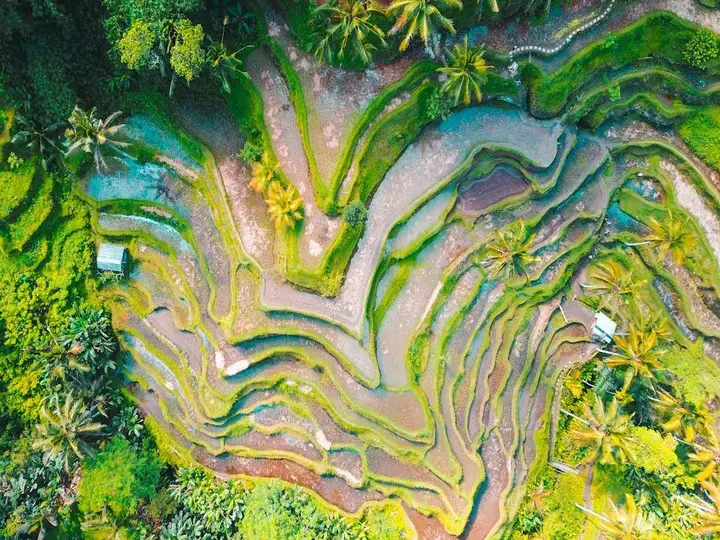
What you hear first is not machinery but the soft, continuous trickle of water slipping from one rice terrace to the next. It is a small sound, almost shy, yet the whole system depends on it. Stand still long enough and your body understands before your mind does: this grain grows inside managed water.
That is why terraces matter beyond their shape. They turn steep ground into a chain of holding bowls. Each one borrows from the one above it and steadies the one below. A meal that seems cheap and plain is often supported by engineering so modest in appearance that city people mistake it for nature.
Rice is grown in many conditions, from rainfed lowlands to highly mechanized plains, and yields differ widely by region and method. Even so, the basic truth holds: whether the field is terraced by hand or laser-leveled by machine, rice depends on timing, water control, and repeated human decisions.
When was the last time a meal this ordinary asked so much of a landscape?
That is the turn, I think. My niece stopped looking only outward and began looking downward, at the narrow bank under her shoes, at the channel cut beside it, at the wet earth held in place because someone repaired it again and again.
What your last bowl of rice was really resting on
Start with scale. More than half the world eats this grain as part of daily life.
Then water. Rice, especially in flooded systems, relies on careful management rather than simple abundance. Too little at the wrong time hurts the crop. Too much in the wrong place breaks a field.
Then labor. Seedlings are transplanted or sown. Bunds are patched. Weeds are checked. Channels are cleared. Harvest comes on a schedule the field, not the clock, decides.
Then upkeep. Terraces do not stay terraces because they are old. They stay because people keep returning with tools, feet, and attention. Repetition is the hidden structure of the meal.
This is the part many of us miss. We talk about food as if it begins at the store shelf, or we talk about the planet in such large terms that nothing feels touchable. Rice sits between those habits. It is intimate enough to fit in a bowl and large enough to tie billions of lives to irrigation, seasons, and inherited knowledge.
If not every grain comes from terraces, why look here at all?
It is fair to say not all rice is grown on stepped hillsides, and not every rice-growing place looks like this one. Much of the world’s rice comes from flat lowlands, and a great deal of it is produced with modern machinery, purchased inputs, and large irrigation works. The point is not that terraces are pure and everything else is lesser.
The point is dependence. A terraced hillside makes dependence visible. You can see the water being handed down. You can see that flatness has been built, not given. You can see that one family’s patch of field often makes sense only as part of a shared system above and below it.
That visibility is useful in a hurried age. It reminds us that ordinary food does not come from nowhere, even when production is industrial, even when the field is broad and mechanized instead of stepped and narrow. Land must still be shaped or managed. Water must still be secured. Someone must still decide, watch, and repair.
My niece asked me which part was hardest. I told her it is usually not one dramatic task. It is the return. Coming back to clear a blockage after rain. Coming back to check the seedlings. Coming back because if you skip the small care, the field remembers.
The quiet thing an ordinary meal can teach you
A hillside of rice holds more than grain. It holds stored water, patient shaping of earth, and the memory of people who learned that feeding others is often a matter of small acts done on time. That is true here, and in different forms it is true far beyond here.
The next time rice lands on your plate, you do not need to perform gratitude or turn dinner into a lecture. Just pause long enough to remember that a food this common still depends on managed ground, moving water, and somebody’s repeated care.
That, more than anything, is what these steps keep for us: the plain old link between family, field, and the meal that waits at the end of the day.