Fewer Seats, More Capacity: The Number Behind the Modern Bus Interior

You step onto a newer bus, notice the missing seats, assume somebody shaved comfort out of the service to save money—but the real reason is often almost the opposite. Fewer seats can mean more passengers overall.
عرض النقاط الرئيسية
- Fewer seats do not necessarily mean lower capacity, because usable standing and circulation space can let a bus carry more passengers overall.
- Modern bus interiors are designed to reduce aisle congestion and make boarding, exiting, and moving inside the vehicle easier.
- Open multi-use areas can shift between standing room, wheelchair space, stroller space, and shopping trolley space depending on demand.
- ADVERTISEMENT
- Transit capacity standards measure both seated and standing passengers, not seat count alone.
- Low-floor layouts and clearer door areas help reduce dwell time by speeding up boarding and improving interior flow.
- Accessibility rules often require wheelchair securement areas and clear paths, which usually means sacrificing some fixed seating.
- Removing seats without protecting priority seating, grab rails, and rider comfort is poor design, but thoughtful space reallocation can make buses work better for more people.
That sounds like transit-planner wordplay until you ride the same route long enough to see where the bus actually fails. It usually is not at the moment every seat is taken. It is when people cannot get past each other.
If you have had this thought, you are not being fussy. A bus with fewer places to sit can feel like a cut, especially after a long day, with shopping bags, with a child, or with knees that prefer not to negotiate every corner standing up.
But seat count and passenger capacity are not the same measure. Modern bus interiors are built around a trade: less fixed furniture, more usable room for the mix of bodies and devices that now board through the day.
قراءة مقترحة
It looks emptier because the old clutter is gone
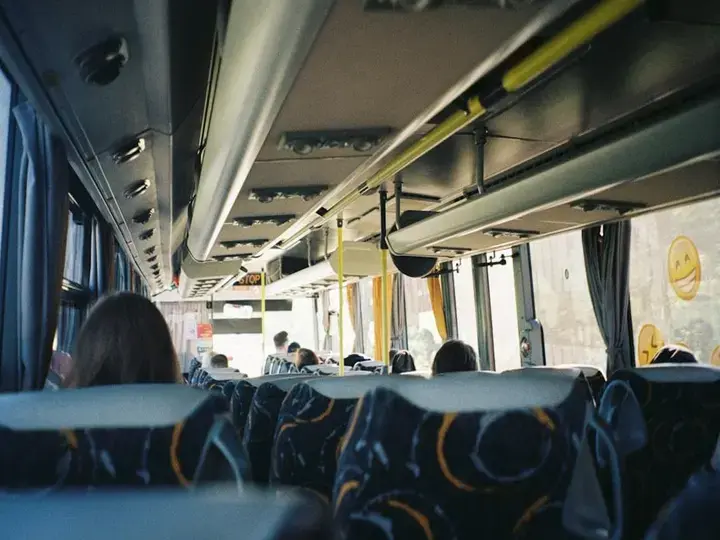
Walk your eye down one of these buses and the subtraction is obvious. Fewer forward-facing rows. Wider aisle. Open area near the door. Fold-up seats where a solid bench used to be. Marked space that seems, at first glance, to be doing nothing.
Then the bus leans into a turn and you hear the rubbery squeak of shoe soles shifting on the textured floor. That little chorus tells the truth of the design. The bus is not only carrying seated bodies. It is carrying entering, exiting, balancing, turning, parking a stroller, positioning a walker, and making room at the exact same time.
So why does a bus with less furniture sometimes carry more people?
Because an occupied seat uses a fixed footprint whether the bus is quiet at noon or packed at school dismissal. Open floor can change jobs from stop to stop. In the peak it becomes standing space. On the next block it becomes a wheelchair bay. Two stops later it is stroller room, shopping-trolley room, or simply the difference between a smooth exit and an aisle jam.
The number that matters is not seats but usable space
This is not just design-fashion talk. The Transit Capacity and Quality of Service Manual published by the Transportation Research Board in 2013 treats bus capacity as a mix of seated and standing passengers, not seat count alone. In plain bus-rider English: a full bus is measured by how many people it can carry safely and reasonably, not by whether each person gets a dedicated chair.
Research on low-floor buses reached the same general conclusion years earlier. A 2000 study by the European Conference of Ministers of Transport on accessible public transport, drawing on operating experience across multiple systems, described low-floor layouts as cutting boarding barriers and reducing stop delays because passengers using wheelchairs, walkers, or strollers could board and position themselves more directly. Same bus, less interior wrestling.
You can see the arithmetic without needing a spreadsheet. Two seats fix two people into one shape. An open zone can hold several standing riders in the rush, then flex to one wheelchair user secured safely, then back again.
That is the part that sounds backwards the first time you hear it: fewer seats can feel like less bus. In practice, fewer seats can mean more bus, because transit capacity is about total usable passenger space plus how quickly people can move through it.
Where the missing seats quietly start earning their keep
First comes standing room. In crowded periods, standing passengers do not need a whole seat module around them. They need floor area, stable grab points, and enough clearance that one person stopping near the front door does not block half the vehicle.
Then comes the multi-use zone. Those fold-up seats by the door can look stingy when they are upright and empty. They make more sense the moment a wheelchair user boards, or a parent angles in with a stroller instead of trying to wedge it into a narrow aisle like an apology on wheels.
Accessibility guidance pushes this design in a very direct way. In the United States, the ADA accessibility specifications for buses require a wheelchair securement area and a clear path to it. In Britain, similar guidance from the Department for Transport and PSV Accessibility Regulations has long required dedicated wheelchair space and layout choices that allow access to it. That space has to come from somewhere, and usually it comes from fixed seating.
Then there is boarding speed. Low-floor buses with wider, clearer door areas reduce dwell time, the transit term for the seconds a bus spends stopped while people get on and off. Those seconds sound small until they stack across a whole route.
The International Association of Public Transport, UITP, has repeatedly pointed to level boarding and better interior circulation as part of faster, more reliable bus operation. Plainly put: if passengers can enter, pay or tap, move inward, and exit without a knot forming at the doorway, the line keeps moving.
Picture your own route at the exact point it goes wrong
Try a small test on your next ride. Do people on your route get stuck because there are too few seats, or because the front door area clogs while someone is trying to move to the wheelchair bay, the stroller space, or the rear exit?
Here is the scene I keep seeing. A parent boards with a stroller. One standing rider steps sideways into the open area instead of pinning everyone in place. Someone near the back slips out through the rear door. The bus stops, reshuffles, and starts again without that old aisle drama where every body has to negotiate around seat corners.
That is what the cleared aisle buys. Not elegance. Not minimalism. A little less friction at the exact places transit systems usually lose time and patience.
Yes, but what if you are the person who needs the seat?
This is the honest limit. A more open bus interior does not feel better for everyone. If you cannot stand long, are carrying heavy bags, are older, are pregnant, are traveling with children, or ride on rough streets where every lurch travels straight up your spine, a missing seat is not an abstract planning trade. It is a real loss in comfort.
That is why good design cannot mean seat removal alone. It has to include clear priority seating near the door, grab rails placed where actual hands can reach them, enough legible space for mobility devices, and ride quality steady enough that standing does not become its own punishment.
Jarrett Walker, the transit planner and author of Human Transit, has made this point for years in plain terms: frequency, speed, and capacity matter at the network level, but vehicles still have to work for human bodies as they are. A smart bus is not one that eliminates seats. It is one that uses seats carefully while protecting circulation and access.
So the complaint is partly right. If an agency strips seats without thinking about who rides, that is bad design. If it reallocates space so more people can board, move, and fit—including riders with wheelchairs and strollers—that is a better use of the same box on wheels.
The bus is doing two jobs at once
Older bus interiors were better at one clear thing: giving a tidy row of places to sit. Newer ones are trying to do that and also handle surges, mobility devices, shopping carts, walkers, parents with children, and faster stop-by-stop movement. The result can look barer than it is useful.
That is the quiet irony of the modern bus. It can seem as if something has been taken away when what was really removed was one kind of blockage. Less furniture, more room for the part of transit that happens between the seats.
So next time you board and notice the missing row, look at where people get stuck, not just where they sit. The emptier-looking bus is often making space for more passengers and more kinds of movement, and once you see that, the ride makes a little more sense.