It Looks Hand-Painted, but This Leaf Beetle Is a Plant-Eating Specialist

It may look like a tiny piece of decoration, but this kind of beetle is, in plain garden terms, a plant-eater built for the job, and the proof is usually right there on the leaf as much as on the insect.
That matters because people often sort insects too quickly into two boxes: pretty or pest. Leaf beetles upset that neat split. Many are both attractive and highly effective herbivores, with bodies and habits that make more sense once you stop reading them as ornament and start reading them as evidence.
Recommend
A good plain-language place to start is university extension advice on bean leaf beetles. Iowa State University Extension and Outreach describes the bean leaf beetle as a member of the leaf beetle family, Chrysomelidae, that feeds on soybean and bean plants and leaves visible chewing injury. That family context is useful even when you are not naming the exact species, because it tells you what sort of animal you may be looking at: not a random visitor, but often a leaf-focused feeder.
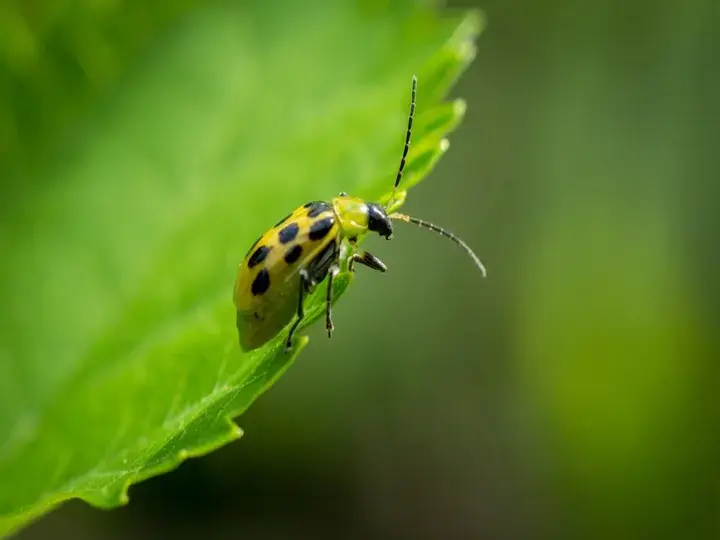
The pretty little bug is often eating before you notice it
I have seen this play out in backyards many times. A neighbor calls me over to admire a small striped beetle on beans or another tender plant, and at first the insect gets all the attention. Then the eye drops a few inches. Small rounded holes. Nibbled edges. A patch that looks thinned or scraped.
That is the first useful shift: look at the plant as hard as you look at the beetle. Leaf beetles tend to be compact, with a smooth, rounded body that sits close to the leaf surface. They are not built like long-legged wanderers or narrow-bodied hunters. They look settled there, because feeding there is often the point.
The antennae help, too, though only a little. They are usually modest rather than dramatic, and the mouthparts are chewing mouthparts, made for taking tissue, not sipping nectar. You may not see the jaws plainly without magnification, but you can often see the result: clean bites from leaf edges, little holes through softer tissue, or a skeletonized patch where green material has been removed and veins remain.
The bigger clue is repeat presence. If you keep finding the same kind of beetle on the same kind of plant, that is not just scenery. Many leaf beetles are tied closely to host plants or host groups. In other words, the plant under the beetle is not background. It is part of the ID.
Would you have guessed this was a specialist eater?
Would you have guessed that a beetle with such neat patterning was more likely a specialist herbivore than just a pretty pattern with legs?
This is where the whole insect turns. What looks decorative is often functional. In leaf beetles, beauty and appetite are not opposite ideas. The tidy shell, the close fit to the leaf, the repeated return to one host plant, and the style of damage all point in the same direction: a small animal closely matched to a food source.
Host plant + feeding marks
For many leaf beetles, that pairing can tell you more than color pattern alone.
That match is the real aha. Many leaf beetles do not feed broadly on whatever green thing happens to be nearby. They are often associated with particular plants or plant families. Field guides and extension pages use host plant information for a reason. Finding a beetle on the right plant can be as informative as the stripes on its back.
How to tell when it is more than a random leaf landing
You can read the situation as a short field sequence rather than a guess based on looks alone.
A simple way to read a leaf beetle in the field
Start with the host plant
If the beetle keeps appearing on beans, soybeans, willow, elm, milkweed, or another plant repeatedly, that repeat visit matters.
Check for feeding damage
Rounded holes, chewed margins, and skeletonized surfaces suggest the plant is being used, not just visited.
Read the body shape
A small, oval or rounded body that sits close to the leaf fits a foliage-feeding life.
Add family context
Once Chrysomelidae is in the picture, repeated host use is easier to interpret as part of a plant-feeding story.
Here is a simple self-check. If you see the beetle repeatedly on the same host plant and you also see rounded holes or skeletonized feeding marks, consider specialization before assuming it is a random visitor.
A fair warning before you name it too fast
There is an honest limit here: pattern alone is not enough for species ID, and not every small striped beetle on a leaf is the same insect. Several beetles can look similar at a glance. Some are only distantly related. Others share colors but feed in different ways.
And yes, many insects do land on many plants. Wind, chance, and simple wandering all happen. A beetle on a leaf once is not a case solved.
That is why the best reading comes from combining clues rather than trusting one. Host plant. Repeat presence. Body form. Feeding marks. Family context. Put those together and the insect stops being a mystery ornament and starts reading like a specialist at work.
What to avoid assuming too quickly
A small striped beetle on a leaf can be identified by pattern alone, and one sighting tells you what it is doing.
A better reading combines host plant, repeat presence, body form, feeding marks, and family context before you call it a specialist feeder.
For gardeners, that is a calmer and smarter way to look. You do not have to leap straight to “pest,” and you do not have to settle for “pretty bug.” You can ask a better question: what is this beetle doing here, and what on the plant proves it?
The field habit that makes these beetles easier to understand
When you find one of these hand-painted-looking beetles, spend your extra ten seconds on the leaf itself: host choice and chewing marks usually explain the beetle better than color ever will.