Reflective Towers Aren’t Just About Looks

What looks like decoration is actually a design tool: those mirrored surfaces are not simply making a tower look modern; they are making it appear larger, less graspable, and more powerful before your brain has time to measure it.
عرض النقاط الرئيسية
- Reflective glass makes buildings appear larger and more powerful by weakening clear visual boundaries.
- Human vision relies on edges, borders, and contrast to judge size and distance quickly.
- Vertical lines such as mullions and seams guide the eye upward and intensify the feeling of height.
- ADVERTISEMENT
- Mirrored facades borrow the sky and surrounding buildings, making towers feel less fixed and more untouchable.
- Repetitive curtain-wall grids remove human-scale cues like balconies, ornament, and visible details.
- The combined effect of blurred edges, vertical pull, and repetition creates a fast impression of authority and awe.
- Weather, street width, viewing angle, and personal response can change how strongly a glass tower feels imposing.
That feeling you get on the sidewalk is not random. Reflective glass often performs scale and power. It changes how you read edges, height, and distance in the first second of looking.
Architects and perception researchers have been circling this for years. In 1974, environmental psychologist Colin Ellard and others had not yet done the work he is known for, but later research in his 2015 book Places of the Heart and related environmental psychology writing made the same plain point: buildings shape bodily response fast, often before conscious thought catches up. In architecture itself, Rudolf Arnheim argued in The Dynamics of Architectural Form in 1977 that people read size, weight, and dominance through visible cues such as direction, repetition, and contrast, not by calculating dimensions like surveyors.
قراءة مقترحة
Why the glass edge keeps slipping away
Start with the surface. A matte building gives your eye a boundary. You can tell where wall stops and sky starts.
Mirrored glass weakens that boundary. It throws back clouds, neighboring facades, and light, so the tower stops reading as one clean object. Your eye has less to grab.
That matters because human vision uses edges to judge size and distance. Vision scientist James J. Gibson wrote in The Ecological Approach to Visual Perception in 1979 that surfaces, borders, and contrast are basic cues for how we orient ourselves in space. When the border gets visually unstable, the object can feel harder to size up. On a city block, “harder to size up” often turns into “bigger than I can comfortably read.”
This is the first trick of engineered awe. The tower does not only stand there. It borrows the sky and nearby buildings, and that makes its mass feel less fixed.
Then the lines take over your neck
The second mechanism is simpler and stronger: vertical pull. Long uninterrupted mullions, narrow window bands, and corner seams act like arrows for the eye.
You do not inspect them one by one. You follow them upward. Arnheim wrote that vertical orientation carries a strong perceptual charge because it directs attention against gravity. On the street, that means the facade is not just tall. It is actively teaching your eye how to climb it.
Older towers often interrupt that climb with cornices, setbacks, balconies, or ornament. Many glass towers do the opposite. They reduce sideways distractions, so your eye keeps rising with fewer places to rest.
Now imagine standing at street level and looking straight up.
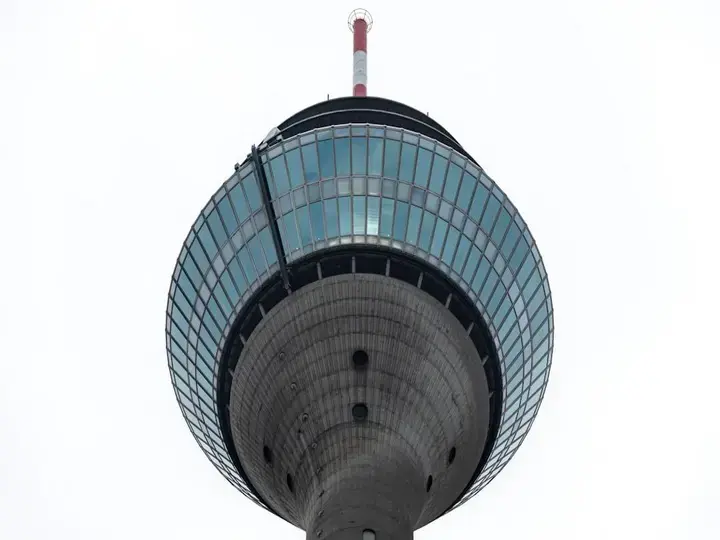
Your head tips back. The sky breaks into sharp blue fragments across the mirrored facade. The building starts carrying pieces of the world around it instead of looking like one heavy block of its own.
That is the hinge. When a surface behaves like borrowed sky, your eye struggles to read where the building ends. The tower can feel larger, colder, and more untouchable than its physical outline alone would suggest.
The quiet grid that erases human scale
The third mechanism is repetition. Floor after floor, panel after panel, bay after bay: the same shape comes back with machine-like regularity.
Repetition sounds harmless until you notice what it removes. It strips out clues tied to the body. A balcony hints at a person stepping outside. An ornate doorway hints at a hand, a face, a pace of walking. A smooth repeating curtain wall gives you fewer of those anchors, so the building reads in modules instead of rooms or lives.
Architectural theorist Nikos Salingaros has written about how people respond more comfortably to buildings with visible scaling levels and detail that connect large form to human size. When those middle-scale cues disappear, very large buildings can feel more remote and imposing. That does not make them bad. It does explain why some towers seem to deny you a foothold with your eyes.
Put the three moves together and the effect stacks fast. Reflection blurs edges. Vertical lines pull your eye upward. Repeated geometry suppresses human scale. From the sidewalk, that combination reads as authority before it reads as material.
A quick street test you can try today
Stand where you can see two tall buildings from about the same distance. Pick one with a reflective glass facade and one that looks more matte or broken up by balconies, masonry, or ornament.
Do not check the height first. Just notice which one feels taller in the first second. Then look for the three cues: slippery edges, upward lines, repeated modules. After that, check the actual heights if you can. The point is not to catch yourself being wrong. The point is to feel how fast design gets there before measurement does.
No, this is not a mind-control theory
To be fair, glass is often chosen for reasons that have nothing to do with dominance. It can fit a developer’s brand, match a current style, speed up curtain-wall construction, or help with daylight depending on the system. Not every shiny tower is trying to intimidate you.
But intent and effect are different questions. A building does not need a secret psychological mission to dominate perception. If its facade weakens edges, its lines pull upward, and its geometry wipes out human scale, people can still feel awe, coldness, or distance on contact.
This effect also does not hit everyone the same way. Weather changes reflection. A narrow street can intensify height. A wide plaza can soften it. Crowds, trees, shadows, and your viewing angle all matter. Some people read mirrored towers as thrilling; others read them as sterile. The design logic is real either way.
Once you see the trick, the block changes
So if a glass tower makes you feel small or slightly shut out, that is not a personal failure to “get” architecture. Your eyes are picking up a set of cues that designers and theorists have understood for a long time, even if most of us were never taught the language for it.
Next time, look for three things before you decide how a tower makes you feel: reflection that steals the edge, vertical pull that lifts your gaze, and repetition that hides human scale. Those are the sidewalk clues.
Once you notice them, the skyline stops acting like a mute wall of glass and starts talking back in a way you can actually read.