Why Dual Sticks Still Rule 3D Games

What feels natural about dual-stick control is actually not hand symmetry, but job separation: in most 3D games, one thumb handles going somewhere and the other handles looking somewhere, which is why some games click the instant you touch them and others feel weirdly slippery.
عرض النقاط الرئيسية
- Dual-stick control works because one thumb handles movement while the other handles camera and orientation.
- In 3D games, players constantly update locomotion and viewpoint at the same time rather than performing one single control task.
- Games feel intuitive when movement stays readable on the left stick and visual framing stays readable on the right stick.
- ADVERTISEMENT
- Research on two-handed input and bimanual coordination supports the idea that separate hand roles are learnable and effective.
- The standard control layout emerged gradually as 3D games exposed the limits of single-stick movement with button-based camera control.
- Bad acceleration, dead zones, or camera tuning can break the clean split between body control and perception, making a game feel wrong.
- Dual sticks remain dominant not because they are perfect, but because they turn a complex 3D problem into two manageable thumb-sized tasks.
If you have played for years on modern pads, you already know this in your hands. You push forward with the left thumb, sweep the camera with the right, and your brain treats that split as ordinary. It is ordinary now. But it was learned, and it works for a reason.
The moment your thumbs stop doing one thing
Think about a simple room entry in a third-person game. You tilt the left stick forward to move through the doorway. At the same time, your right thumb nudges the camera right because you want to see around a column, check an enemy lane, or keep your character framed cleanly.
قراءة مقترحة
Then the little corrections start. You angle left to avoid clipping the wall. You pull the camera back a touch. You re-center after the turn. If aiming matters, you make one more tiny adjustment with the right stick while still moving with the left.
Slow that down and the hidden logic shows up. You are not doing one big thing called control. You are doing two ongoing things at once: moving the body through space, and pointing perception through space.
That is the real split. Body here. View there. The controller feels right when each thumb gets one of those jobs.
Try a quick self-check. Hold a controller if one is nearby, or just mime it with your hands. Now imagine walking forward with the left stick while sweeping the camera with the right, then compare that with trying to move and look with one input. The second version usually feels like taking turns with your own attention.
Why that room-entry moment explains so much
The reason dual sticks settled in is that 3D play keeps asking for parallel updates. Move, look, adjust, correct, anticipate. One thumb handles locomotion. One manages orientation. Both refresh constantly.
This is where a lot of “good feel” lives. A game feels intuitive when the left stick gives you a stable sense of where your character is going, while the right stick gives you a stable sense of what matters around them. When those jobs bleed into each other, the game can feel mushy even if the inputs are technically responsive.
Human-factors research points in the same direction, even if it was not written for games. A 2004 review by R. S. Balakrishnan and colleagues in the journal ACM Computing Surveys pulled together work on two-handed input in human-computer interaction and found that people often do well when each hand supports a different role rather than duplicating the same fine task. That literature often describes one hand setting context while the other refines action. The limit is obvious: a mouse, stylus, or lab task is not a console shooter or action game. Still, the pattern fits what players do with two sticks surprisingly well.
Motor-control researchers have also long noted that our hands can perform partly separate tasks at the same time, though not without practice. A classic 1987 paper by Guido Swinnen and colleagues in the Journal of Experimental Psychology looked at bimanual coordination and showed that people can split hand actions, but some pairings are easier than others and training matters. Again, that is not a gamepad study. But it helps explain why dual sticks feel learnable rather than magically innate.
The history was messy, which makes the result more interesting
So when did this become the default? Not all at once. Nintendo’s 1996 Nintendo 64 pad gave players one analog stick and often pushed camera control onto buttons, with games like Super Mario 64 using the C buttons for view changes. It worked, but it also exposed the problem: 3D games kept asking players to move and manage viewpoint at the same time.
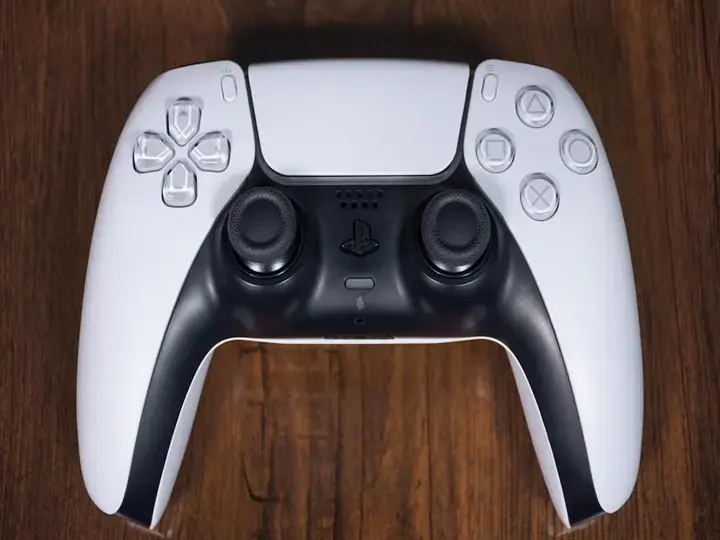
Sony’s answer arrived in 1997 with the original Dual Analog Controller, followed by the DualShock. Two sticks on one pad did not instantly solve every design problem, but it gave developers a hardware layout that matched the two-job split much more directly. By the PlayStation 2 and Xbox era, first- and third-person 3D games were increasingly built around left-stick movement and right-stick camera control because developers could count on players having those inputs.
You can hear that shift in plain language from developers themselves. In interviews collected around the making of Halo and other early console shooters, designers repeatedly talked about one stick for movement and one for looking as the key to making 3D control workable on a couch with a pad. The exact tuning varied a lot, but the layout itself became a shared assumption.
That shared assumption changed players too. Once enough games taught the same split, your thumbs built a habit library. But habit alone does not explain why one bad camera still annoys you instantly. Your body is not just recalling a standard. It is noticing when the two jobs are being assigned poorly.
The real aha: you are steering a body and a viewpoint, not one thing
This is the point where “natural” starts to mean something different. Dual sticks do not feel normal because humans were born wanting two tiny thumb levers. They feel normal because 3D games ask for a split between where the character goes and where attention points.
That is why the same control scheme can feel great in one game and awful in another. If the left stick has too much acceleration, your body feels detached. If the right stick has strange dead zones, inconsistent sensitivity, or a camera that fights your intent, your perception feels detached. Either way, one thumb has lost its clean job.
A useful test, the next time a game feels off, is to stop blaming “the controls” as one blob. Ask two separate questions instead. Does the left stick make movement readable? Does the right stick make orientation readable? You will often find the problem much faster.
This also explains why camera options matter so much. Invert Y, sensitivity sliders, aim assist, snap-back rules, and dead-zone settings are not side dishes. They are repairs and refinements for the right thumb’s workload.
Hard cut: dual sticks are also an awkward compromise. They were shaped by hardware limits, TV distance, genre convention, and the lack of a better mass-market input that was cheap, durable, and easy to standardize. Keyboard and mouse can beat them for precision. Motion controls can feel more direct in some cases. Accessibility remaps can blow up the whole default and make a game far better for a specific player. And some genres barely need dual-stick logic at all.
But that is exactly why their staying power means something. A compromise does not survive for decades just because people are stubborn. It survives because, flawed as it is, it maps well onto a durable fact about 3D play: moving through space and aiming your view through space are separate tasks that need constant, parallel attention.
When the default works—and when it plainly doesn’t
This setup does not work equally well for every genre, player, disability profile, or camera model. A fixed-camera survival horror game asks less from the right stick. A strategy game may care more about cursor movement than embodied movement. Some players do better with gyro aim, remapped sticks, one-handed controllers, back paddles, or mouse and keyboard.
That does not weaken the main point. It sharpens it. The best scheme is the one that gives each ongoing job a clear home for the player actually holding the device.
You can feel the difference almost immediately. In a well-tuned action game, the left thumb commits to motion while the right thumb scouts, frames, tracks, and recenters without drama. In a bad one, each thumb keeps cleaning up for the other.
So the practical takeaway is simple. On your next game, notice whether each thumb has a clean job. If movement and looking stay distinct, the game will probably feel fair even before you master it. If those jobs tangle together, you will feel friction long before you can name the setting that caused it.
You already learned this years ago without needing the words. Dual sticks still rule 3D games not because they were destined to, but because they turn a messy 3D problem into two thumb-sized tasks your hands can actually live with.