The Design Trick Hiding in Old Railway Viaducts

The Nine Arch Bridge near Ella and Demodara looks graceful not because someone set out to make a pretty monument, but because an old railway had to solve a hard problem well: carry a train out of a tunnel, around a bend, and across a ravine on stone arches that could take weight again and again.
عرض النقاط الرئيسية
- The Nine Arch Bridge near Ella and Demodara is a colonial-era stone and brick railway viaduct known for its nine arches and curved alignment.
- Its beauty comes less from decoration and more from how smoothly it carries a train from tunnel to bend to ravine crossing.
- The bridge’s masonry arches work well because stone is strong in compression and channels heavy train loads safely downward.
- ADVERTISEMENT
- The curve of the track is as important as the arches because it creates a steady, manageable railway path across difficult hillside terrain.
- What tourists see in seconds reflects decades of maintenance, weathering, inspections, and repeated safe load-bearing.
- The bridge feels visually satisfying because the geometry of movement above and structural support below work together without conflict.
- Nine Arch Bridge stands out as both a scenic landmark and a durable piece of railway infrastructure whose good looks come from doing a hard job well.
Most visitors meet it first as a scenic stop in Sri Lanka’s hill country. That is fair enough. You do not need any engineering at all to enjoy it. But once you know what the bridge is doing, your eye starts noticing a different kind of beauty.
My nephew, who thinks I turn every outing into a lecture, would call that suspicious. I call it paying attention. Look at the curve and ask yourself something simple: does this feel beautiful because it is decorated, or because it looks stable enough to trust?
قراءة مقترحة
Why the bridge feels better than a normal viewpoint
Here is the plain fact first. The Nine Arch Bridge is a colonial-era railway viaduct in Sri Lanka, commonly described as having nine arches, built in stone and brick rather than steel. It sits on the line through the tea country near Ella, and it has lasted long enough to become one of the island’s best-known railway sights.
Its appeal is not only that a train passes over it. Plenty of bridges carry trains. This one satisfies the eye because the track does not arrive with a jolt, then leave with a jolt. It follows a continuous curve, and the arches below repeat that calm logic instead of fighting it.
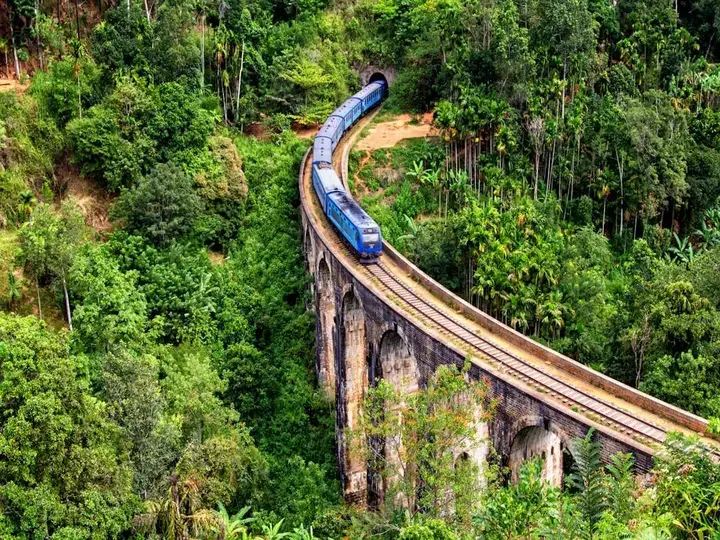
That is the trick hiding in old railway viaducts. The line has to guide heavy vehicles smoothly. The structure underneath has to send that weight down into the ground. When both jobs are solved cleanly, the result can look almost effortless.
The engineering secret is not decoration
My nephew usually says, “It is just an old bridge.” Fair point. But railways are fussy things. Trains do not like sudden changes in direction or sharp rises and dips, so route builders work hard to create a manageable path. On a hillside, that often means cutting a tunnel, then carrying the track across open ground at nearly the same level.
Now add the weight. A train does not press on a bridge in one dramatic burst and then disappear from the engineer’s mind. Every axle loads the rails. The rails pass that force into the deck. The deck passes it into the arches. The arches push it outward and downward into the piers, and from there into the foundations.
Stone is well suited to this kind of work because it is strong in compression, which means it handles being squeezed far better than being pulled apart. An arch takes advantage of that. Instead of trying to span space with a flat piece that wants to bend, it turns the load into compressive force moving through the curve of the masonry.
Short version: curve above, arches below, force moving down. That is why the bridge looks composed. The shape is not pretending.
Engineers have explained this for a long time in language less friendly than mine. The Institution of Civil Engineers, in its public material on masonry arches, makes the same basic point: these bridges endure because their shape keeps loads in compression when they are maintained properly. The handsome part and the hardworking part are the same part.
The few seconds tourists see—and the decades they do not
Stand at the lookout and the whole event is over quickly. A train slips out of the tunnel, takes the bend, crosses the viaduct, and the crowd gets its moment.
Then cut the timescale open.
That brief crossing is riding on decades of stored labor: every monsoon, every damp season, every spell of heat, every inspection, every repair to mortar, drainage, track, or masonry. What looks light in one passing instant is actually a structure that has spent year after year taking repeated loads and sending them safely through the same old paths of force.
That is the midpoint most visitors miss. The graceful moment is not fragile. It is accumulated survival.
Why the curve matters as much as the arches
My nephew once said the arches were doing all the famous work. Not quite. The alignment matters too. A railway curve is never just a flourish. It helps the line fit the ground without forcing an abrupt change that would make operation rougher and engineering harder.
On this bridge, the curve and the viaduct belong to the same idea. The track needs a steady path from tunnel to hillside. The arches need regular spacing and support points that can carry that path. Seen together, they make the crossing feel coherent, which is another word for believable.
If you want a small self-check, ignore the fame for a second and watch only the geometry. The scene works because your eye can follow one line of travel and one line of support without hitting a visual argument. You are seeing alignment above and compression below.
Is this just clever talk over a pretty place?
It is worth asking. People do project meaning onto travel landmarks all the time. Sometimes a place is simply pleasant, and that is enough.
But this is not engineering poetry pasted onto a postcard. The satisfaction here matches real physical logic. Trains need a smooth route. Masonry arches handle compressive loads well. Repetition spreads forces through multiple supports. Long survival in wet tropical conditions depends not on romance, but on sound form and continued maintenance.
Heritage agencies in Sri Lanka present the bridge as both an attraction and a working piece of railway history, which is the right balance. You can admire it as a view. You can also respect it as infrastructure that earned its good looks by doing a difficult job for a very long time.
What to notice the next time you are there
If you visit the Nine Arch Bridge, or even just watch a train cross in a video, do one small thing. Do not separate the curve from the arches. Watch them as one idea.
See how the line of the track asks for a steady crossing, then see how the masonry below answers that request. One carries movement. The other carries load. Together they make the bridge look easier than it is.
That, to my mind, is why this old viaduct stays with people. It looks effortless because so much effort has already been absorbed into its design. Next time you see it, watch the bend and the arches as a single thought, and you will feel less like a tourist at a viewpoint and more like someone who has been quietly let in on the secret.