Those Stacked Basalt Walls Come From Cooling, Then Cracking

What looks like a wall someone arranged by hand is actually cooled lava, and the order comes from a simple bit of physics: basalt shrinks as it cools, then breaks along repeating lines of stress instead of staying one solid mass.
عرض النقاط الرئيسية
- Basalt columns form when a thick mass of lava cools, contracts, and fractures instead of shrinking evenly.
- The columns are not stacked structures but the remaining pieces of one larger rock body split by joints.
- Polygonal sides, often five or six, develop because stress spreads through cooling rock in repeating patterns.
- ADVERTISEMENT
- Cooling speed, lava thickness, water, and later erosion all affect whether neat columns appear or remain hidden.
- Famous examples such as Giant's Causeway, Staffa, and sites in Iceland reveal columnar basalt after erosion exposes the fractures.
- The process is slow in overall cooling but fast in cracking, with fractures snapping forward in bursts as stress is released.
- Geologists can read cooling direction from the orientation of basalt columns because cracks tend to form at right angles to the cooling surface.
That is the first thing to hold onto. These stacked-looking rock faces were not laid like bricks. They organized themselves.
The U.S. Geological Survey explains columnar jointing this way: when a thick body of lava cools, it contracts, and that contraction produces fractures that often divide the rock into columns with polygonal sides, commonly five or six. In plain language, hot rock takes up more space than cool rock. When it loses heat, it tightens, and if it cannot shrink evenly, it cracks.
قراءة مقترحة
Why orderly rock starts as a single hot mass
Basalt is the dark volcanic rock made from fairly fluid lava. If a basalt flow is thick enough, or if magma cools in place below the surface, the outside loses heat first while the interior stays hot longer. That sets up stress inside the rock.
Picture one broad sheet of lava, not a pile of stones. As it cools, the sheet wants to contract. But each part is tugging against the parts beside it, so the strain cannot be relieved smoothly. The rock begins to fracture.
Geologists call those fractures joints. The columns are not things that grew upward like built pillars; they are the pieces left behind after one larger mass split apart. That is the bit many people miss on a first walk through basalt country.
A well-known example is the Giant's Causeway in Northern Ireland, where about 40,000 basalt columns were exposed by erosion after lava cooled and cracked around 60 million years ago. Another is Staffa in Scotland. Iceland has many of the same forms, because it has no shortage of basalt and no shortage of ways to cut it open later.
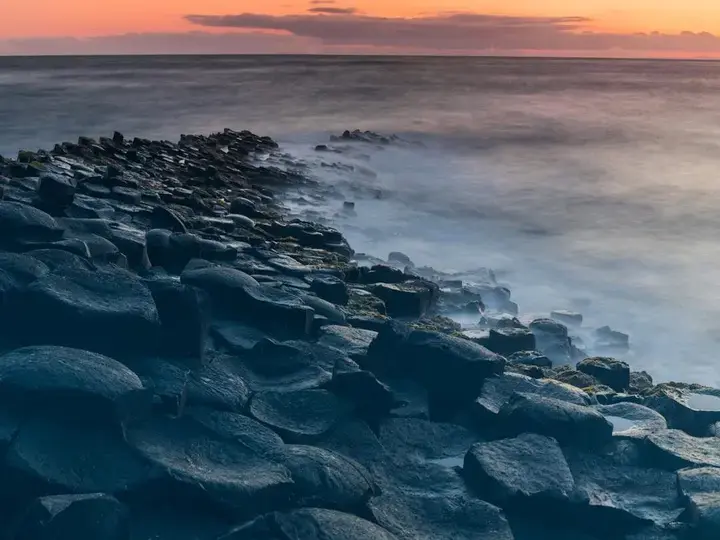
Not every lava flow turns into neat columns. Cooling rate matters. Thickness matters. Water can change the cooling pattern. Later erosion matters too, because it may reveal clean column faces in one place and leave a broken jumble in another.
The part your hands already know
If you want the home version, take a dry cracker and bend it gently. Or think of mud drying in a puddle. As moisture leaves, the surface shrinks, tension builds, and cracks spread into little blocks and polygons. Basalt is doing the same kind of thing on a far larger, hotter, slower stage.
I have found that this is the moment when the rock starts making sense. Crouch down, hold the cracker, and snap it. The break does not ask permission from your ideas about beauty or chaos. It follows stress.
Researchers have long studied why those crack networks often settle into polygons. A useful paper by Goehring, Mahadevan, and Morris in 2006 in Proceedings of the National Academy of Sciences looked at shrinking starch and cooling lava as related pattern-forming systems, showing that crack networks can mature toward more regular polygon shapes as stress is relieved over time. The material changes, but the logic is familiar: shrinking sheets fracture into efficient partitions.
Slow for months. Then suddenly, pop
Here is the turn in the story. The cooling can be slow, over days, months, sometimes longer in thick bodies of rock. Heat leaves little by little. Stress builds little by little.
Then the crack itself is not slow at all. It snaps forward.
Basalt cools, tightens, resists, snaps, propagates, locks into pattern. A fracture can jump through stressed rock in sharp steps. What the eye reads as patient geometry was, in part, fixed by bursts of release.
And if you have ever stood near cooling rock, or even listened to ice or drying timber under strain, you can imagine the sound of it: little pops, ticks, and sharp reports as stress gives way. Basalt country is not only shaped by flowing lava. It is shaped by the noise of rock breaking.
That is the real aha. The same place was made by both slowness and violence. The columns were not stacked. They were divided.
If cracking is messy, why do the walls look so clean?
Fair objection. Cracks in a sidewalk look disorderly enough, so why do basalt cliffs so often look almost planned?
Part of the answer is that stress tends to spread through the cooling rock in a fairly even way. A polygonal network is a good way to divide a shrinking sheet without leaving too much extra strain in one spot. Hexagons get famous because they pack space neatly, but basalt columns are often a mix of five-, six-, and seven-sided forms, not mathematical perfection.
Then erosion does its tidy work. It clears away softer material, opens joints, drops loose blocks, and leaves the stronger columns standing side by side where we can read them. What looks like design is self-organization plus selective exposure.
That is why one cliff may show long, organ-pipe columns while the next slope is only a heap of broken angles. The same broad process can leave very different results depending on cooling conditions and on what weather and water did afterward.
How to read basalt on your next walk
When you come to dark volcanic rock, do not just look for height. Look for repeated angles. Look for flat column faces meeting in polygons. Look for broken ends where a column has snapped across, not been stacked up. Those are the marks of cooling and cracking.
If you find a canyon wall or cliff with columns running mostly upright, remember that the cracks usually formed roughly at right angles to the cooling surface. That can tell geologists something about how the lava body lost heat. The British Geological Survey and the USGS both use this same plain idea when explaining columnar basalt: cooling direction and fracture pattern are linked.
So the next time a basalt wall looks hand-built, give it a second glance. You are looking at heat turned into stone, then stone pulled apart by its own shrinking. It is self-made country, and once you know the cracker trick, it starts talking to you in a very clear voice.