Escalators Can Be Slower Than Stairs — and Public Buildings Use Them Anyway

The slower option can be the better design choice when a building needs to meter crowds into the next space, not because it failed at speed but because it succeeded at flow.
عرض النقاط الرئيسية
- Escalators in public buildings often prioritize system-wide flow over individual travel speed.
- A slower escalator can reduce bottlenecks at landings by spacing people out more evenly.
- Designers use escalators to improve sightlines so people can preview exits, queues, and routes before stepping off.
- ADVERTISEMENT
- Vertical circulation works best when stairs, escalators, platforms, and fare lines are planned as one connected system.
- Escalators can make main routes usable for more people, including older adults and travelers carrying bags.
- Buildings use escalator landings to guide behavior, directing people toward signs, shops, queues, or dispersal zones.
- Faster escalators can still be better in simple, low-volume spaces with generous landing areas and clear destinations.
That sounds backwards when you are late for a train or dragging a suitcase through an airport. But escalators in public buildings are often there to choreograph bodies, sightlines, and choices, not simply to move each person as fast as possible.
Why the “faster is better” instinct misses the real job
A stair can beat an escalator on raw speed. Transport for London has even had to tell riders this directly. In a 2016 trial at Holborn station, signs asking people to stand on both sides of escalators increased capacity, because the old stand-right, walk-left habit left half the machine underused during rush periods.
قراءة مقترحة
The repeatable takeaway is simple enough to tell a friend: in crowded places, the fastest trip for one person is not always the best flow for everyone. Buildings are judged on throughput, which means how many people move through safely and without jams, not on whether one impatient commuter can shave off ten seconds.
You can see the logic first in crowd handling. An escalator releases people at a controlled rhythm. Stairs let strong walkers surge, slow walkers hesitate, and groups spread unevenly. That sounds free, but at the top or bottom it can create clumps, especially where a concourse narrows or a ticket gate sits ahead.
Transit engineers have been measuring this for years. The US Transportation Research Board’s Transit Capacity and Quality of Service Manual, third edition, published in 2013, treats vertical circulation as a capacity problem, not a comfort extra. Its plain point: a station works only if stairs, escalators, platforms, and fare lines are sized as one system, because bottlenecks usually happen at the merge, not on the moving steps themselves.
For you as a rider, that means a slightly slower escalator can help prevent the ugly accordion effect at the landing. If people arrive less aggressively, they have more room to peel off, read signs, or join a queue without getting rear-ended by the next wave.
Visibility comes next. Designers like escalators because they lift your eyes while moving your body. On a stair, especially in a rush, you watch your footing. On an escalator, your gaze is freed up earlier, which gives the building a few extra seconds to show you exits, platforms, security lanes, check-in zones, or yes, shops.
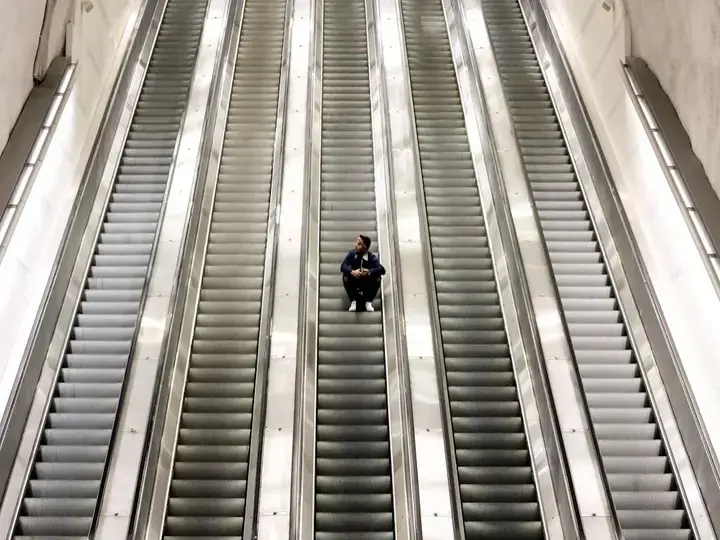
This is not theory dressed up as poetry. In wayfinding research, visibility and preview matter. A 2010 review by Arthur and Passini’s wayfinding school of thought, widely used in architecture and transport design, makes the same practical point: people make better route choices when they can see the next decision point before they reach it. Escalators often create that preview better than stairs because the rider is carried at a stable pace and angle.
Accessibility is part of the same story, though with limits. Escalators do not replace elevators for wheelchair users, people with many strollers, or some travelers with mobility needs. But for many others, including older adults, people carrying bags, and anyone who tires on long climbs, escalators widen the group that can use the main route instead of peeling off into a slower side path.
That matters because mixed user groups change the whole building. If more people can stay on the primary path, circulation stays legible. If only the fittest take the main route and everyone else has to hunt for lifts, the system becomes harder to read and harder to manage.
Then there is behavioral control, the least romantic and maybe the most honest part. Escalators do not just move you up or down. They deliver you to a specific patch of floor, at a specific angle, facing a specific direction, with very little room to improvise during the ride.
Retail designers have used that for decades. So have airports and museums. Put the landing into a broad dispersal zone and people spread. Aim it at a bank of signs and wayfinding improves. Deliver riders into a queue mouth or security funnel and the building has quietly sorted them before they made a conscious choice.
What if you’ve been judging this machine by the wrong metric?
The building may care less about your personal speed than about where you arrive, how many people arrive together, and what you do in the first five seconds after stepping off. Once you see that, the “slow” escalator stops looking like a lazy stair substitute and starts looking like a timing device.
Watch what happens at the landing, not on the ride
Take a familiar airport setup. You rise from a train or check-in level on a long escalator. During the ride, the security area comes into view. You can spot the queue shape, the sign for fast track, the tray return area, maybe the lift off to one side. By the time you step off, you are already sorted in your head.
If that same vertical move were a short stair dumping everyone abruptly into a narrow merge, the decision load would hit all at once. People would stop dead to read signs. Families would bunch up. Fast walkers would try to pass at the exact point where passing becomes dangerous. The vertical trip might be shorter, but the arrival would be messier.
This is the part designers rarely say out loud in public, because it sounds controlling. Sometimes it is controlling. Museums slow your approach to galleries so you enter oriented rather than spilling in sideways. Department stores place escalators so you step off facing merchandise, not the exit. Stations line them up with gates and platform sightlines so the crowd behaves before staff have to intervene.
And yes, there is an honest limit here. Not every slow escalator is smart design. Sometimes the machine is old, the motor is set conservatively for maintenance reasons, code limits are in play, or the budget did not stretch to a better circulation plan.
The fair objection: sometimes faster really is better
People are not wrong to think a faster escalator can cut travel time and feel more convenient. In a low-volume setting with a simple destination and plenty of landing space, faster movement may work just fine. If all you need is to get a moderate number of people one floor up, there is no grand hidden theory required.
The split is between individual trip speed and system-level flow. One person hustling to the platform cares about seconds. A station operator cares about how a thousand people clear the landing, find the right route, and avoid blocking each other. The best setting depends on volume, destination complexity, and who is using the space.
Here is a self-check for this week. The next time you enter a station, mall, airport, or museum, notice where the escalator drops you. Does it feed a broad dispersal zone, a retail sightline, a ticketing queue, or a narrow merge point? That answer tells you more about the building’s priorities than the speed of the steps does.
So yes, escalators can be slower than stairs and still be the better choice. Some infrastructure feels less efficient up close because it is doing a better job at the scale of the whole building. Once you start watching landings instead of just rides, the city gets a little easier to read, and that is a nice thing to carry with you on the commute.