How Stonehenge Was Raised, One Stage at a Time

The surprising part is not that Stonehenge required superhuman strength, but that it could be built by repeating one simple action—pull, lift, brace, pack—far more times than modern people instinctively imagine.
عرض النقاط الرئيسية
- Stonehenge was built in stages between roughly 3000 BC and 1600 BC, not in a single burst of construction.
- Most of the large sarsen stones likely came from West Woods in Wiltshire, about 25 kilometers from the site.
- Builders probably moved stones using sledges, ropes, timber, prepared tracks, and repeated human effort rather than any lost technology.
- ADVERTISEMENT
- Standing the stones upright likely involved sloped pits, levers, bracing, and packing rubble and chalk to secure them.
- The monument shows careful craftsmanship, including shaped stones and carpentry-style mortise-and-tenon and tongue-and-groove joints.
- Experimental archaeology supports the idea that large stones can be moved and raised with simple tools when leverage is applied repeatedly.
- Stonehenge becomes more impressive when seen as the result of practical skill, organization, and patient work passed across generations.
That is the plain answer. Stonehenge was raised through sequences of simple, repeatable actions, not a lost grand technique. English Heritage dates the monument’s main building and rebuilding phases to roughly 3000 BC to 1600 BC, which already tells you something important: this was not one burst of genius, but a very long chain of jobs.
Start with one stone, not the whole mystery
It helps to shrink the problem. Forget the whole ring for a moment and think about one big sarsen stone lying on the ground. Most of those sarsens, according to a 2020 geochemical provenance study led by David Nash and published in Science Advances, most likely came from West Woods in Wiltshire, about 25 kilometers from Stonehenge.
قراءة مقترحة
So the builders first had to get a rough, heavy block out of that area and bring it overland. Archaeologists do not have a complete instruction manual, and some details of the hauling method are still debated. What matters is that the serious proposals use known materials—timber, rope, earth, human force—and actions that can be repeated again and again.
One likely picture is a stone dragged on a wooden sledge, with people pulling by rope while others manage the path. Timber rollers may have helped in some places, though not every archaeologist thinks rollers were always practical on uneven ground. Another aid would have been a prepared track, with brushwood, planks, or packed earth to reduce sinking and jolting.
That may sound plain because it is plain. If you have ever shifted a heavy sofa by lifting one corner, packing something under it, resetting your grip, and doing it again, you already understand the logic. The object is much larger here, but the method is the same sort of patient cheating against weight.
The hard part was not magic. It was friction.
A sarsen is not a neat block from a machine-cut yard. It is rough, misshapen, and stubborn. Up close, the surface is chalky with grit, hard on the palms, with edges and bumps that would scrape skin, catch rope, and resist any tidy plan.
That roughness matters because it makes the engineering feel real. These were not smooth pieces waiting politely to be assembled. They were abrasive masses that had to be shaped, nudged, and controlled while people worked in mud, on chalk, with timber creaking under load.
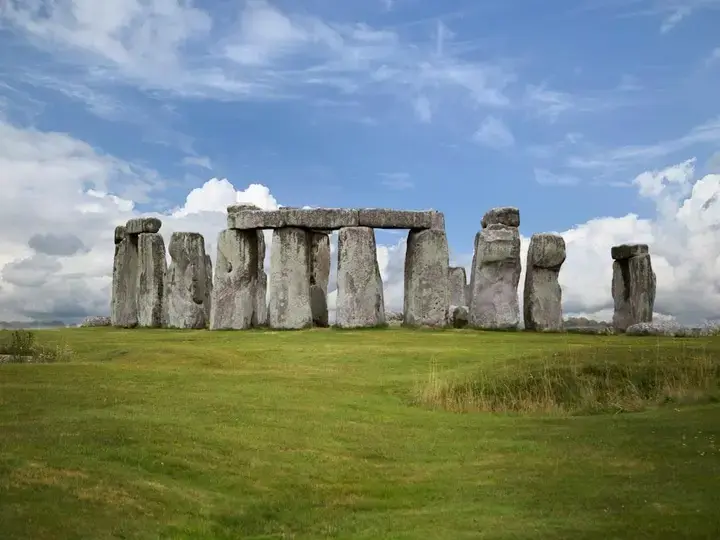
Archaeologists such as Mike Parker Pearson have long stressed that prehistoric builders were skilled organizers, not guessers. At Stonehenge, the stones were dressed and shaped, especially the great sarsens of the outer circle and trilithons. You can see from the finished monument that this was careful work, not just brute dragging.
How do you stand a giant stone up without a crane?
By making the ground do part of the work. A likely method was to dig a hole with one sloping side, drag the stone until its base sat over the edge, then lever the top upward while the base dropped into place. As the stone rose, workers could pack the hole with rubble and chalk to stop it slipping back.
This is where the long lever really earns its keep. Timber poles turn a near-impossible lift into many smaller lifts. You raise the stone a little, brace it, pack under it, reset the poles, and raise it again.
Drag, brace, raise, pack, lever, reset.
That rhythm is not dramatic, but it is believable. Experimental archaeology has shown versions of these methods can move and tip large stones using simple equipment. Different teams have tried different setups over the years, and not every trial matches Stonehenge exactly, but the broad point holds: repeated leverage works.
Then comes the detail that often surprises people. The builders did not just stand stones up and hope for the best. They shaped the tops of upright sarsens with mortise-and-tenon joints—the same basic idea used in carpentry, where a peg on one piece fits into a hole on another—and they used tongue-and-groove joints between lintels, the horizontal stones, so neighboring pieces locked together.
That changes the whole picture a bit, doesn’t it. Stonehenge was not crude heaving. It was fitting. The builders were thinking like woodworkers at a huge scale, making parts meet cleanly so the ring held together.
Picture the moment one upright finally bites into its socket. Your hands sting from rope and rough stone. Chalk dust sits in the cuts on your skin. The face of the sarsen is gritty and irregular, nothing elegant about it.
And then the scale suddenly flips: some of those same stones, handled so awkwardly in a single workday, stayed standing for around 4,500 years.
The real shock is how effort turns into deep time
That is the point where Stonehenge stops being only a building problem. One lift, one packed wedge of chalk, one lintel eased into place by inches—those are small acts. Yet they produced something that outlasted empires, kingdoms, and the language of the people who set it there.
English Heritage’s phasing matters here. Stonehenge did not appear fully formed. The site began as an earthwork enclosure around 3000 BC, then changed over many centuries as people added, moved, and reworked stones. The monument we think of today came from stages, not a single campaign.
That long timeline makes the achievement easier to trust and, in a way, more impressive. A generation could quarry. Another could haul. Another could reset, refine, and fit. Memory did some of the lifting too.
But doesn’t “simple methods” still sound too simple?
Yes, if “simple” sounds like “easy.” It was not easy. A method can be simple in principle and still demand planning, timing, strong backs, spare timber, good rope, prepared routes, and a lot of people willing to keep doing the same hard thing.
That is the answer to the usual objection. No archaeologist is saying Stonehenge was casual work. They are saying its builders did not need fantasy machines. They needed manageable actions, repeated in the right order, with enough discipline to keep errors from compounding.
The bluestones make this even clearer, though they should not take over the story. Their journey involved longer distances and still raises active questions about route and method. But even there, the serious explanations stay inside the same world of sledges, dragging, water transport in part of the route, and staged movement rather than some vanished secret device.
Mike Pitts and Mike Parker Pearson, among others, have both argued in different ways that Stonehenge makes more sense when we treat prehistoric builders as practical problem-solvers. That is a good discipline for the rest of us too. Once you stop asking for the one magic trick, the monument becomes easier to read.
What Stonehenge looks like once the mystery clears a little
It looks more human, not less. You can imagine crews cutting and trimming stone. You can imagine the stop-start misery of hauling, the small gains won by a lever, the care needed to seat a lintel onto shaped uprights. You can imagine people teaching the next group how to do it a little better.
And that, really, is the marvel. Stonehenge did not need to be lowered from some lost age of superior powers. It was raised by ordinary human abilities—hands, rope, timber, judgment, memory—compounded over a very long time.
Once you see it that way, the monument does not shrink. It grows. The stones ask for respect not because they hide magic, but because they show what patient people can do when one careful shove is followed by another, and another, until the work stands longer than anyone who began it.