A Giraffe’s 'Long Neck' Isn’t What You Think

A giraffe is not just a regular mammal with a ridiculous neck. That is the easy mistake. Look again from the shoulders down to the hooves, and the whole animal starts to change shape in your mind.
عرض النقاط الرئيسية
- The article argues that a giraffe’s height comes from its whole body plan, not only its long neck.
- A 2015 Royal Society Open Science study found that giraffe height depends on unusually long legs as well as an elongated neck.
- Giraffes have the standard seven neck vertebrae seen in most mammals, but those vertebrae are greatly lengthened.
- ADVERTISEMENT
- Their high shoulders, long forelimbs and hind limbs, and elevated torso all contribute to their towering appearance.
- Researchers describe giraffes as animals whose frame has been lengthened in several places at once rather than in one exaggerated segment.
- Biomechanics studies show that the giraffe’s long limbs influence stride, posture, and balance during movement.
- A better way to read a giraffe is to look from the hooves upward, noticing body height before focusing on the neck.
Biologists who actually measure giraffe bodies do not treat the neck as the whole story. In a 2015 study in the journal Royal Society Open Science, Graham Mitchell, John Skinner, and colleagues measured giraffe limb bones and body proportions and showed that the animal’s height depends on unusually long legs as well as an elongated neck. The neck is real. It is just not working alone.
The Part Everyone Points At First
If you have ever stood near a giraffe enclosure, you have seen the same gesture repeated over and over: a hand lifts, a finger traces upward, and the sentence begins with the neck. Fair enough. It is the most obvious thing about the animal.
قراءة مقترحة
But slow down the way a good docent would. Start at the skull, then let your eye move down to the base of the neck, where it meets a chest set surprisingly high off the ground. Even before you get to the legs, the giraffe is already telling you it has been built as a tall animal all over, not simply topped with an extra-long pole.
A useful fact here is one many people half remember: giraffes, like most mammals, have seven neck vertebrae. Those bones are not more numerous than ours. They are much longer. That matters because it shows the neck is stretched, yes, but it also hints that the trick is proportion, not a single freakish add-on.
Try a quick self-check. Mentally cover the neck on a giraffe in a photo, at the zoo, or in memory. Now look only at shoulder height, leg length, and how deep the torso hangs between those legs. The animal still reads as very tall.
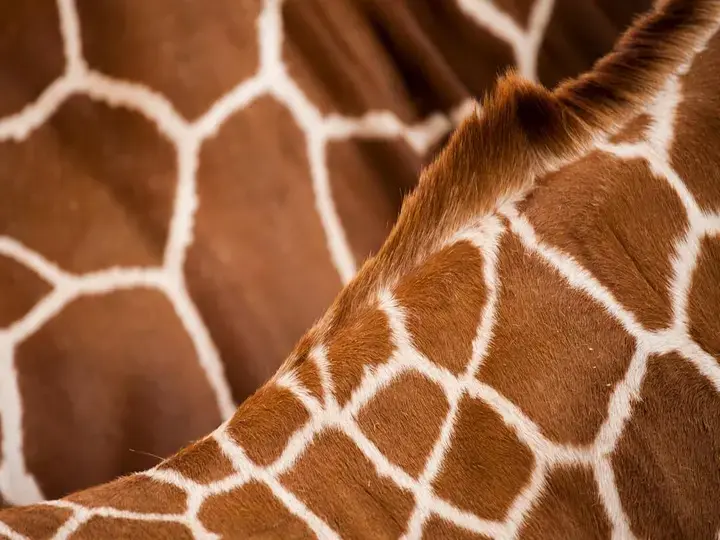
What Your Eye Misses When It Fixates on the Neck
Here is where the common explanation starts to wobble. A horse with a giraffe neck would still not look like a giraffe. The shoulders would sit too low, the legs would be too short, and the body would seem too compact.
Giraffes carry a tall shoulder column. Their front legs are strikingly long, and the hind legs are long too, even if the sloping back can hide that at a glance. The torso is also set in a way that keeps the whole body lifted, rather than hanging low the way it does in many other large mammals.
This is the point many anatomy papers make in plain terms. Mitchell and Skinner have argued in several works on giraffe form and locomotion that giraffe height is distributed through the body plan. Researchers measuring limb bones are not finding a normal mammal with one absurd segment. They are finding an animal whose frame has been lengthened in several places at once.
If the neck looks impossibly long, what if the real trick is somewhere else?
That question usually resets the picture. Because once you stop giving the neck all the credit, other facts rush in. Neck, yes. Legs, also. Shoulders, yes. Torso, still yes.
Look at the front end first. The withers, the ridge at the top of the shoulders, sit high. Then look at the forelimbs below them. In giraffes, the lower parts of the legs are especially lengthened, which is one reason the body seems to hover so far above the ground.
Now look at the body between the legs. It is not a deep, barrel-shaped trunk that eats up height. It is comparatively narrow and suspended high. Put all of that together and the neck stops being the entire explanation. It becomes the most noticeable piece of a bigger design.
The Whole Animal, Not One Exaggerated Part
This is the real update worth keeping. A giraffe makes more sense if you think of it as a tall frame with a long neck attached, not a normal frame stretched only upward from the chest. That sounds like a small correction, but it changes what you actually see.
It also matches how the animal moves. In biomechanics work on giraffe locomotion, including research by R. McNeill Alexander and later studies on giraffe gait, the long limbs are not background details. They shape stride, posture, and how the body balances that famous neck during walking and running.
There is a fair objection here. The neck still is unusually long, and it still matters a great deal for feeding, display, and the basic look of the animal. Of course. The correction is not that the neck is ordinary. The correction is that our eyes overcredit it and under-notice everything supporting it.
And this shortcut will not decode every giraffe instantly. In some photos, perspective can make the neck seem even more dominant, and a crouched stance or bent legs can hide how much height is living in the rest of the body. Still, the more often you check the shoulders, torso, and legs first, the less the old cartoon version holds up.
A Better Way to Read a Giraffe in Ten Seconds
Next time, start at the hooves. Follow the legs up to the shoulders. Notice how high the body sits before the neck even begins to do its work. Then let your eye travel the neck to the head.
That small change fixes the old misreading fast. Lots of people meet giraffes by seeing one oversized part and stopping there. Once you work upward instead, the animal feels more ingenious, not less strange.