The Lion Fact Most People Get Wrong: The Mane Is Not a Hunting Tool

The most striking thing about a male lion is not what helps him hunt. It often makes hunting harder, because in many prides lionesses do most of the stalking and chasing, while the mane does a different job entirely.
عرض النقاط الرئيسية
- Lionesses are usually the main hunters in a pride, handling the coordinated stalking and ambush work.
- A male lion’s mane can make hunting harder because it adds bulk, traps heat, and makes the animal more visible.
- Research suggests the mane evolved mainly for social display, male-male competition, and protection during fights.
- ADVERTISEMENT
- Studies found that darker manes attract more female attention and make rival males more cautious.
- The mane may signal male quality because it carries a real physical cost, including higher body temperature.
- Male lions do hunt in some situations, especially depending on habitat, prey, and pride structure.
- The best way to understand lion behavior is to see the pride as a division of labor rather than a single dominant hunter.
That matters because the usual story people carry around is simple: big mane, big power, better predator. Real lions are more interesting than that. To understand the mane, you have to watch who actually lowers down in the grass, who circles, who waits, and who arrives as muscle, backup, or defense.
The part most people miss when they watch lions hunt
As a rule of thumb, lionesses are the main hunters in a pride. They are usually the ones doing the coordinated stalk-and-ambush work, especially when prey is alert and speed has to come late, not early.
قراءة مقترحة
That pattern has been reported again and again in field studies and long-term observations of prides. Craig Packer, who has studied lions in East Africa for decades, has described prides as social cats in which females form the stable hunting core, while males are more tied to territory, defense, and competition with other males.
If you want the behavior to make sense, start with the mechanics of a hunt. A good stalk hunter stays low, stays quiet, and stays cool for as long as possible. Then comes a short burst of speed at close range. Lionesses, with no heavy mane around the head and neck, are simply better shaped for that job.
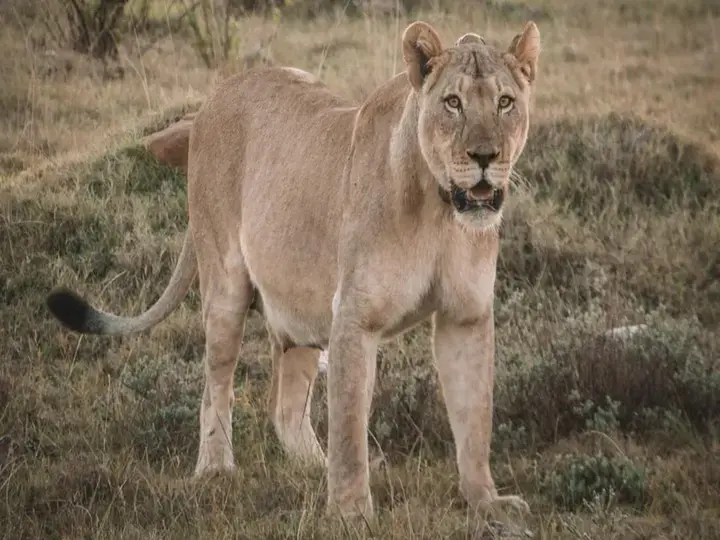
You can test this yourself the next time you watch a lion documentary or reserve clip. Look for who flattens into the cover, who spreads out to flank, and who holds the line of escape. Then ask which body features help silent pursuit, and which ones would make an animal easier to see.
Why the mane makes sense once you stop treating it like hunting gear
The mane fits a male lion's life better as social equipment than as prey-catching equipment. It makes the head and neck look bigger. It advertises age and condition. And it can give some protection in fights, especially around the neck and throat where rival males bite and rake.
One of the clearest pieces of evidence came from Peyton West and Craig Packer in 2002 in Nature. Using life-sized lion models with different mane lengths and colors, they found that female lions spent longer near males with darker manes, while rival males were more hesitant around those same dark-maned models. In plain language: the mane changed how lions judged one another.
That same study linked darker manes with male condition, but also with a cost. Dark-maned males tended to have higher body temperatures. That is a useful clue. A mane can signal quality precisely because it is not free to carry.
Now slow the scene down to a pride at rest. The lionesses are the ones who may rise and begin the low, measured work of closing distance on antelope or zebra. A male may remain behind, or come in later, or use his size against bigger prey when the moment favors him. The point is not that he does nothing. The point is that his job is not usually the quiet setup.
And yet the obvious thought still tugs at you: surely that huge mane should help a top predator dominate a hunt. It looks like battle gear. It makes the animal seem larger and more fearsome. If you were designing a killer in your head, you might well give him exactly that.
But a stalk hunter needs the opposite. Stay low. Stay cool. Stay quiet. Burst late. A mane adds bulk, traps heat, and catches attention. What looks like predator equipment turns out to be social equipment.
Yes, male lions do hunt. That still does not make the mane a hunting tool.
This is the honest part: lion behavior varies. Habitat matters. Prey matters. Pride structure matters. A male defending territory lives differently from a nomad, and a coalition of males can behave differently from a lone male. So “lionesses do most of the hunting” is a useful rule, not a claim that males never hunt.
Males do kill prey. They may hunt alone, take easy chances, steal kills, or help bring down very large animals under some conditions. In a 2013 study in PLOS ONE, Robert Mosser and Craig Packer reported that male lions in open habitats could gain more from cooperation in defending large territories and access to prey, which helps explain why male behavior shifts with setting rather than following one fixed script.
Still, that counterpoint does not rescue the old myth. “Males can hunt” and “the mane evolved to help hunting” are two different claims. The better-supported one is that the mane is tied more strongly to male-male competition, display, and protection than to stealthy prey capture.
You can see the logic in the body itself. The mane sits where bites from rivals are dangerous. It changes the outline of the head and neck in a way other lions notice at once. And because it can add heat load, especially when dark and full, it behaves like a trait shaped by social pressure more than by the clean efficiency a hunter would want.
A better way to watch lions from now on
If you keep one idea from all this, keep this one: ask not who looks most impressive, but who is doing which job. In lions, the family story is less like a single crowned hunter and more like a division of labor inside a social carnivore.
That makes the mane no less magnificent. If anything, it makes it more interesting. You are not looking at a built-in hunting upgrade. You are looking at a signal, a shield, and a message to rivals and mates written in hair.
So the next time you watch lions, follow the dust tracks carefully. The low stalking usually belongs to the lionesses. The heavy mane belongs to a different kind of power. Once you see that, lions become easier to admire honestly, and harder to mistake.