From Genoese Fortress to City Icon: Galata Tower Then and Now

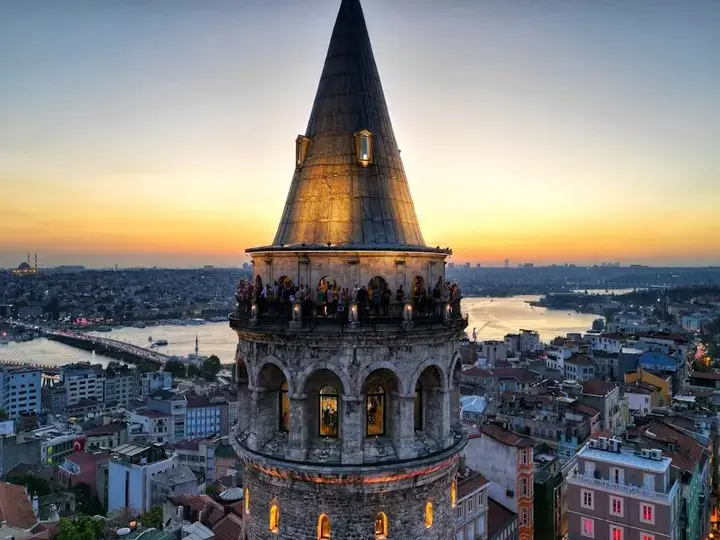
You look across the water at Galata Tower rising over ferries, quay traffic, and the packed streets below, assume it is simply Istanbul’s most photogenic fixed point, and then notice one stubborn detail: it stands where a watcher would want to stand.
عرض النقاط الرئيسية
- Galata Tower’s famous waterfront view reflects its original purpose as a strategic lookout over ships, quays, and trade routes.
- The current tower was built by the Genoese in 1348 as part of the fortifications of their commercial colony in Galata.
- Its location above the Golden Horn gave the Genoese a strong vantage point for monitoring maritime movement and protecting commerce.
- ADVERTISEMENT
- The tower functioned within a wider fortified urban system rather than as an isolated military structure.
- Its height, visibility, and position made it useful both as a symbol of authority and as a practical tool for defense and orientation.
- After 1453, the tower remained valuable and was reused, including as a lookout for fires in the Ottoman period.
- Today, Galata Tower still helps people read Istanbul’s landscape through the same qualities of watchfulness, trade, and place-making that shaped its origin.
That is the trick of this skyline. It feels effortless now. People commute past it, point at it, use it to meet friends, and fold it into the easy mental map of the city. But Galata’s fame did not begin as decoration. Part of what makes it so satisfying to spot from the water is that it was built to spot you too.
The postcard answer is too small
If you are seeing the tower from Eminönü, Karaköy, or a ferry crossing the Bosphorus, try a quick self-check before any history lesson starts. From that height and that slope, what would a lookout need to follow? Ships entering and leaving the Golden Horn. Movement along the shoreline. The line of approach from the water toward a rich trading district.
قراءة مقترحة
That is not modern overreading. According to the Republic of Türkiye Ministry of Culture and Tourism and the Galata Tower Museum’s plain-language history, the current tower was built by the Genoese in 1348 as part of the fortifications of their colony in Galata, then known as Christea Turris, or the Tower of Christ. The key point is not just the date. It is the job: this was a major strong point in a walled commercial settlement run by people whose money and safety depended on maritime trade.
The Byzantine capital sat across the water. The Genoese colony sat here, on this side, with warehouses, quays, and privileges tied to commerce. A high stone tower above the harbor edge made sense in the plainest possible way. It helped a trading power watch what mattered.
What the tower could see that a visitor might miss
Historians of medieval Genoese trade in the eastern Mediterranean have long treated Galata as more than a picturesque quarter. In his 1996 study of Genoese trade and colonization, historian Michel Balard describes Pera-Galata as a fortified Genoese base linked to commerce, defense, and control of access around the Golden Horn. Put simply, the tower belonged to a system, not a lonely stone gesture.
That wider system matters because Istanbul’s water is never just scenery. The Golden Horn was an inlet, harbor, border, and working machine all at once. A tower above it could help mark position, guard a district, and reinforce the authority of the community below. Watching ships, protecting trade, signaling position, anchoring district identity. The tower did all four at once.
You can still feel the logic of that placement even in a very ordinary crossing. A commuter glances up almost without thinking. A captain keeps the shoreline in view. Gulls cut across your line of sight, the boat shifts under your feet, and there it is again: the tower, easy to pick out through moving water and traffic because it was meant to be easy to pick out.
Cross the water a second time, and the whole view changes
Now go back to the same view you started with, but strip away the postcard habit. Keep only the useful parts. The elevation is not just handsome. It extends sightlines. The position above the waterfront is not just dramatic. It links hilltop watchfulness to harbor activity. The tower’s dominance over a tight district is not just visual. It declares control.
This is the halfway turn that makes Galata clearer. The same features that make it a city icon now made it useful then. Height. Visibility. Relation to maritime movement. A fixed point above a trading shore. What looks to us like beauty was, in part, strategy that aged well.
That does not mean medieval sailors saw a single master switch for the whole city. They did not. Galata Tower was not a lone all-seeing military machine in the modern sense, and popular retellings can flatten it into that. Its importance makes better sense as part of a wider urban network of walls, quays, ships, neighboring defenses, and people whose daily work depended on knowing what was happening on the water.
Why the tower stayed in the city’s memory after its first job changed
Galata Tower kept being reused because strong positions rarely lose all value at once. After the Ottoman conquest of Constantinople in 1453, the district and its structures were folded into a new imperial city. Over the centuries, the tower served different purposes, including use as a lookout for fires, a function often noted by the Istanbul Metropolitan Municipality and the museum history attached to the site. Once you have a tall, visible stone point in a dense wooden city, people keep finding reasons to watch from it.
That later afterlife can blur the Genoese beginning. Visitors hear “tower,” think “viewpoint,” and stop there. Fair enough. Not every old tower was mainly military, and Galata’s meaning has never been only one thing. But if you remove the Genoese colony, the fortified setting, and the trade routes below, you also remove the reason this tower stands exactly here with such authority.
That is why the view matters beyond the postcard. It is readable. Water in front, commerce below, height above, and a district gathered around a marker that once helped organize risk as much as beauty. Few cities leave that lesson so plainly in everyday sight.
Cities often keep their old purposes tucked inside ordinary views. Next time you see Galata from the water, do not just admire the skyline; read it for position, trade, and watchfulness. The ferry will keep moving, the gulls will keep crossing, and the tower will still be doing what it has always done best: helping the city make sense from the water.