Why a Glass Sphere Turns the Horizon Upside Down

What looks like distortion is actually image-making; the glass ball is not scrambling the horizon so much as rebuilding it upside down.
عرض النقاط الرئيسية
- A clear glass sphere flips a distant scene because refraction bends light in a regular, predictable way.
- Light from the top and bottom of the horizon crosses inside or just beyond the ball, producing an inverted image.
- The effect is image formation rather than simple visual distortion, though edge distortion can also occur.
- ADVERTISEMENT
- A sphere acts like a lens and can create a small real image of a larger scene.
- What your eye sees depends on the distance between the object, the sphere, and your viewing position.
- Different spheres produce different results depending on size, material, density, and background distance.
- You can observe the flipping effect yourself with a marble, water glass, or clear ornament and a strong horizontal line.
That sounds like a trick until you remember what clear curved glass does to light. It bends it. And when the bending is strong enough, the light from the top of a distant scene and the light from the bottom trade places before they reach your eye.
The strange part is that the ball is being orderly, not chaotic
Stand still for a second and imagine looking through the sphere at a far-off line where sea meets sky. The pebbles are under your feet, the horizon is well beyond your hand, and the ball sits between. Nothing in that setup is random. Light from the distant scene is arriving in neat bundles, and the sphere redirects those bundles in a very regular way.
قراءة مقترحة
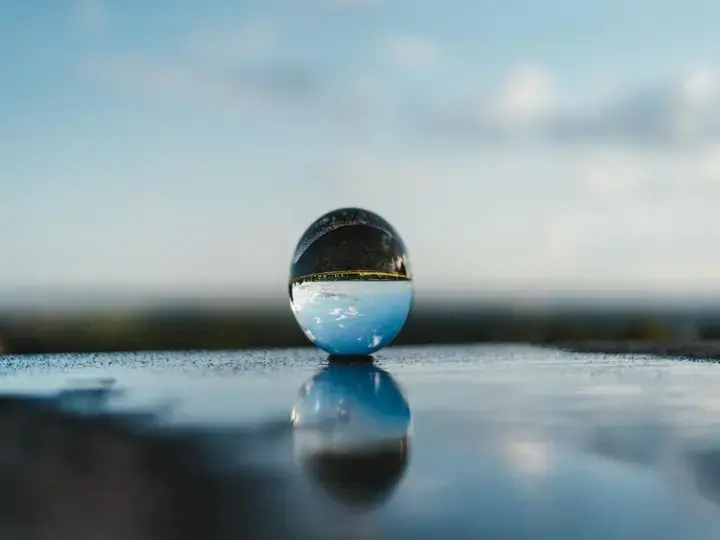
This is refraction, the basic rule that light changes direction when it moves from air into glass and then back into air. A round glass sphere acts as a lens. Educational optics guides from The Physics Classroom and the Exploratorium both explain the same plain point: a curved transparent object can focus light and make a real image, and that image can be inverted when the rays cross.
Here is the sketch worth keeping in your head. Light from the top of the horizon enters the ball. It bends inward. Light from the bottom enters too. It also bends inward. The paths cross. After that crossing, the top is headed downward and the bottom upward. Your eye reads that rebuilt image as upside down.
Light enters. It bends. Rays cross. The scene appears inverted.
Why your eye sees a tiny upside-down world instead of a blur
A sphere can form what optics calls a real image, meaning the light has actually been brought together into an organized picture in space. That is the big shift. The ball is not just warping the beach scene the way a funhouse mirror warps a face. It is acting more like a simple camera lens, making a small image of a larger world.
You can see the same idea away from the beach. Hold a marble over printed text and move it slowly. At some distances the letters look enlarged, at others they flip. A water glass near a window can do it too, especially with a strong straight line outside, like a roofline or windowsill.
Now imagine this: if you picked up the sphere and changed your position, would the world inside it stay upside down forever, or would it seem to flip back as the geometry changed?
That question is the whole mechanism in your hand. Change the distance between your eye, the ball, and the far object, and you change where the crossing happens and how clearly you catch that rebuilt image. The effect is physical, not magical. Move the pieces around, and the picture changes with them.
So is it distortion after all, or something cleaner than that?
Both words can apply, but they do different jobs. Curved glass often does distort edges, especially near the sides, because different parts of the view are bent by different amounts. But the upside-down horizon comes from image formation. That is a more specific thing: light rays from different parts of the scene are being redirected into a new, ordered image.
If you want a plain version you could repeat at dinner, try this: a glass ball works like a lens, and when light from a distant scene crosses inside or just beyond it, the little image you see is inverted. That is the simple model. Keep that, and most of the mystery stays pleasant instead of confusing.
Why one ball gives a dramatic flip and another barely does anything
Not every sphere gives the same neat result. The exact look changes with the size of the ball, the kind of glass or liquid inside it, how far away the background is, and where your eye or camera sits. A small dense marble can behave differently from a large clear ornament. Shift the viewing distance and the image may sharpen, soften, enlarge, or stop looking strongly inverted.
That is not a loophole in the explanation. It is part of the explanation. Lenses always depend on geometry.
Try this in two minutes and watch the flip happen yourself
Take a clear marble, a rounded drinking glass filled with water, or a transparent ornament. Put it in front of something with a strong horizontal line in the distance. A windowsill works. So does a fence rail or roof edge across the street.
Then move the object closer and farther from your eye. Do it slowly. At one position the line may look bent. At another, it will sharpen into a small image. Keep going, and you may catch the moment when that tiny view looks flipped. That is the crossing of rays made visible.
The nice part is that once you have seen it happen in your own hand, the beach-ball mystery stops being a photo trick. The world inside the sphere looked dreamlike because the sphere was doing precise physics, and a marble or water glass on your windowsill can prove it before the day is over.