Why Fawns Have White Spots and Lose Them Later

Losing those white spots is not a setback for a deer; it is an advantage, because what helps a fawn disappear while lying still would make less sense once that deer has to live by watching, moving, and running. That change is written right into one visible detail: the spotted coat itself.
عرض النقاط الرئيسية
- White-tailed fawns use their spotted coats mainly to break up their outline while lying still in patchy woodland cover.
- In the first weeks of life, fawns survive mostly by hiding quietly rather than traveling constantly with their mothers.
- Biologists describe young fawns as a “hider” species because concealment is their main early defense.
- ADVERTISEMENT
- The spotted coat works best when combined with stillness, good bedding cover, and careful maternal behavior.
- As fawns grow through summer into fall, they begin losing their spots and develop the more even brown coat of older deer.
- Older deer survive less by blending in and more by staying alert, detecting danger early, and escaping quickly.
- The loss of spots is not a setback but a normal shift from a hiding strategy to a watch-and-run survival strategy.
People often read spots as a simple gift from nature, as if more camouflage would always be better. Wildlife biologists see something narrower and more interesting. The spots are well suited to one job, and only one job, in the first part of a white-tailed deer’s life.
The coat that works best when nothing moves
A very young fawn survives its first weeks mostly by staying down and staying quiet. Instead of following its mother all day, it often spends long stretches bedded alone while she feeds elsewhere and returns to nurse it. That hiding pattern is standard white-tailed deer behavior described by state wildlife agencies and deer biologists across North America.
قراءة مقترحة
In that stage, the white spots help break up the fawn’s outline. Against patchy ground and shifting woodland light, the body reads less like one clean animal shape. Add stillness, and the effect improves. Hidden and still. Pattern over outline. Freeze, not flee.
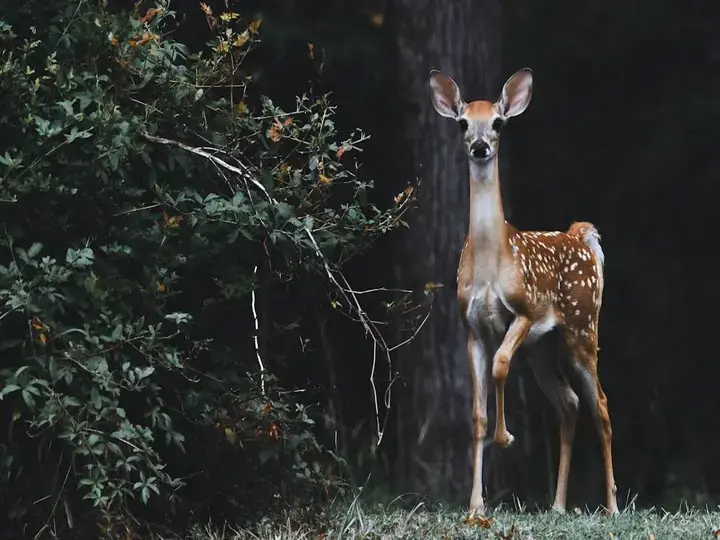
This is not just folk wisdom from hunters and hikers. Deer biologists have long described fawns as a “hider” species in early life, meaning their main defense is concealment rather than following the mother on the move. The Mississippi State University Extension Service explains it plainly: newborn white-tailed deer spend much of their time hidden, and the spotted coat helps camouflage them until they are strong enough to travel more with the doe.
The University of Georgia’s deer research and outreach materials make the same point in simple terms. In the first weeks, a fawn’s best chance is often to remain motionless and avoid being noticed at all. The coat helps, but the behavior is doing just as much work.
That last part matters. Spots are not a magic shield. A fawn’s survival also depends on where it is bedded, how old it is, how much cover the habitat offers, how many predators are nearby, and on the mother’s habits, including how she avoids drawing attention to the bed site with her own visits and scent.
You can test the idea for yourself without any field guide. Ask what kind of animal gains the most from broken-up patterning: one lying still in patchy cover, or one crossing open ground. The answer is usually the still one.
The moment the sign flips
If the spots are so useful, why would a fawn ever give them up?
Because the deer’s job changes. Hard cut. As a fawn grows, it spends less of its life flattened into cover and more of it on its feet, feeding, following, scanning, and escaping. What protected a hidden body now fits the animal less well.
Picture the difference. A small fawn stays pressed and motionless, trusting stillness. An older deer lifts its head, ears forward, body ready to spring. One survives by not being found. The other survives by noticing danger early and leaving fast.
That is the real turn in meaning. Camouflage is not universally helpful; it is task-specific. Spots are excellent for a deer whose safest move is no move at all. They matter less for a deer that lives by vigilance, mobility, strong legs, and a fast burst into cover.
White-tailed fawns usually begin losing their spots as they grow through their first summer and into fall, replacing that coat with the more even brown of older deer. State agencies such as the Penn State Extension and the Virginia Department of Wildlife Resources describe this as a normal shift in development, not a loss of protection. The protection is changing form.
Why an older deer does not just keep both systems
A fair thought is this: wouldn’t it be even better to keep the spots and also gain speed? On paper, maybe. In real animals, traits are tuned to a stage of life and a style of survival, not piled up without cost or tradeoff.
An older deer is larger, more visible, and more often in motion. Once an animal moves, especially through open gaps, broken patterning helps less than people imagine because motion itself gives it away. At that point the better system is an alert head, ears that keep checking, legs ready to launch, and behavior that puts distance between deer and danger quickly.
This is why the older deer’s survival plan is not just a scaled-up fawn plan. It is a different arrangement of body and behavior. The spotted coat belongs most strongly to the hiding phase, when the best defense is to let the woods swallow the outline before anything notices it.
And even then, biology leaves room for humility. Some fawns with good cover are still found. Some survive in thin cover because the mother chose well, visited carefully, or because predators simply never passed close enough. The spots help. They do not decide everything.
What to notice the next time you see a deer
So the fading spots are not nature taking something away. They mark a change in assignment. The young deer is no longer built mainly to vanish by stillness; it is growing into an animal that survives by being alert, reading trouble early, and running before danger closes in.
Next time you see a deer, try one simple lens: does its body say hide, or does it say watch and run? That small shift will tell you more than the coat alone.
Once you see the spots that way, the woods feel a little plainer and a little wiser.