The Steeple That Helped Alpine Towns Find Their Bearings

It looks like scenery, but in many Alpine towns the church steeple also worked as a practical marker, because a tall fixed tower was easier to pick out in snow, fog, and failing light than low roofs or winding roads. That matters if you want to understand why such a building stood where it did and why people kept reading it with such care.
عرض النقاط الرئيسية
- In many Alpine towns, church steeples served as reliable visual markers because they rose above roofs and stayed visible in poor weather and low light.
- Before road signs, electric lighting, and pocket maps, travelers used tall fixed towers to locate settlements and judge direction from a distance.
- A centrally placed steeple helped people confirm arrival, estimate distance, choose meeting points, and orient themselves when roads and rooflines blurred together.
- ADVERTISEMENT
- The bell added an acoustic layer of orientation, helping people place the town even when fog, snow, or mist made sight less dependable.
- Regional heritage studies and Swiss settlement inventories often describe church towers as defining landmarks and structuring elements within village form.
- Although steeples were primarily religious structures, their visibility and prominence also gave them an important civic and practical role in mountain life.
- Over generations, the steeple became more than decoration because it quietly helped residents, traders, children, and travelers find their way again and again.
From a train window, or on foot coming down a valley, the eye settles on the same thing first: one vertical line that does not shift. In mountain settlements, that kind of certainty was useful. Before road signs, before electric lighting spread, before every turn had a map in the pocket, people needed a point they could trust from a distance.
Why the prettiest part was also the most useful
قراءة مقترحة
The plain answer is height, visibility, and fixed position. A steeple rose above clustered houses. It held its place at the center of town. And because it was built to be seen, it could help a traveler judge where the settlement actually was when snow cover blurred paths and rooflines together.
Architectural historians have long noted this double role. The art historian Nikolaus Pevsner, writing on European building traditions, repeatedly treated church towers as dominant visual elements in settlements, while regional heritage offices in the Alps often describe village churches as orienting points within the built fabric. In Switzerland, the Federal Office of Culture and cantonal inventories of historic settlements regularly note churches and towers as defining landmarks in village form, not just devotional structures.
You do not need much theory to feel the logic. Imagine approaching a town in snowfall or low winter light. Roofs sit low and merge into one another. Roads bend with the slope. A tower, by contrast, keeps rising where you expect it to rise. It gives direction, helps with distance, confirms arrival, offers a meeting point, and even serves as a rough weather reference when mist begins to swallow its upper section.
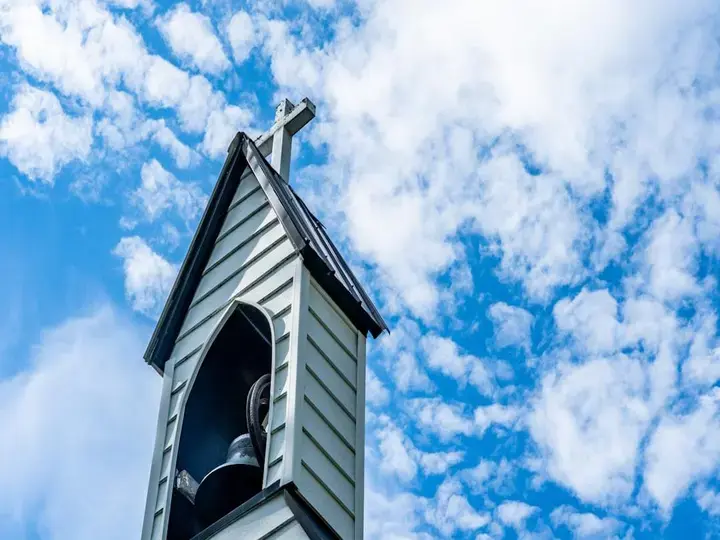
That practical role was not exclusive to churches, and not every Alpine settlement relied on a steeple in the same way. In some valleys, a bridge, a civic tower, a castle keep, or even the form of the ground itself mattered more. But where a church stood near the center and its tower cleared the roofs, it often became the easiest common reference people had.
If you want a quick self-check, try this: picture yourself entering a mountain town before modern street lighting, with fog in the hollow and snow still falling. What fixed upright structure would help you orient faster than the road edge or the line of houses? In many places, it was the steeple.
Then the bell goes. Not sharply, as it would on a dry day, but softened by snow and mist, a muffled peal that seems to stop in the air rather than carry clean through it. You hear it before you sort out every lane. For a moment, sound does what sight is struggling to do: it places the town.
Now make the jump from one winter morning to a few hundred winters. The same tower stands, and not just for one passerby. Residents returning with wood, children sent across the village, traders arriving from the next hamlet, men coming down from upper pasture, families looking for the church square in weather that closed the valley in early—all of them could use the same vertical marker again and again. That is when the steeple changes in the mind from decoration to instrument.
What the tower told people before signs could
Mountain country makes ordinary movement harder. Valleys narrow the view. Slopes interrupt straight lines. Snow hides paths, and winter light fades early. A centrally placed tower answered those problems in a very simple way: it stayed put and stayed legible.
This is one reason towers were built high and kept visible on approaches into town. Regional settlement studies in the Alpine world, including inventories connected to Switzerland’s ISOS program for historic sites of national importance, often describe church towers as structuring elements in village silhouettes and orientation points within settlement patterns. That language may sound official, but the idea is everyday enough: if people can find the tower, they can find the town.
And once they find the town, the tower keeps helping. Height makes it visible from farther off. Its fixed position makes it reliable. Its repeated form makes it memorable. It can mark the center, signal the likely location of the square or burial ground, help neighboring hamlets agree on direction, and give a shared point for time when bells mark the hour or an alarm.
The obvious objection is fair: a steeple was first a religious sign. Of course it was. Its meaning, funding, and prominence grew out of worship and church life. But both things can be true at once. The very prominence that served religious purpose also gave the building civic use in rough ground and winter weather.
Why people remembered one line above all the rest
People tend to remember what helps them return. In an Alpine town, the steeple did that kind of work quietly. Not every day was dramatic. Most of the value was ordinary: finding the center, judging how far remained, telling someone where to meet, hearing the bell through bad air, keeping one stable point in a place where routes twisted with terrain.
That is why the steeple matters more than it may seem at first glance. It gathered belief, yes, but it also gathered movement. It gave the settlement a readable shape. Over time, that made it part of belonging itself: not just a place to look at, but a place by which people located one another.
The valley can feel still, yet it was formed by people learning how to find each other in winter. Landmarks last not only because they mean something, but because they once helped people do something. And there is a quiet comfort in that old usefulness still standing where it always stood.