Those Big Holes in Bread Usually Don’t Mean It’s Underbaked

Many people assume big holes mean bread is underbaked, but the opposite is often true in an artisan loaf, which means you may not be looking at a mistake at all.
عرض النقاط الرئيسية
- Large holes in artisan bread are often a normal result of strong fermentation, high hydration, and steam expansion during baking.
- An open crumb forms when gas from yeast or sourdough gets trapped in the gluten network and expands in the oven.
- Big holes alone do not prove bread is raw if the crumb is set, springy, and not gummy after cooling.
- ADVERTISEMENT
- Truly underbaked bread usually has a wet, heavy, or paste-like center rather than clean walls around the air pockets.
- A few giant tunnels with dense surrounding crumb can point to underproofing, uneven shaping, or trapped air pockets.
- Cutting bread too early can make even a fully baked loaf seem damp because moisture is still redistributing as it cools.
- A better doneness test is to check for springy texture, lack of gumminess, full cooling, or an internal temperature around 205 to 210°F.
Large holes in bread usually reflect fermentation, hydration, and steam behavior rather than raw dough. If the slice is set, not gummy, and had time to cool, those airy pockets are often part of good crumb, not a kitchen crime scene.
Why the “raw bread” verdict is so often wrong
Hard cut to the evidence. Yeast or sourdough microbes make carbon dioxide during fermentation, and that gas gets trapped in the dough’s gluten network. King Arthur Baking explains this plainly: an open crumb is often the result of well-fermented, higher-hydration dough that can hold and expand those gas pockets.
قراءة مقترحة
Then heat takes over. In the oven, the gases already in the dough expand, water turns to steam, and the loaf gets oven spring before the starches gel and the proteins firm up enough to set the structure. Fermentation traps gas. Hydration lets bubbles stretch. Steam drives oven spring. Structure sets.
Bread scientists have been looking at this for years. A 2006 review by Scanlon and Zghal in the Journal of Cereal Science examined bread crumb structure and gas cells, explaining that crumb is a cellular solid: the holes are the spaces left by gas cells formed during proofing and enlarged during baking. That is loaf architecture, not automatic evidence of uncooked dough.
When you pull apart a slice near the crust, there is often that faint sweet-toasted aroma, especially in a loaf with seeds. That smell is a baked smell, a developed smell, the kind you get when starches and sugars have had time to do their work in the oven.
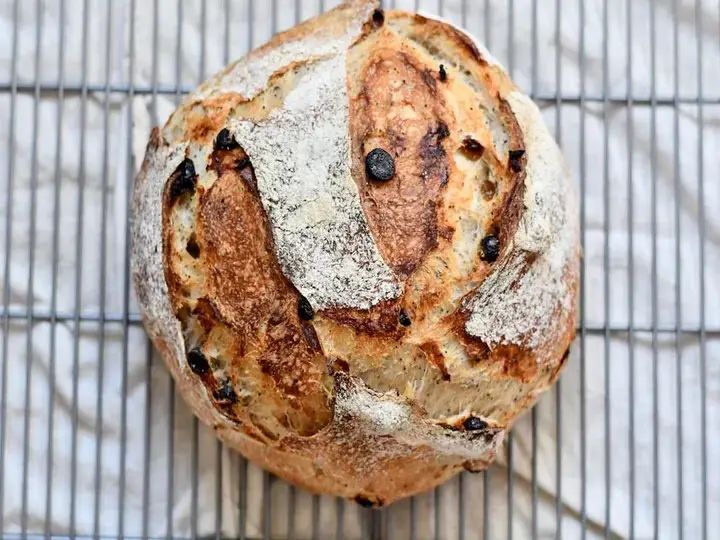
Those holes are often evidence that something went right.
That is the part many of us were never taught at the table. Irregular holes usually reflect the interaction of fermentation, hydration, and steam expansion rather than uncooked dough. Once you know that, the slice stops looking suspicious and starts making sense.
What the crumb is actually telling you
Think of a loaf cut open on the board. Someone sees tunnels and says, “Still raw.” Fair enough; the crumb looks dramatic. But crumb needs to be read like evidence, not judged by hole size alone.
If the interior is springy, the walls around the holes are set, and the slice does not smear into a pasty line under the knife, you are usually looking at a properly baked loaf with an open crumb. A truly underbaked loaf tends to be gummy or wet in the center, with a heavy, almost paste-like texture rather than clean, elastic walls around the bubbles.
Research backs the basic mechanism. A 2011 review by Cauvain in Breadmaking looked at how gas cells are created, retained, and expanded during mixing, fermentation, proofing, and baking. The shape and size of those cells depend on dough development and baking behavior, which is why a holey loaf can be very well baked while a tighter-crumb loaf can still be underdone.
So when are big holes actually a warning sign?
Usually does not mean always. Large holes can also show up when dough is underproofed, shaped unevenly, or handled in a way that leaves one big trapped pocket instead of many smaller ones. In those cases, the crumb may have a few giant caverns and denser bread around them, which is different from a generally open, lacy interior.
Cutting too early can also frame an innocent loaf. Bread keeps setting as it cools; steam is still moving moisture around inside after it leaves the oven. Slice into it while it is too hot and even a fully baked loaf can seem damp or gummy in the middle.
King Arthur Baking and many working bakers make the same distinction: open crumb is about structure, while underbaking shows up in texture. That is the family defense right there. The holes are not the charge; the gumminess is.
One better way to judge doneness next time
Use a quick self-check that looks at the inside, not just the holes. Press the crumb lightly and see whether it feels set and springy rather than sticky. Look for gumminess or a damp, paste-like center. If you use a thermometer, many lean hearth loaves are generally done around 205 to 210°F in the center, and if you do not, let the loaf cool fully before deciding the verdict.
That one habit will save you a lot of false alarms. A strange-looking slice is not automatically a failed loaf. Next time, judge by texture, gumminess, cooling time, and doneness cues—not hole size alone.
Rustic bread can look a little wild and still be exactly right.