Why Violins Have F-Holes Instead of Simple Round Openings

The violin’s f-holes are not decorative cutouts, and they are not simply old-fashioned substitutes for an ordinary round hole; compared with a simple round opening, they help the instrument project and vibrate more effectively because they let the body move and the air respond in a more useful way. That sounds backwards at first. A round hole seems simpler, easier to cut, and perfectly adequate if all you want is an opening in a wooden box.
عرض النقاط الرئيسية
- Violin f-holes improve projection by helping the strings, body, and enclosed air work together efficiently rather than simply letting sound escape.
- Research suggests elongated f-holes can move air more effectively than round openings of the same area because their perimeter plays a major acoustic role.
- The shape of the openings affects how the violin’s internal air resonates and how the body vibrates.
- ADVERTISEMENT
- Two narrow f-holes preserve more of the top plate’s central wood, allowing it to flex and radiate sound better than a large round cutout would.
- The top plate acts as a major sound-producing surface, so the placement and shape of the f-holes matter mechanically as well as acoustically.
- F-holes are not a standalone magic feature, because their success depends on the violin’s wider system including wood thickness, arching, bridge setup, and internal structure.
- Makers kept using f-holes not just from tradition or decoration, but because the shape reliably balanced airflow, vibration, and tonal performance.
But a violin is not just a box with strings on top. In a quiet practice room, when the bow first catches the string, there is that dry, resonant hush before the note fully blooms. What you are hearing in that instant is not only string sound. The whole instrument is waking up: the air inside, the top plate, the back, and the narrow strips of wood left around those two elegant openings.
قراءة مقترحة
Why the “Simple Hole” Idea Fails So Fast
If sound were only trying to escape from the violin’s body, a larger round hole might seem the obvious answer. But projection is not the same as letting air leak out. Projection is the instrument’s ability to turn the string’s small motion into a larger, room-filling sound by coupling string, wood, and enclosed air efficiently.
Acousticians have measured this. In 2015, a study by David Bissinger published in PLOS ONE examined violin air modes and body vibration using experimental and modeled data, showing that the violin’s main air resonance and body resonances interact with the geometry of the openings rather than behaving like a generic hole in a box. The point in plain English is that opening shape affects how the air inside the violin “breathes” and how the top plate is allowed to move while doing it.
There is an older piece of evidence people in acoustics like to mention because it captures the puzzle beautifully. In 2011, researchers led by Nicholas Makris published a paper in the Proceedings of the Royal Society A comparing the perimeter and acoustic behavior of violin f-holes with round openings, drawing on measurements from classical instruments. Their striking finding was that elongated, slotted openings can move air more effectively than a simple circular opening of the same area. In other words, the useful part is not just how much wood is removed, but the length and shape of the edge where air is set into motion.
That edge matters because sound radiation from an opening depends heavily on its perimeter. Two long, narrow f-holes give a lot of active edge without forcing the maker to carve away one big chunk from the center of the top. More edge, used wisely, helps the air mode speak.
There is a small self-check you can do with your hands. Imagine a thin, flexible lid on a box. Now picture cutting one big round hole in the middle. You have removed a broad patch of material that might have flexed. Next picture two narrow slits. You still have openings, but you have left behind more of the plate’s broad central area to bend and spring.
The Hidden Job of the Top Plate
Here is the part people miss. The violin top is not there merely to contain air. It is a thin spruce plate that must move with exquisite freedom. Cut too much from the wrong place, and you weaken one of the main vibrating surfaces of the instrument.
This is why makers care so much about where the wood remains. The f-holes sit on either side of the bridge line, shaping the flexibility of the top around one of the busiest mechanical regions of the whole instrument. The bridge pushes and rocks. The top responds. The air inside answers back. The sound comes out not from one source, but from this little coalition of moving parts.
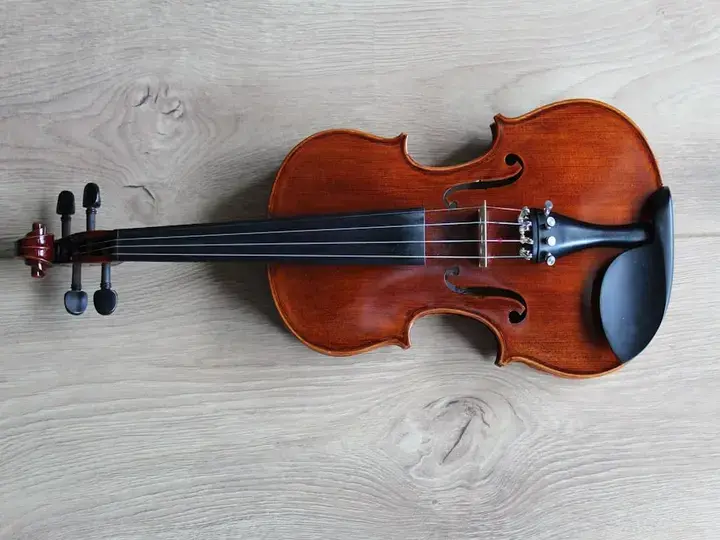
Violin maker and researcher Martin Schleske has often explained the instrument this way in workshop language: the violin must breathe through the openings, yes, but the plates themselves are the real loudspeakers. That is exactly the right image to keep in mind. A violin with perfect holes and a stiff, poorly working top will not become glorious by geometry alone.
So there is the honest caveat. F-holes are not a magic switch on their own. Wood thickness, arching, bass bar, soundpost, varnish, plate tuning, bridge setup, and strings all matter too. The shape works because it belongs to a larger system.
If round holes seem simpler, why did makers keep choosing the harder shape?
Because the harder shape solves two problems at once. It gives the violin efficient air motion and sound radiation, and at the same time it preserves the flexibility of the top plate better than a broad round cutout would. That is the locksmith’s trick in the wood: the opening is not merely open, it is shaped to leave the surrounding structure alive.
And once makers discovered a form that did this reliably, they had every reason to keep it. By the late 16th and early 17th centuries, violin-family instruments were already moving toward these elongated openings, and the Cremonese tradition refined them rather than abandoning them. Tradition certainly played a part after that, but tradition in instrument making usually sticks hardest when the hand keeps confirming what the ear already knows.
Here the mechanism speeds up nicely if you say it plain. Air moves. Plates flex. Sound radiates. Projection improves. None of those steps belongs to the f-hole alone, but the f-hole shape helps each step happen without asking the top to give up too much of its spring.
Why Decoration Is the Wrong Explanation
Some people have heard that f-holes are mostly decorative, or that they survive simply because old violins looked that way and everyone copied them. There is a grain of truth there. Violin making is a conservative craft, and appearance does carry tradition. But decoration does not explain why this particular shape settled into place so firmly while makers were obsessed with tonal results.
Instruments are merciless about empty ornament. If a feature repeatedly got in the way of response, power, or balance, generations of players and makers would not have kept trusting it. The f-hole lasted because it performs well inside the violin’s acoustic design, not because makers were romantics with knives.
You can even hear the logic without touching a research paper. The violin needs the top to remain a lively diaphragm. It needs the cavity air to couple to the outside world. It needs the whole body to radiate more than the strings could ever manage by themselves. The f-hole shape is one of the ways those demands stop fighting each other.
What to Notice the Next Time You See One
So the memorable answer is this: violins have f-holes instead of simple round openings because the best opening is not the easiest or the biggest. It is the shape that helps the violin body breathe while still letting the top plate keep moving freely enough to make sound carry.
Once you know that, the familiar cutout looks different. Not ornamental, not accidental, and not just inherited habit. It is a working part of the instrument’s voice, carved with the same seriousness as the bridge or the arch of the top.
Set a violin on the bench and those two openings no longer look like decoration at all. They look like carefully made breathing spaces, and that is a pleasing thing to know the next time you hear that first quiet catch of bow on string.