No, Penguins Don't Just Live on Ice: Discover Their Diverse Habitats

If you picture king penguins on endless Antarctic ice, you’re missing the truer scene. King penguins are not simply animals of ice. The species, king penguin, Aptenodytes patagonicus, breeds mainly on cold, ice-free shorelines of subantarctic islands, where birds stand on pebbly ground near surf and weather rather than on a flat white sheet.
عرض النقاط الرئيسية
- King penguins mainly breed on cold, ice-free shorelines of subantarctic islands rather than on Antarctic sea ice.
- Important breeding locations include South Georgia, Crozet, Kerguelen, and the Falkland Islands.
- Their habitat is defined by open ground, rocky or pebbly shores, surf access, and harsh coastal weather.
- ADVERTISEMENT
- The common idea that all penguins live on ice confuses king penguins with more ice-dependent species such as emperor penguins.
- For king penguins, habitat includes the practical conditions needed to protect eggs, raise chicks, and move between colony and sea.
- Adults rely on breeding sites close to productive cold ocean waters so they can make repeated feeding trips offshore.
- A more accurate image of king penguins is a tall seabird living on exposed subantarctic coasts shaped by rock, wind, rain, and crowded colony life.
That correction is not a bit of trivia. It changes what “habitat” means. According to the IUCN species account and long-running field work at colonies on places such as South Georgia, Crozet, Kerguelen, and the Falkland Islands, king penguins gather where they can come ashore, breed on open ground, and return to the sea without crossing a world of permanent ice.
قراءة مقترحة
The trouble with the tidy ice picture
The usual mental shortcut is simple: penguin equals Antarctica, Antarctica equals ice, so penguin habitat must be ice. It is an understandable mix-up, because some penguin species do depend much more directly on sea ice or Antarctic conditions, and because nearly every generic penguin cartoon has taught the same lesson.
But king penguins sit a little to the north of that lazy picture. Their breeding colonies are concentrated on subantarctic islands in the Southern Ocean. Cold, yes. Harsh, certainly. Yet the breeding ground itself is commonly bare of ice, close to the sea, and exposed to wind, rain, salt spray, and shifting footing.
That matters because a habitat is not just a backdrop behind an animal. It is the ground the animal must stand on, the route it must walk, the place where an egg is kept safe, where a chick waits, and where an adult returns from feeding trips offshore.
Picture daily life for a moment. A king penguin does not need a dramatic glacier under every step. It needs access to productive cold ocean water and a breeding site on land that is open enough for a colony, near enough to the shore for repeated trips, and solid enough for thousands of bodies to occupy at once.
So the useful words are these: rock, wind, surf, open ground, colony pressure, weather exposure. Those are habitat words too. They belong in the same sentence as king penguins far more often than most of us were taught.
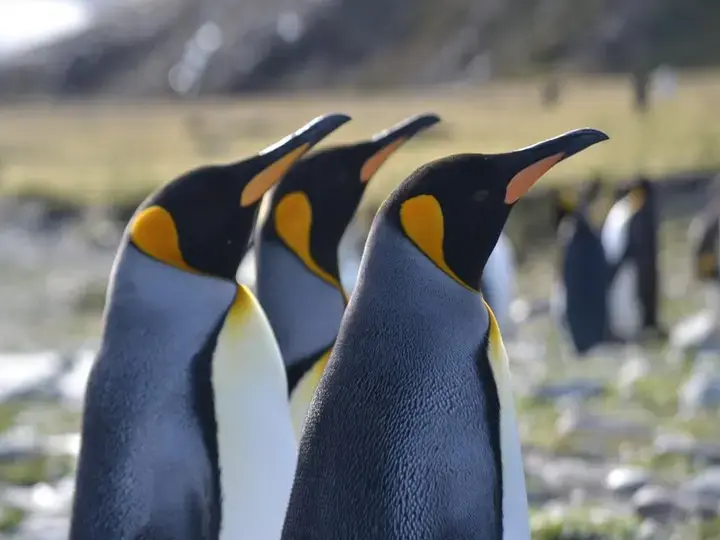
When habitat stops being scenery
Now take the old picture to its limit: a smooth, empty world of nothing but ice. But if you had to stand here barefoot, would you call this “just ice”?
Underfoot there is rock and wet, uneven ground. At the edges, cold water throws light back at you and the wind keeps moving across the colony. And through it comes that small hard sound, the pebbly clatter of penguin feet shifting over wet rocky ground, a noise that tells you at once this place is not a frozen blank but a worked, physical shore.
That is the real update. Habitat is not the pretty setting around the bird; it is the full set of conditions the bird’s body has to manage. For king penguins, that includes exposed coastal weather, crowded breeding ground, and a shoreline from which adults can leave for the Southern Ocean and come back again.
Yes, ice matters—just not in the way people blur together
That doesn’t mean ice is irrelevant to penguins as a group. This is the honest part. Readers are often blending king penguins with emperor penguins, with Antarctic travel imagery, and with the general idea of a polar bird standing on snow.
King penguins do forage in cold southern waters, and many of the places they inhabit feel severe enough that “icy” does not sound wrong in casual speech. But species-specific habitat is more exact than casual speech. For breeding, the king penguin’s usual setting is an ice-free subantarctic island coast, not a vast platform of sea ice.
A good self-check is to imagine the practical problem. Where would an egg, a chick, and a parent changing shifts actually manage daily life: on slick sea ice, or on exposed ground close to surf access? Once you ask it that way, the answer becomes less postcard-like and more biological.
Field reporting and ecological work from colonies on South Georgia have made this plain for years. The birds mass on open beaches, flats, and rocky margins near the sea. They are shaped by the cold ocean, certainly, but also by mud, stones, slope, rain, and wind. None of that is decorative. It is the place they live.
The picture worth keeping from now on
So when someone says penguins live on ice, the kind correction is this: some do rely heavily on icy environments, but king penguins are not simply animals of ice. King penguins, Aptenodytes patagonicus, are birds of subantarctic coasts—ice-free breeding areas near the sea, rocky or pebbly shorelines, cold surf edges, and exposed weather.
Once that mistaken picture gives way, the animal becomes more interesting. You stop seeing a mascot on a white stage and start seeing a tall seabird making a living where rock, wind, water, and crowded ground all press in at once.
And that is a better picture to carry around: not blank ice alone, but a hard, cold shoreline where king penguins belong in a much more real way. It is a pleasant thing, I think, when the world turns out to be more specific than the shortcut.