Innovative Cooling System to Enhance Solar Panel Efficiency
ADVERTISEMENT
Solar energy has become one of the most promising renewable energy sources of the 21st century. Its clean, sustainable nature and wide availability make it essential for meeting global energy needs and cutting carbon emissions. A persistent challenge for photovoltaic (PV) technology is reduced efficiency at high temperatures. Recent innovations
ADVERTISEMENT
have introduced advanced cooling systems designed to improve solar panel efficiency and extend their service life. This article examines the basics of solar panels, their efficiency and limitations, and the pioneering role of innovative cooling systems in transforming solar energy production.
1. Definition and Concept of Solar Panel.
A solar panel is a device that converts sunlight into electricity using photovoltaic cells. It is designed to absorb photons and produce direct current (DC) electricity, which can be converted to alternating current (AC) for use in homes, industry, and the grid.
ADVERTISEMENT
Photo by Sauberstauber on Wikipedia
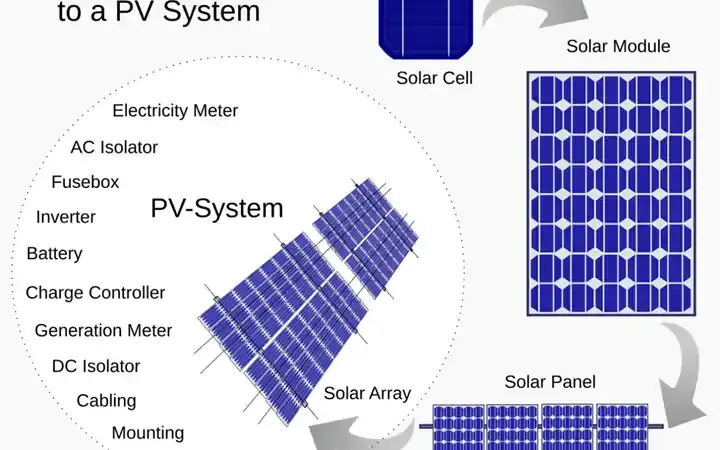
From a solar cell to a photovoltaic system: diagram of potential components of a photovoltaic system
2. Main Components of a Solar Panel.
A. Photovoltaic Cells - The basic unit that absorbs sunlight and generates electricity.
B. Glass Layer - Provides protection against weather.
C. Encapsulation Layer - Ensures durability and electrical insulation.
D. Back Sheet - Prevents mechanical damage and moisture ingress.
E. Frame - Typically aluminum, provides structural support.
F. Junction Box - Connects the solar panel to external circuits.
3. Function and Role of Each Component in the Solar Panel.
1. Cells: Convert light into electricity.
2. Glass: Protects against debris and UV damage.
3. Encapsulation: Holds cells together and prevents degradation.
4. Back Sheet: Provides electrical isolation and protection.
ADVERTISEMENT
5. Frame: Ensures installation durability and ease.
6. Junction Box: Facilitates electrical connections and safety.
3. Evolution and Development of the Solar Panel.
Solar panels have evolved from the first silicon-based photovoltaic cells developed in 1954 at Bell Labs to today’s high-efficiency monocrystalline modules. Efficiency has risen from under 6% in early cells to more than 24% in modern modules. Emerging technologies such as perovskite cells promise efficiencies above 30%.
Photo by AleSpa on Wikipedia
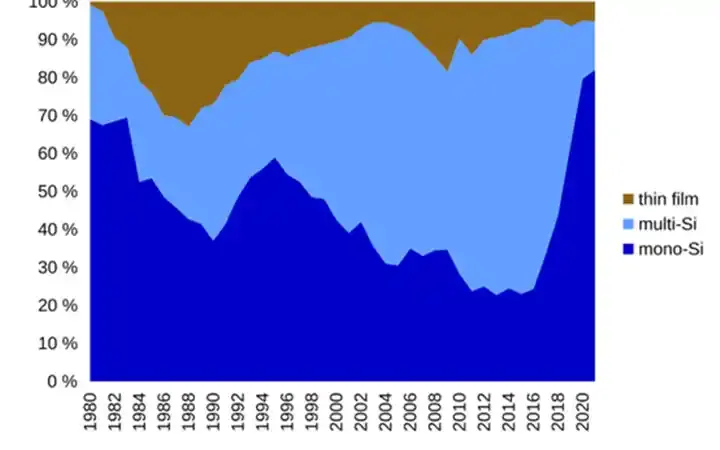
Global market share by photovoltaic technology from 1980 to 2021, in terms of annual global production. Includes monocrystalline silicon (mono-Si), polycrystalline silicon (multi-Si), and thin-film technologies
4. Types and Brands of Solar Panels.
A. Monocrystalline Panels - High efficiency (19-24%), long lifespan.
ADVERTISEMENT
B. Polycrystalline Panels - Moderate efficiency (15-18%), cost-effective.
C. Thin-Film Panels - Lightweight, flexible, lower efficiency (10-12%).
D. Bifacial Panels - Capture light from both sides, increasing output.
Major manufacturers include LONGi, JinkoSolar, Trina Solar, and Canadian Solar.
5. Operating Principle of the Solar Panel.
Solar panels operate on the photovoltaic effect: photons strike a semiconductor (usually silicon), exciting electrons and producing an electric current. An internal electric field guides the flow of electrons, creating usable DC power.
Photo by AleSpa on Wikipedia
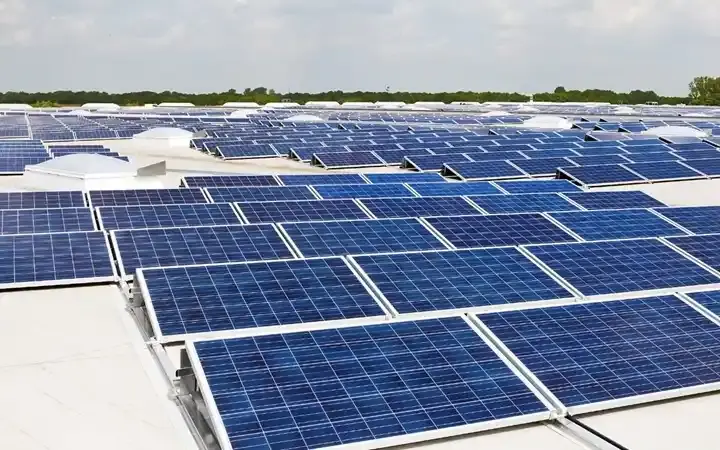
Solar array mounted on a home rooftop
6. Specifications of a Good Solar Panel.
1. High efficiency (greater than 20%).
2. Low temperature coefficient.
3. Long lifespan (greater than 25 years).
ADVERTISEMENT
4. Long warranty (25-30 years).
5. High weather durability.
7. Limitations of Solar Panels.
1. Temperature sensitivity: efficiency decreases by 0.3–0.5% per degree above 25°C.
2. Intermittent generation: output depends on weather and sunlight.
3. Land use: large-scale farms require extensive area.
4. Degradation: panels lose about 0.5% efficiency annually.
8. Definition of Solar Panel Efficiency.
Efficiency is the ratio of electrical output from the panel to the incoming solar energy on its surface. Typical commercial panels achieve efficiencies around 17–24%.
9. Key Methods to Enhance Solar Panel Efficiency.
1. Use of advanced materials (perovskites, tandem cells).
2. Light-trapping designs.
3. Anti-reflective coatings.
4. Bifacial technology.
5. Active and passive cooling systems.
10. Innovative Cooling System to Increase Solar Panel Efficiency.
High temperatures significantly reduce solar panel performance. Innovative cooling systems—such as water-based systems, phase change materials (PCMs), and photovoltaic-thermal (PVT) hybrid systems—have been developed to address this. These systems dissipate excess heat and keep panels closer to optimal operating temperatures.
ADVERTISEMENT
Photo on TechXplore
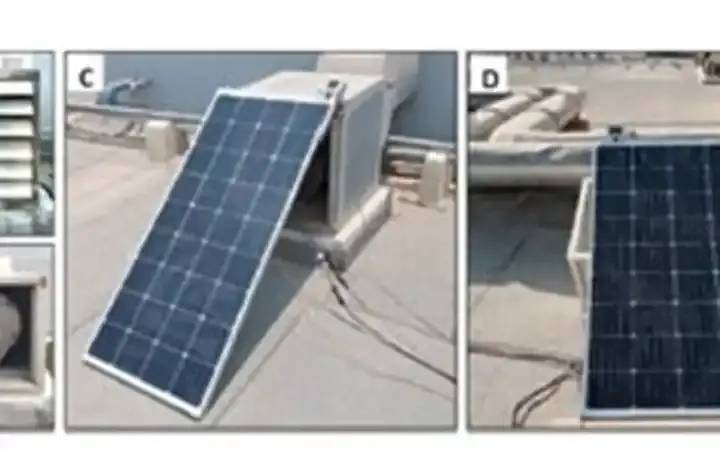
Diagrammatic setup for experimental and prototype models: (A) standard exhaust, (B) exhaust without fins, (C) photovoltaic panel with exhaust air back cooling, (D) reference solar panel without cooling
11. Inventors and Components of the Innovative Cooling System.
Research institutions such as MIT, Stanford University, and the Fraunhofer Institute have led cooling innovations. Startups in Europe and Asia have introduced new cooling mechanisms, including nano-based cooling and integrated circulation systems.
A. Coolant (water or nano-fluids).
B. Heat exchanger or cooling plate.
C. Pumps and flow system.
D. Storage tank (for photovoltaic-thermal systems).
E. Control system (sensors and thermostats).
12. Operating Principle, Benefits, and Gains of the Cooling System.
The cooling system removes excess heat from solar cells through conduction and convection. Heat-absorbing fluids circulate to carry heat away, and in hybrid systems the recovered heat can be reused for heating applications.
ADVERTISEMENT
1. Increased efficiency: cooling can boost output by 5–15%.
3. Dual output (in PVT): provides both electricity and useful heat.
4. Economic savings: higher energy yields shorten payback periods.
13. Expected Outcomes and Impacts of the Cooling System on Commercially Available Solar Panels.
1. Improved energy output per panel.
2. Reduced land requirements for a given energy output.
3. Lower energy costs over the panel's lifecycle.
Adopting cooling systems can make current PV technologies more competitive, potentially reducing the levelized cost of electricity (LCOE) by 10–20%. Integration of cooling could enable hybrid energy solutions for residential and industrial use.
14. Future of Innovative Cooling Systems and the Solar Panel Market.
Future cooling systems will incorporate smart controls, advanced nanomaterials, and AI-based optimization. Expect wider integration with building materials (such as solar facades) and deployment across large-scale solar farms.
ADVERTISEMENT
By 2030, the global solar energy market is expected to exceed 3 TW of installed capacity. Cooling innovations are likely to play a key role in lowering costs and improving adoption in hot climates, especially in Asia, the Middle East, and Africa.
Conclusion.
Solar panels are central to the global shift toward renewable energy, but higher temperatures reduce their efficiency. Innovative cooling systems offer a practical solution: they raise efficiency, extend panel life, and improve overall performance. Continued research and deployment of these systems can reshape the solar market, making PV technologies more viable and cost-effective.
Johannes Falk
ADVERTISEMENT
Arab youth works worth seeing
ADVERTISEMENT
In recent decades, artistic works have rarely caught people’s attention, and few receive genuine praise or enjoyment. There are many reasons for this, including a decline in quality and an emphasis on form over substance. It is surprising how much ridicule older works receive on social media,
ADVERTISEMENT
where people focus on ironic formalities rather than the work’s underlying idea.
At the same time, a few recent Arab productions have won wide admiration and attracted large audiences. This shows that good work is still appreciated across the Arab world. Here is a selection of those productions that are truly worth watching...
1- The series "Balto"
Photo via Wikimedia
Putting a single young talent at the center of a production is itself a gamble for its creators. Pushing several emerging talents—who make up most of the cast—and ensuring they carry the leading roles is an even bolder move. This applied to the actors, the director, and the writer.
ADVERTISEMENT
The makers of the series won that difficult bet.
"Balto" follows Atef Kamal, a newly graduated young doctor who is assigned to a health unit in a village in the Egyptian countryside. He faces many professional and personal challenges as he adapts to village life and interacts with its residents. The series is largely satirical of social and professional situations and draws on the author’s own experiences. It contains deeply comic moments, sometimes edged with dark humor that can leave viewers unsettled. The writer and director often take a startling approach, presenting unexpected developments.
The series’ realistic comedic style touches on the concerns of ordinary people in the Egyptian countryside, offering funny moments that create an atmosphere of joy and suspense. Beyond comedy, it addresses humanitarian and dramatic issues—poverty, social injustice, and entrenched, unreasonable traditions. One prominent storyline involves villagers following a charlatan who convinces them he has miraculous healing powers.
ADVERTISEMENT
2- Musamir
It is one of the most significant Saudi productions, created mainly by Saudi artists and creators. Some even call it the most important work in the Kingdom’s history to date.
Presented as a fantasy animated series with many layers and a large cast of characters, it is a difficult project to undertake. "Musamir" follows a group of friends living in Saudi Arabia as they navigate humorous everyday adventures. The cartoon addresses social issues affecting Saudi life in a light, satirical tone.
Overall, "Musamir" is a distinctive Saudi cartoon that has attracted viewers across the Arab world.
The series is available on YouTube and on several streaming platforms.
3- The film "Al-Harifa"
ADVERTISEMENT
It is a youth-oriented film featuring a mostly unknown cast led by Nour El-Nabawy, the son of the well-known actor Khaled El Nabawy. Remarkably, the film earned very large box-office revenues relative to its budget, grossing more than 70 million Egyptian pounds—a significant sum for a largely youth-driven production. It is worth mentioning that former Egyptian international Ahmed Hossam, known as Mido, made his first real cinematic appearance, and several well-known names from the history of Egyptian football also took part.
"Al-Harifa" follows Majid, a talented young footballer who is forced to leave his private international school and transfer to a public school because of family circumstances. Majid faces many challenges in his new environment and finds himself in a completely different world. He soon becomes involved in the school’s football scene, joining the team for a tournament in the hope of winning a major prize.
ADVERTISEMENT
Football’s popularity in Egypt appears to have been a major factor in the film’s success. At the same time, the film is well made and professional; you will not get bored while watching it, even though many of its plot developments are predictable.
The film focuses on a social class and a generation of young people who are often criticized and blamed by some for moral decline. Yet the film presents them differently, highlighting humane aspects that are often overlooked in other works.
Ahmed Mohamed
ADVERTISEMENT
5 Myths About Hair You Shouldn't Believe
ADVERTISEMENT
We all dream of having healthy, shiny, long hair, and we’re always looking for the best hair-care products to get there. We try home remedies and eagerly follow advice meant to improve our hair. You’re reading this article because its title caught your attention and suggested that some tips might
ADVERTISEMENT
be myths.
Since childhood, we’ve heard many claims about hair, memorized them, and even passed them on. We’ve followed many of these tips only to learn, scientifically, that a lot of them are untrue. If you’ve tried treatments that didn’t work, repeated hair-care methods with no improvement, or heard tips with no proof, join us here to discover myths you shouldn’t believe.
1- Myth: Graying Hair
Photo by Chris Knight on Unsplash
ADVERTISEMENT
People often say that plucking a white hair or stress causes hair to gray faster. Both claims lack scientific basis. Each hair has its own follicle, so plucking a white hair does not affect the rest of the hair on your head.
Graying is influenced by genetics and age. When melanin levels in the hair decrease, the hair turns white. Melanin is the pigment responsible for the color of hair, skin, and eyes. Eating foods rich in vitamins can help boost melanin production. Spinach, fish, meats, grains, nuts, citrus fruits, berries, leafy greens, and some herbs like turmeric and green tea can help increase melanin production in the body. Remember, stress does not cause hair to turn white.
2- Myth: Hair Growth
ADVERTISEMENT
Photo by Hai Phung on Unsplash
Many people think that cutting hair regularly makes it grow faster, but that’s incorrect. Hair growth occurs at the roots, not the ends. Trimming the ends prevents breakage, keeps hair healthy, and makes it look neater because split ends make hair appear shorter than it really is. Remember, hair growth starts at the roots, and the best way to support it is through healthy nutrition that delivers essential nutrients to the hair.
Brushing removes dust, helps distribute natural oils, and detangles hair. However, over-brushing puts stress on the hair, leading to shedding, breakage, and brittleness. Experts recommend brushing in moderation and working from the roots toward the ends without pulling to avoid weakening the hair.
ADVERTISEMENT
4- Myth: Shiny Hair From Cold Water Rinse
Photo by SAJAD FI on Unsplash
Many people believe that rinsing hair with cold water after warm water gives it a shiny appearance, but that isn’t true. Hair is made of dead cells and is not affected by hot or cold water. Using natural hair masks and conditioners after washing will make hair soft and shiny. Shiny hair is a sign of healthy hair. Also, avoid washing hair with very hot water, as it strips away beneficial oils.
5- Myth: Dandruff Caused by Dry Scalp
Photo by Matthew Tkocz on Unsplash
The truth is often the opposite. Dandruff is frequently caused by fungi that grow on an oily scalp. Use a specialized shampoo and don’t worry about washing your hair regularly.
ADVERTISEMENT
There are several causes of dandruff, such as using too much shampoo or not rinsing shampoo and conditioner thoroughly, which leaves residue that flakes. Poor nutrition and deficiencies in nutrients like vitamin B, zinc, and omega-3, along with certain skin conditions, can also contribute to dandruff.