The Essential Role of Greenhouse Warming in Making Mars Habitable: Best Ways to Transform Mars for Human Living

Many scientists and science fiction writers have long considered transforming Mars into a habitable planet by melting the vast ice reserves at its poles to create an environment suitable for humans. This subject is highly controversial; some believe Earth inhabitants have no right to interfere with another planet's climate, while others see Mars as a potential refuge for the human race as conditions on Earth deteriorate. Another argument suggests that Mars was likely warmer and wetter in its distant past and might have harbored life, making its reversion to a previous state logical.
عرض النقاط الرئيسية
- Scientists are considering making Mars habitable by warming its surface and melting its polar ice to create a suitable environment for humans.
- Ethical debates have arisen about the legitimacy of altering the climate of another planet and the potential to use Mars as a refuge for humans escaping Earth.
- One proposal for warming Mars involves using industrial greenhouse gases stronger than carbon dioxide to stimulate warming.
- ADVERTISEMENT
- Computer models indicate that manufactured fluorine gases on Mars could accelerate warming at rates far beyond carbon dioxide.
- A recent geological study indicates the Hellas Basin, rather than the equator, may be the first region suitable for plant growth on Mars.
- Researchers have concluded that atmospheric pressure, temperature, and humidity are crucial for making Martian soil viable for tree growth.
- The idea of manufacturing or transporting greenhouse gases to Mars is becoming one of the prominent proposals for achieving the goal of colonizing the Red Planet.
Among the ideas on how to warm Mars: spraying "things" near the poles that would absorb more sunlight, or placing large mirrors in orbit around the planet to reflect additional sunlight onto it. This article presents some of the ideas circulating among space researchers keen on colonizing Mars.
قراءة مقترحة
Inducing Greenhouse Warming:
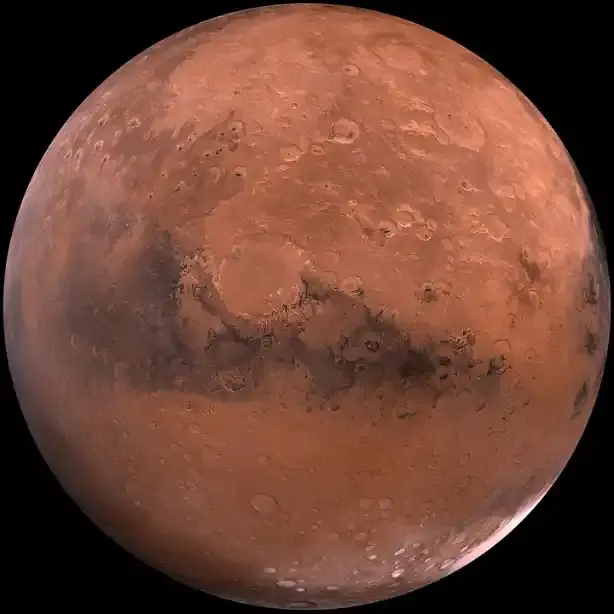
New research published in the Journal of Geophysical Research: Planets, by the American Geophysical Union, suggests that inducing greenhouse warming, by injecting greenhouse gases, might be the best strategy for making Mars suitable for life, given that governments decide to pursue it. Scientists have determined that the conditions causing Earth's temperature rise could be harnessed to transform Mars. Inducing planetary-scale greenhouse warming could be a boon for science in several ways. Margarita Marinova, from NASA's Ames Research Center, states: "Bringing life to Mars and studying its evolution would enhance our understanding of evolution, and life’s capacity to adapt and reproduce in other worlds. Since warming Mars effectively returns it to its more habitable previous state, it would give any potential latent life on Mars a chance to resurrect and evolve further." Because Mars' atmosphere is extremely thin and it is farther from the Sun, Mars is colder than Earth. There is no evidence of liquid water on the surface currently, and liquid water is essential for life as we know it. However, the polar regions contain vast stores of water ice and carbon dioxide ice, or dry ice. Theorists in the past have speculated that melting the poles could thicken the atmosphere, which would act like a blanket to insulate the surface and eventually create an Earth-like climate.
Preferred Greenhouse Gas:
The new research includes computerized modeling of how human-induced greenhouse gases would affect Mars' temperature and their role in melting water ice and carbon dioxide ice at the poles. The study concluded that industrially manufactured gases could be 10,000 times more effective than carbon dioxide in warming the Red Planet. Marinova and her colleagues discovered that the most effective gases would be fluorine-based and could be easily manufactured from elements available on Mars. According to models, adding 300 parts per million of a gas mixture to the Martian air would trigger a runaway greenhouse effect. The polar ice sheets would slowly evaporate, and released carbon dioxide would cause further warming and melting, increasing atmospheric pressure. But the process would take hundreds or thousands of years to complete.
Required Level of Warming:

The next question is, what level of greenhouse warming is required to sufficiently warm Mars' frigid climate for trees to grow? New research indicates the amount of carbon dioxide (CO2) must increase on Mars to support plant growth — enough to warm the planet so that trees may grow. Interestingly, conditions conducive to plant growth on the Red Planet won't initially occur in the "tropical zones."
Energy Balance:
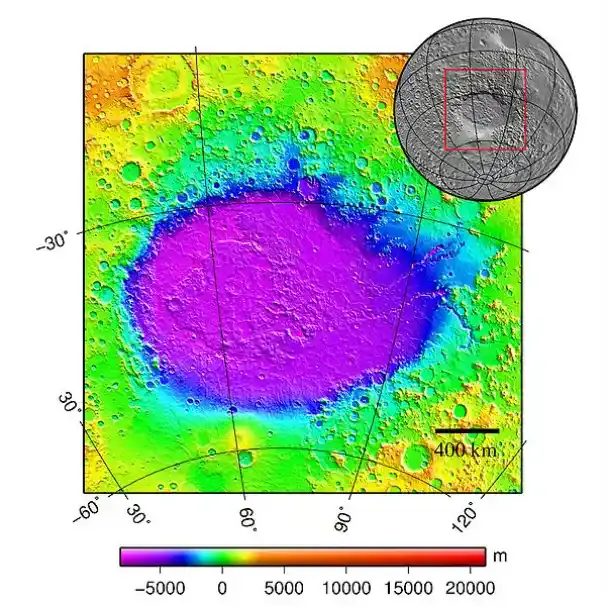
This future scenario of plant growth is led by Robert Oleszewski, a professor at Warsaw University of Technology in Poland. He and colleagues conducted a study on the energy balance on Mars' surface, including the diffusion of heat between condensation and evaporation of carbon dioxide, heat exchange with the subsurface, and heat transfer through atmospheric circulation. Surprisingly, conditions friendly to plant growth do not occur first in the "tropical belt" (±25 degrees) but rather in the Hellas Basin. Further increases in greenhouse warming expand the favorable area for plant growth over the southern hemisphere. Using temperature and pressure datasets collected by the Viking lander on Mars in the 1970s, Oleszewski and his team simulated various processes on Mars, both in the present and in past/future epochs.
Pressure Cooker:
Oleszewski and his colleagues assessed the total required pressure on Mars, the high percentage of acceptable carbon dioxide, the required oxygen, available water amounts, and the necessary temperature ranges for tree growth. Oleszewski points out that current Martian weather conditions make life impossible. The requirements for plant growth on Mars have been considered in the context of terraforming and low-pressure greenhouses. He adds that his research focused on temperature as the primary environmental variable that changes during terraforming and controls the carbon dioxide cycle and liquid water formation. High oxygen levels in the warm, dense atmosphere remain an important distinct concern.
Researchers specifically concluded that the low elevation of the Hellas Basin creates the first favorable conditions for tree growth.
Injecting artificial greenhouse gases into its atmosphere is seen as the best way to make Mars habitable, and these materials can be shipped to or manufactured on Mars. This idea is popular today among experts, and they are actively pursuing it. Who knows, they might succeed!