Ibn al-Haytham: The Father of Optics in the Middle Ages

Ibn al-Haytham was a prominent figure in optics and mathematics during the Islamic Golden Age. Born around 965 in Basra, Iraq, he made significant contributions to the principles of optics and the use of scientific experiments.
عرض النقاط الرئيسية
- Ibn al-Haytham was born in Basra in 965 and educated in Basra and Baghdad, where he chose to leave judicial work and devote his life to science due to his disappointment with the religious disputes of the time.
- During his stay in Egypt and a decade of house arrest, he wrote the "Book of Optics," which became one of his greatest works and contributed to the development of optics.
- He proposed a new theory of vision that contradicted the ideas of Euclid and Ptolemy, explaining that the eye receives light reflected from objects rather than emitting rays.
- ADVERTISEMENT
- He is considered the first to use the experimental method based on hypotheses and careful testing to study visual and natural phenomena.
- He conducted precise experiments on mirrors and lenses of various shapes to understand the properties of reflection and refraction and explained how images form on the retina.
- His understanding of visual contrast and the effect of the surrounding environment on the color of objects played a key role in explaining optical phenomena, such as why stars are not visible during the day.
- Ibn al-Haytham left a scientific legacy that extended its influence into the European Renaissance and played a pivotal role in the foundation of modern optics and the scientific method.
Early Life and Education
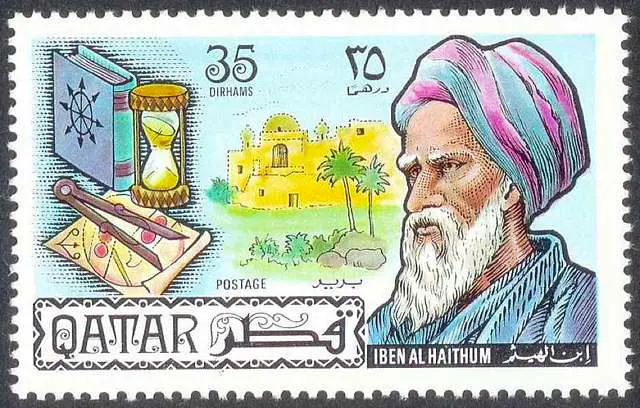
Ibn al-Haytham was born into a family of Arab or Persian descent in Basra, Iraq. He educated in Basra and Baghdad. Initially trained for a civil service job, he was appointed as a judge in Basra. However, due to the various conflicting religious movements at the time, he became disillusioned with religious studies and decided to devote his time and effort to the study of science.
قراءة مقترحة
Ibn al-Haytham received a comprehensive education in various fields of knowledge, including mathematics, physics, astronomy, and Islamic religion. He was educated in Basra and Baghdad, which were major centers of learning during the Islamic Golden Age. The educational system at that time was highly valued in Islamic society and was known for its emphasis on various academic disciplines.
He later moved to Cairo, Egypt, which was then ruled by the Fatimid Caliph who supported sciences, especially astronomy. It is said that Ibn al-Haytham proposed to the Caliph a plan to build a dam (at the same location where the Aswan Dam stands today) to tame the turbulent Nile River. However, historians and scholars debate the accuracy of this claim.
Realizing that constructing a dam on the river might not prevent the waters from flooding its banks, he feigned madness to avoid execution by the infamous ruler. Ibn al-Haytham was placed under house arrest from 1011 until 1021, when the ruler died. During his confinement, he wrote the "Book of Optics," which is considered a masterpiece, and he also produced essays on astronomy, philosophy, number theory, and geometry. This period of isolation allowed Ibn al-Haytham to concentrate on his scientific research and lay the groundwork for his future contributions to optics and other fields of science.
Contributions to Optics
Ibn al-Haytham is famous for his influential work, the Book of Optics, written between 1011 and 1021. This work correctly explained and demonstrated the modern understanding of visual perception. He stated that vision occurs when the eye passively receives rays of light from objects, not through the active emission of rays from the eye. His work combined experimentation with mathematical reasoning.
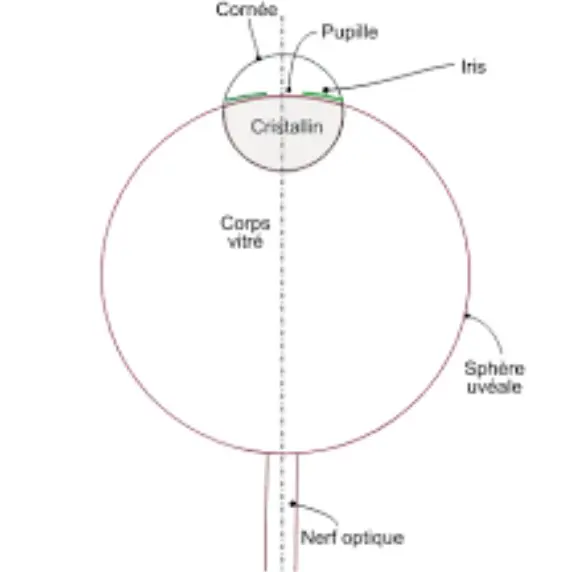
He was the first to accurately describe the different parts of the eye and provided a scientific explanation of the process of vision. He also attempted to explain vision with the naked eye and provided a correct explanation for the apparent increase in the size of the sun and moon when near the horizon.
In his Book of Optics, Ibn al-Haytham debunked the emission theory of vision proposed by Euclid and Ptolemy, which stated that eyes emit rays of light, which then interact with the objects being viewed. Instead, he proposed the theory of intromission, which states that vision occurs when rays of light are reflected from objects and then enter our eyes.
The Experimental Method
Ibn al-Haytham is also credited with introducing the experimental method in the field of optics. He was the first to insist that a hypothesis must be supported by experiments based on confirmed procedures or mathematical proof. This approach marked a significant shift from the predominant Greek approach to science, which primarily relied on abstract philosophical reasoning.
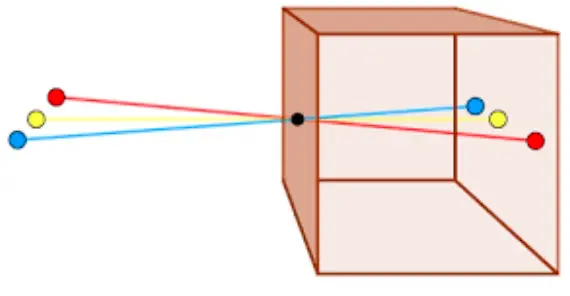
Ibn al-Haytham's discoveries in optics and vision overturned centuries of misunderstanding. In his experiments, he noted that light coming through a small opening travels in straight lines and projects an image on the opposite wall.
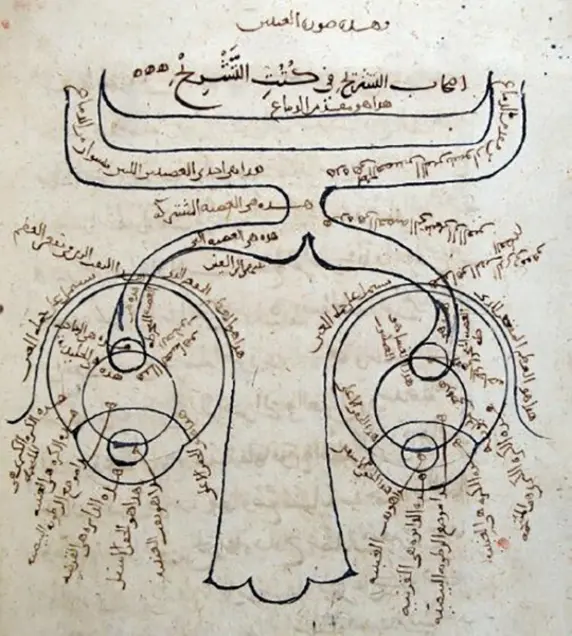
However, he realized that the entry of light into the eye was only the first step in vision. He built upon the work of the Greek physician Galen who provided a detailed description of the eye and visual pathways. Today, the oldest known illustration of the nervous system is from Ibn al-Haytham's Book of Optics, which illustrates the eyes and visual nerves.
Ibn al-Haytham suggested that only the rays of light that strike the surface of the eye directly pass into the eye, creating a representation of the world. It was Kepler in the 16th century who corrected this and proposed that the object seen—what the eye perceives—is delivered by the rays running perpendicular to and striking the eye, forming an inverted image on the retina.
Among Ibn al-Haytham's other insights is his understanding of the crucial role of visual contrast. For example, he realized that the color of an object depends on the color of the environment surrounding it and that differences in brightness levels explain why we cannot see stars during the daytime.
Ibn al-Haytham also engaged in an empirical analysis style coupled with theoretical postulates that resemble, in many ways, the scientific method we know today. Recognizing that the senses can be deceived, he devised methods of verification, testing, and experiment to reveal the truth of natural phenomena as perceived. Up to that time, the study of physical phenomena had been an abstract occupation with incidental experiments.
In search of evidence, Ibn al-Haytham studied lenses, experimented with various mirrors: flat, spherical, parabolic, cylindrical, concave, and convex. His practical results were clear:
He wrote, "The visible objects we see through the refraction of light—through dense media like water and glass—appear larger than their true size."
Understanding Light and Color
Ibn al-Haytham made numerous significant contributions to our understanding of light and color. He was the first to realize that vision occurs when light bounces off an object and is then directed into the eye. He also conducted various experiments with mirrors and lenses, leading to his correct explanation of how we see images.
Ibn al-Haytham believed light and color are physical properties that exist independently of the observer. He proposed that every point of a visible body emits light rays in all directions, and the color of the body we see is the color of the light it reflects. He conducted numerous experiments on mirrors and lenses, studying reflection, refraction, and the nature of images formed by light rays. He made considerable contributions to the science of catoptrics (the study of light reflection) and dioptrics (the study of light refraction).
He explained that we see images because the light emanating from the object enters the eye and forms an image on the retina. This image is then processed by the brain to produce the final perception of the object. He also conducted a thorough examination of the passage of light through various media and discovered the laws of refraction. He noted that the ratio between the angles of incidence and refraction does not remain constant.
Legacy
Ibn al-Haytham's work had a profound impact on the field of optics, laying the groundwork for modern physical optics. His works were frequently cited during the scientific revolution by prominent figures such as Isaac Newton, Johannes Kepler, Christiaan Huygens, and Galileo Galilei.
He was also one of the earliest proponents of the concept that a hypothesis must be supported by experiments grounded in confirmed procedures or mathematical reasoning. This made him an early pioneer of the scientific method, preceding Renaissance scientists by five centuries.
After his death, Ibn al-Haytham's writings were more influential in Latin than in Arabic. The only significant work in Arabic that relied on Ibn al-Haytham's ideas was produced in the early 14th century (in what is now Iran) by Kamal al-Din al-Farisi, who was himself a brilliant scientific thinker.
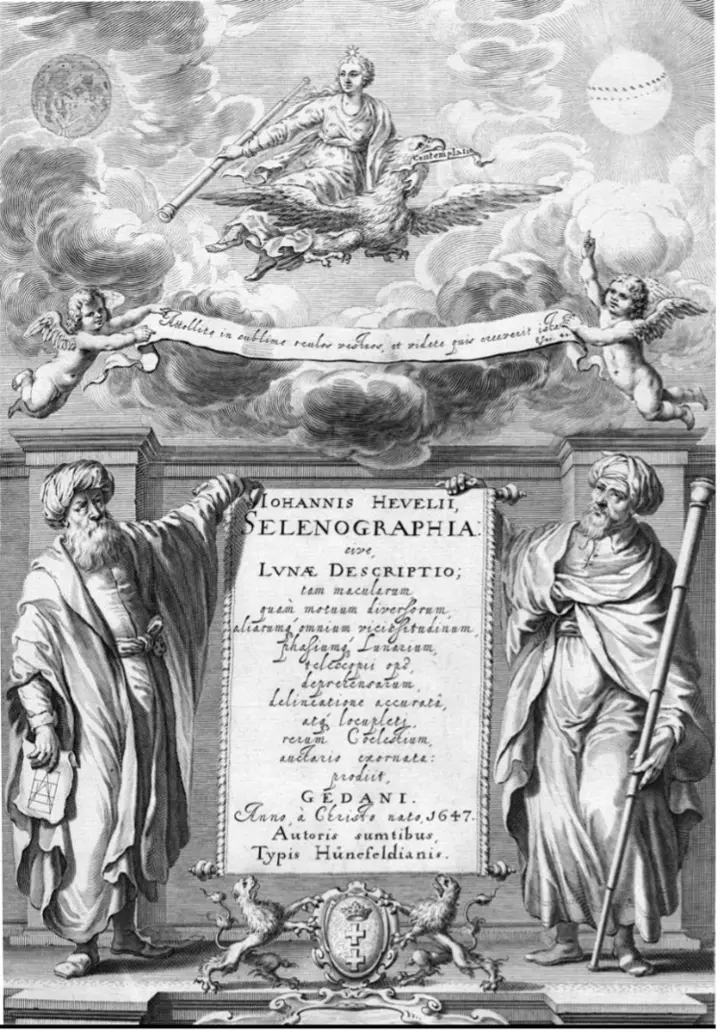
When Ibn al-Haytham's Book of Optics was translated into Latin, it had a significant impact and was widely read. It was published as a printed edition in 1572 to make it more readily available. The Polish astronomer Johannes Hevelius chose to honor Ibn al-Haytham, alongside Galileo, in his famous work on the Moon, Selenographia, published in 1647.
Some of the questions Ibn al-Haytham raised remained unresolved for a millennium. One such problem was known as "Alhazen's problem," for which he provided a geometric solution: "If you have a light source and a spherical mirror, find the point on the mirror where the light reflects to the observer's eye." Ibn al-Haytham solved this problem geometrically, but it remained unsolved using algebraic methods until it was finally resolved in 1997 by Oxford mathematician Peter M. Neumann.
However, there are still riddles remaining. Ibn al-Haytham stated that optical illusions are the cause of the Moon appearing larger when low in the sky near the horizon compared to its size when at its apex, and no one knows why this happens to this day. These and other questions in science are yet to be fully addressed, leaving us with a legacy of puzzles to tackle today.
In conclusion, Ibn al-Haytham's contributions to optics and his introduction of the scientific method were indeed pioneering. His work laid the foundations for modern optics and greatly influenced the development of scientific research methodology, making him a pivotal figure in the history of science.