Derinkuyu: The Mysterious Underground City Found in a Man's Basement

After billions of years of continuous erosion, the region of Cappadocia in central Turkey appears as a magical world from a fairy tale. Here, rocky hills and stone towers called "fairy chimneys" rise from the dusty plains of the Anatolian Peninsula, while winding tunnels meander below. Many of those tunnels are natural, but some are man-made.
عرض النقاط الرئيسية
- Cappadocia is renowned for its unique landscapes, resembling a fantasy world thanks to erosion that has formed 'fairy chimneys' and rock towers.
- Derinkuyu underground city was discovered in 1963 when a man knocked down a wall in his basement, revealing a network of rooms and tunnels.
- It is believed the city was built around 2800 years ago by the Phrygians, known for their skills in rock carving.
- ADVERTISEMENT
- Derinkuyu is not small; it extends to a depth of 280 feet with 18 levels, designed to accommodate 20,000 people with all living facilities.
- The city was used as a safe haven during various periods, including the Byzantine era and the 20th century, to escape religious and political persecution.
- Derinkuyu's structure was defensively built, making it difficult for invaders to penetrate due to its narrow passages and heavy stone doors.
- Despite advanced living arrangements, residents faced challenges like agriculture difficulties and a lack of a proper drainage system, making life underground a daily challenge.
In 1963, a Turkish man knocked down a wall in his basement in Cappadocia during renovations and was surprised to find a complete other room behind it. Further digging revealed a maze of rooms several hundred feet underground.
This was the underground city of Derinkuyu, carved into tuff, the same soft volcanic rock that creates enchanting shapes above ground.
قراءة مقترحة
Here's everything you need to know about this amazing ancient city, located roughly 300 feet beneath the earth's surface.
Origins of Derinkuyu Underground City:
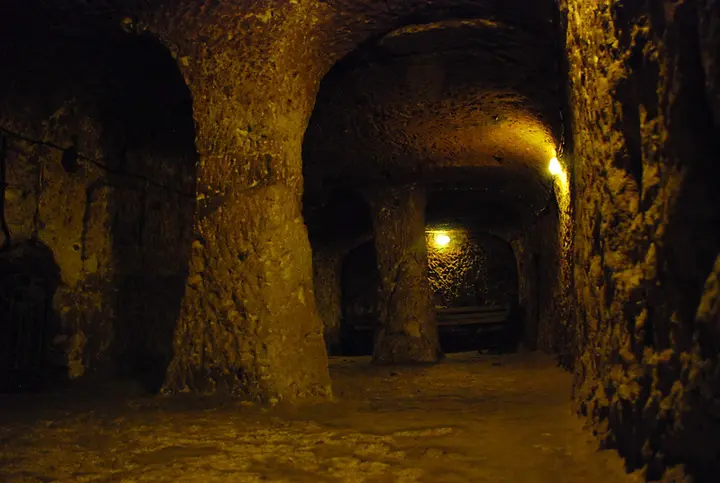
Derinkuyu stretches nearly 280 feet underground, with up to 18 levels, large enough to house 20,000 people. Though only 2,000 square feet of Derinkuyu have been explored so far, the Cappadocia tourism site suggests the city could span up to 7,000 square feet.
According to Ancient Origins, the exact origin and purpose of the underground city remain unknown. Estimates from the Turkish Ministry of Culture suggest the city's construction dates back approximately 2800 years, by a group known as the Phrygians, an Indo-European Iron Age people renowned for their architectural skills.
Andrea De Giorgi, an assistant professor of classical studies at Florida State University, told the BBC, "The Phrygians were one of the early prominent empires in Anatolia. They emerged in the region of west Anatolia at the end of the first millennium BCE, with a penchant for monumentalizing rock formations and creating impressive rock facades. Despite their short-lived kingdom, it spread across most of west and central Anatolia, including the Derinkuyu area."
However, while the Phrygians may have initially built the city, it was later expanded during the Byzantine era, likely by Christians avoiding religious persecution.
The presence of churches in the lower floors of Derinkuyu supports this theory. In fact, the city and its tunnels were used for a similar purpose in the 20th century, when those evading Ottoman persecution once again took shelter underground.
However, there are alternate theories about Derinkuyu's origins. Some historians propose the city was constructed by the Hittites of Anatolia around the 15th century BCE as a means to escape their enemies. Others suggest the caves formed around the same time as the mysterious Göbekli Tepe temple during the Younger Dryas cooling approximately 14,500 years ago.
This theory suggests that as a comet broke up within the Earth's atmosphere, the resulting dust and soot blocked the sun for months, leading the world into an ice age. Consequently, ancient humans began living underground to avoid the cold climate above.
Perhaps unsurprisingly, another theory attributes the creation of the underground city to aliens. In short, either extraterrestrial beings created the underground cities and then abandoned them, or humans constructed them to hide from invading aliens.
However, these latter theories are generally not accepted by the majority of the scientific community.
Life Inside Derinkuyu Underground City
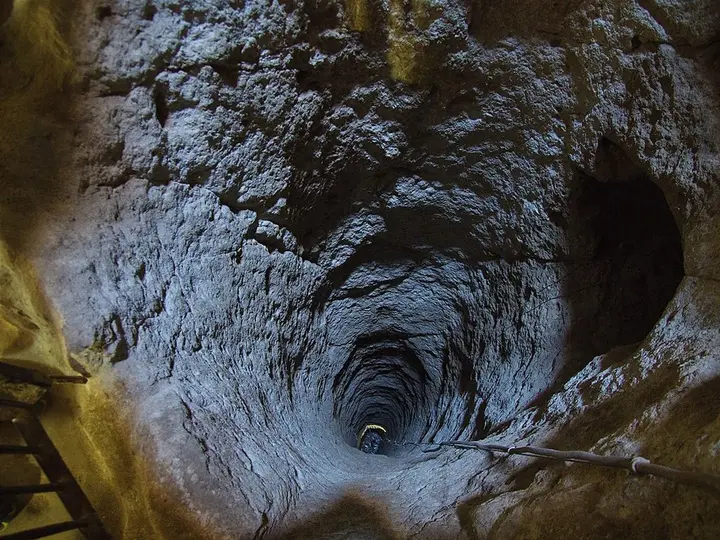
It appears the Cappadocians lived a satisfying life underground much like they did above. Derinkuyu was equipped with wine and oil presses, stables, cellars, storage rooms, dining halls, and chapels. It is likely that a massive 180-foot ventilation shaft also served as a well, and dozens of additional ventilation shafts brought oxygen to those living below.
Reportedly, Derinkuyu had religious schools and study rooms for students. On the lower levels, there was a cross-shaped church carved directly into the rock.
Each level of the city was meticulously designed for a specific purpose. On the upper levels, the Cappadocians kept livestock to minimize exposure to the toxic gases and odors produced by the animals. The livestock also acted as a living insulation layer, helping keep the city warm during the colder months.
The interior layers of the city contain numerous facilities, including homes, cellars, schools, meeting areas, and even a winery. Derinkuyu does not appear to have been used as a temporary refuge; those who dwelled in its caves were equipped to spend months or even years inside.
Yet, the city was not without its flaws. Living underground made it difficult to grow crops, and the lack of plumbing system meant most of Derinkuyu's inhabitants had to rely on pottery jars for sanitation.
How Living Underground Protected Derinkuyu's Inhabitants
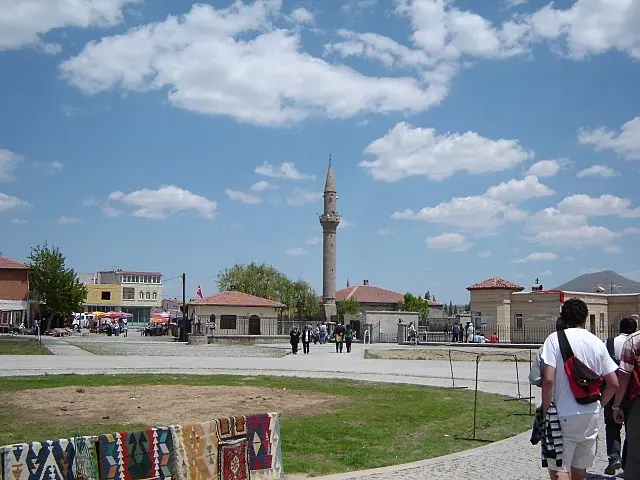
Derinkuyu also served a strategic defensive purpose. The narrow passages made it difficult for invaders to march in formations, and residents could easily use heavy stone doors to block the hallways. On the other hand, the dim lighting
made it hard for attackers to see, while those living in the underground city were better acquainted with its darkness.
These advantages likely led the ancient Phrygians to be the first to inhabit the underground city, followed later by Persians, Byzantine Christians, and others seeking safety below ground.
IFLScience reports that in 1909, a massacre that claimed the lives of around 30,000 Armenian Christians in the city of Adana might have prompted the Cappadocian Christians to go underground once more. In 1923, most Christians were expelled from the region in a population exchange between Greece and Turkey, aimed at eliminating religious minorities in both countries.
After that, Derinkuyu remained undisturbed until 1963 when the astounding underground city in central Turkey was rediscovered and finally received the attention it deserved.