Capital Gate Tower, an asymmetric engineering marvel on the land of Abu Dhabi, United Arab Emirates

Many people know the Leaning Tower of Pisa, but few are aware of the UAE's ingenuity in creating the Capital Gate Tower in Abu Dhabi. The building entered the Guinness Book of Records as "the most inclined tower ever constructed," leaning four to five times more than the Leaning Tower of Pisa. With this landmark, Abu Dhabi rivals Dubai as a cultural hub of the UAE.
Show key points
- Capital Gate Tower in Abu Dhabi holds the Guinness World Record for being the most inclined man-made tower, leaning significantly more than the Leaning Tower of Pisa.
- The building’s design takes inspiration from Abu Dhabi’s natural environment, symbolizing sand whirlpools and sea waves with its curved, tilted structure.
- With a height of 160 meters, the tower features 35 floors, 728 uniquely designed, frequently cleaned windows, and a distinctive westward tilt of 18 degrees.
- ADVERTISEMENT
- A curved central core of reinforced concrete and steel counteracts the immense gravitational pressure from the tower’s top-heavy design.
- The structure includes a mix of office spaces, luxury hotel rooms, a presidential suite on a sloped floor, meeting rooms, a business center, and a rooftop helipad.
- Each floor has a unique shape due to the twisting design, and innovative elements like a high-altitude swimming pool enhance its architectural complexity.
- Sustainable technologies such as sun-shading metal mesh, a double-skin façade, and low-emissivity glass support its energy efficiency and lower environmental impact.
Details about Capital Gate Tower
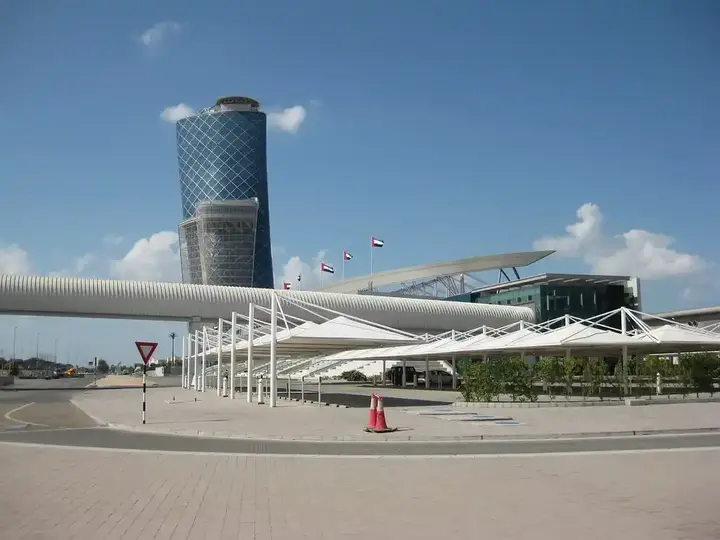
The design draws inspiration from Abu Dhabi's two dominant natural elements: the sea and the desert. The tower's form evokes a whirlpool of sand, while an axial canopy extends over the podium, producing a wave-like effect thanks to the building's proximity to the sea. The tower tilts 18 degrees west, rises to 160 meters, and has 35 floors. It also features 728 specially designed windows that are cleaned twice a month by a 12-person team.
Recommend
You may wonder how the tower remains stable. The top 17 floors cantilever over the edge, placing thousands of tons of load toward the building's center. This is counteracted by the world's first curved central core, made of 15,000 cubic meters of concrete reinforced with 10,000 tons of steel.
The tower includes 15 floors of offices, restaurants and bars, plus the 200-room Andaz Capital Gate Hotel; each room is different because of the building's structure. The luxurious Presidential Suite is partly situated on the 18-degree slope. The building also features 30 meeting rooms, a conference area, a business centre, and a rooftop helipad.
The splendor of planning the Capital Gate Tower
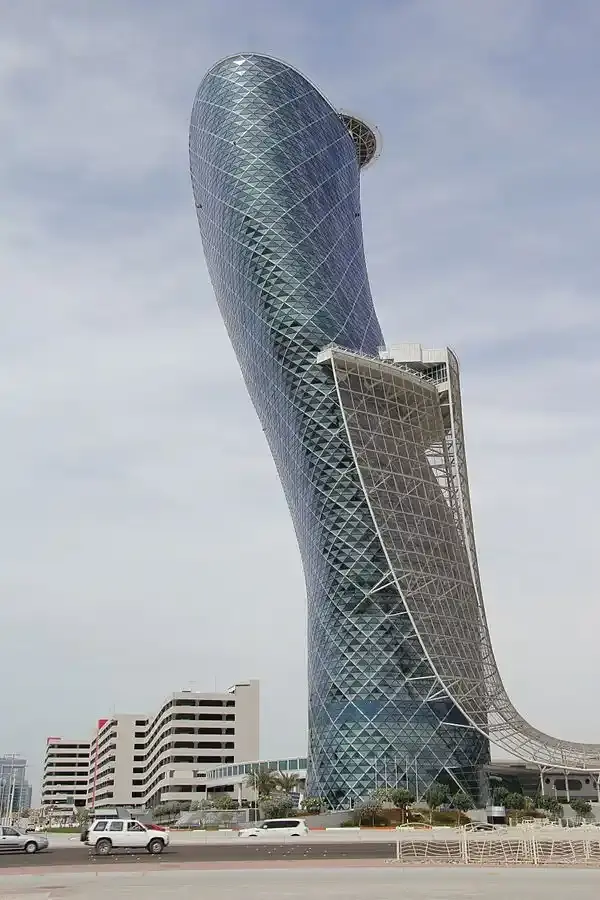
Because of its asymmetrical shape, each floor has a unique form and size. Floor plans evolve from a "curved triangle" to a "curved rectangle" as the building rises. To achieve this twisted form, the floor slabs were rotated, giving the tower a different appearance from every angle. A swimming pool spans the 17th and 18th floors, about 80 meters above ground.
The designers also created a large lobby that admits natural light and includes a tea lounge. Exterior lighting uses smart technology to reduce energy use and adjust to available daylight.
Some obstacles faced by the designers of the tower
Challenges included adding new elements late in construction. A two-storey addition—a swimming pool and a restaurant—was proposed at 90 meters above ground. It weighed 150 tons and was supported by 22 primary steel supports. Six months before construction began, a helipad was added to the design. Unexpected wind loads threatened to uplift the helipad, but the issue was resolved by reducing its clearance to two meters above the roof.
Strategies used in the construction of the Capital Gate Tower
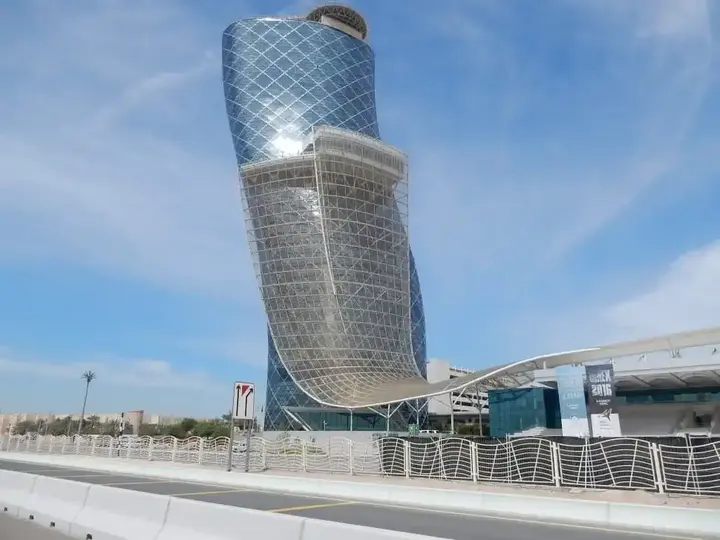
Architects were committed to integrating passive, effective design solutions to achieve sustainable building certification. A sun-shading metal mesh envelopes the south façade to block direct sunlight; the mesh reduces heat gain by about 30%, easing the load on the air conditioning.
In addition, an internal and external ventilation system creates a double-skin façade on the hotel's upper floors, reducing solar heat gain. Air from guest rooms is directed into the façade cavity, forming an insulating layer between the cool indoor air and the hot outside air; this cooled air is then recirculated back into the rooms. The clear façade glass has low emissivity, keeping interior spaces cool while reducing glare. Moreover, the building's organic, curved shape saves a significant amount of construction materials—steel, glass and concrete—thereby lowering the tower's carbon footprint and distinguishing it from other towers.