Three Arab legends you've never heard of before

Many of us grew up with famous tales such as Sinbad, Ali Baba and the Forty Thieves, and Aladdin and the Magic Lamp, yet we rarely hear stories like the ones told here. These are three Arab legends you have probably never heard of—hidden treasures waiting to be discovered. So let’s get to know them.
Show key points
- The legend of the Nisnas describes a terrifying half-human, half-monster creature that hops on one leg and is known to attack and kill humans.
- Ancient historians and writers, including Herodotus and Pliny the Elder, described beings resembling the Nisnas, suggesting the myth had roots in both Arab and Western traditions.
- Arab mythology sometimes links the Nisnas to a demon-human hybrid called "crack," believed to be created through interbreeding.
- ADVERTISEMENT
- The tar monster is a pre-Islamic Arab myth about a wolf-like demon that lives in graveyards and consumes the bodies of the dead.
- This tar monster myth might stem from misunderstood medical conditions like lycanthropy and porphyria, which caused people to believe they were turning into wolves.
- Bahmut, a colossal fish in Arab legends, was believed to carry the Earth on its back and appears in various religious and mythological tales.
- The encounter between Prophet Jesus and the Bahmut, as described in mythology, underscores the creature's immense size and mythical significance.
The Legendary Monkey Monster
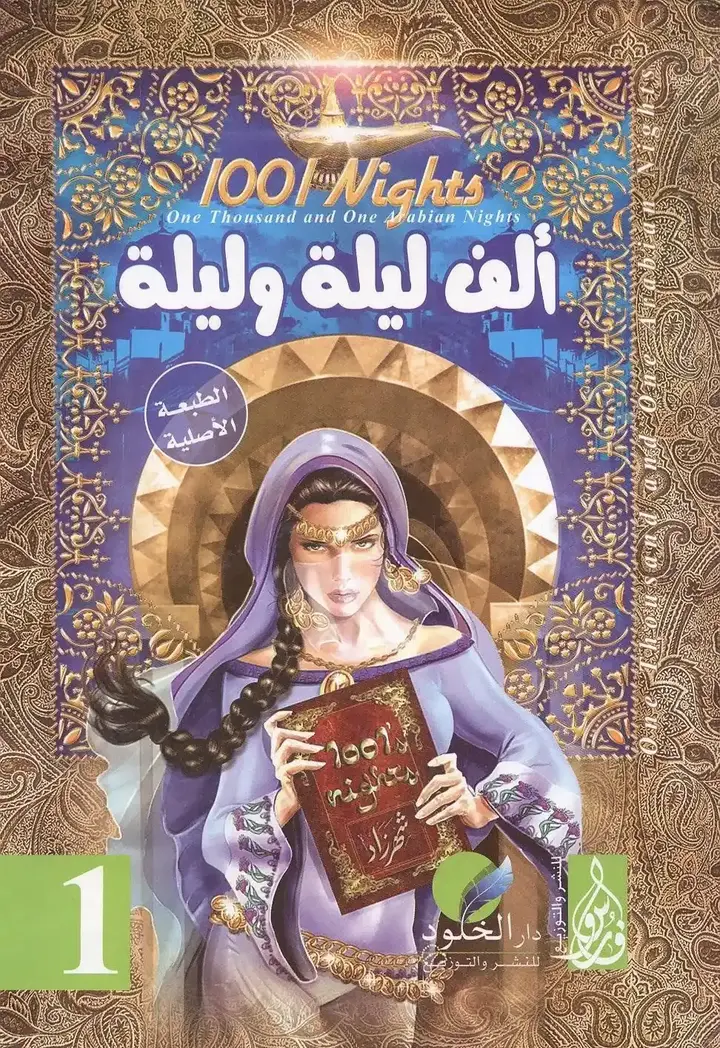
At first glance the name suggests the nisnas we think of—a kind of monkey—but the nisnas in these legends is a frightening creature with only half a head and half a body. It hops on one foot with huge bounds, springs on humans and kills them. It is mentioned in many ancient stories, the most famous of which is One Thousand and One Nights.
Recommend
An Iraqi historian recounts in his book "The Detailed History of the Arabs Before Islam" the people called "Wabar," saying they "were born Nisnas bin Umaym bin Amaliq bin Yalmaa bin Laudh bin Sam. They were originally human, but God made them a woman; the man among them has half a head and half a face, one eye, one hand and one leg. They graze like animals, jump heavily and are considered a hostile denial."
The creature was described by the Greek writer Herodotus in the fifth century BC, who wrote, "There was a tribe of men without heads, and instead their eyes and mouths were on their chests." He was not alone: more than four centuries later the Roman writer Pliny the Elder insisted these creatures existed and were real.
Language reference books classify the nisnas as myth. The dictionary "The Crown of the Bride" states: "Nisnas... In the hadith: 'Whoever disobeys their Messenger is alive and Allah has deformed them as a woman, each of them has a hand and a man of one slit who jump like a bird and graze as cattle graze, and it is found in the islands of the China Sea.'"
In pre-Islamic Arab mythology, the breed was said to be the product of interbreeding between a type of demon called "shaqq" and humans, and to have the ability to kill people. The famous Muslim scholar al-Qazwini described the shaqq in his book, saying: "Its image is half-human, and they claim that the nisnas are composed of the shaqq and the human being, and appear to man in his travels."
The Legend of the Qatrab
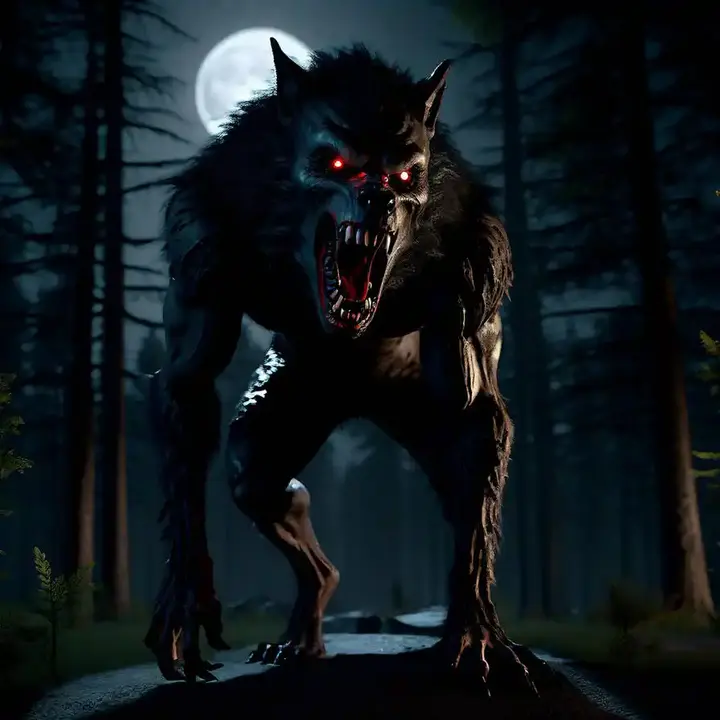
This myth was a common superstition among the Arabs before Islam. The qatrab is said to be a wolf-like monster, a type of demon or jinn that lives in cemeteries and feeds on corpses. It resembles the ghoul; Edward Lane, the English translator of One Thousand and One Nights, says the male ghoul is called a qatrab. Some accounts say the qatrab was once a normal human whose transformation began after a bite from a rabid wolf. That illness forced him into isolation and, on nights of the full moon, his body hair would thicken, his fangs appear, and he would pursue his usual habits, including cannibalism.
The Arabic name qatrab is also used for a rare psychological syndrome, lycanthropy, in which the patient believes they are turning into a wolf. The Muslim physician Abu Bakr Muhammad al-Razi described it in the early tenth century as a brain disorder or psychosis rather than a physical transformation; al-Razi saw it as a kind of madness that makes a person behave like a wolf.
It is interesting that it was most likely understood as an illness, since Arab scholars including Ibn Sina and al-Zahrawi discussed it. One patient complained of thick hair and light sensitivity, and it was called "al-qatrab" at the time. There is also a condition with a scientific explanation and treatment called porphyria. In rare cases porphyria can cause long nails, protruding teeth, reddened eyes, wrinkled skin and an inability to tolerate sunlight, making sufferers seem like human wolves.
The Legendary Creature Bahamut
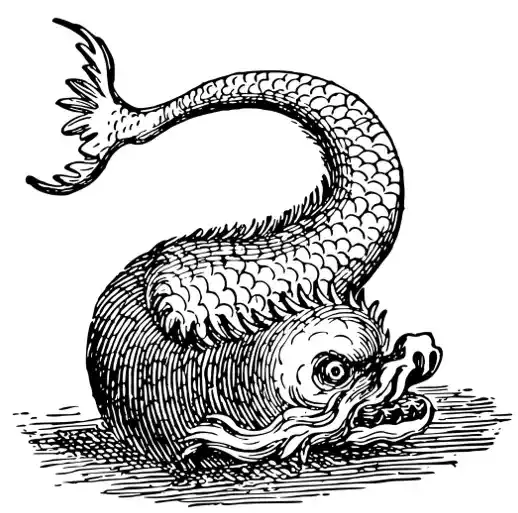
Bahamut is a mythical creature that appears in Arab mythology from the pre-Islamic era. It was known as a giant fish inhabiting the depths of the ocean, and the ancient Arabs thought Bahamut carried the earth on its back. In Night 496 of One Thousand and One Nights it appears as a whale: God created a vast sea beneath it, a light and a rock above it, and an angel-king who carries the seven lands on his shoulders.
It is also reported that God informed the Prophet Jesus of it, so Jesus asked God to show it to him. God commanded an angel-king to take Jesus to see it. When the angel led him to the sea where the whale swam past like lightning, Jesus fainted. When he woke, God inspired him and said, "Jesus, have you seen the whale? And did you know its length and width?" Jesus replied, "O Lord, your glory and majesty are unseen, but a great light of three days passed over me, and I did not know what that light was about."