The Arab-Islamic conquest of Andalusia: history - civilization and heritage
ADVERTISEMENT
The Arab-Islamic conquest of Andalusia, which began in the early eighth century, represents one of the most important chapters in the history of Islamic expansion and European civilization. It left an indelible mark on the region’s cultural, intellectual, and architectural life and led to the emergence of
ADVERTISEMENT
a dynamic, sophisticated Islamic civilization in the Iberian Peninsula, characterized by cultural exchange, intellectual prosperity, and religious tolerance. This article examines the historical events and impact of the Arab-Islamic conquest of Andalusia and highlights its contributions to the region and to the wider world.
Opening date:
Photo via Wikimedia
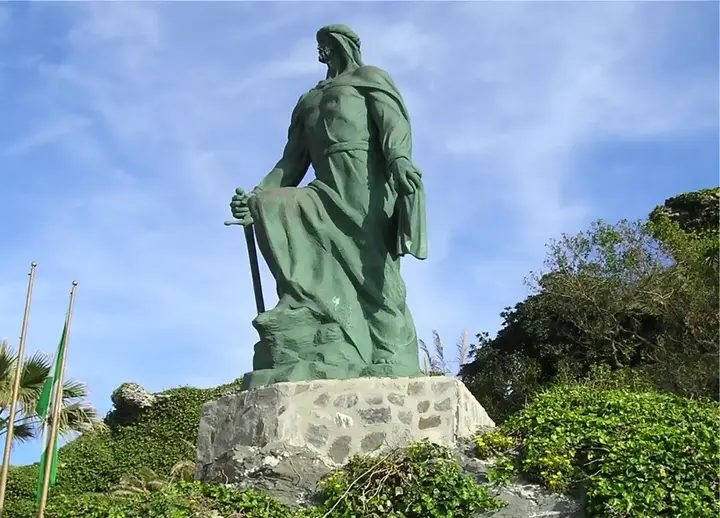
The conquest of Andalusia began in 711 AD, when an army of about 7,000 fighters, led by Tariq ibn Ziyad, crossed the Strait of Gibraltar and defeated the Visigothic forces of King Roderick at the Battle of Guadalete. Tariq’s forces were soon reinforced by Musa ibn Nusayr, who organized a second invasion; within a few years the two commanders controlled more than two-thirds of the Iberian Peninsula. The second invasion brought some 18,000 mostly Arab soldiers, who quickly captured Seville and then defeated Roderick’s supporters at Mérida before joining Tariq’s forces at Talavera. In the following year the combined armies pressed on into Galicia and the northeast, taking León, Astorga, and Zaragoza. This decisive series of victories led to the rapid expansion of Islamic rule across the peninsula and to the establishment of a sophisticated, cosmopolitan civilization in Andalusia.
ADVERTISEMENT
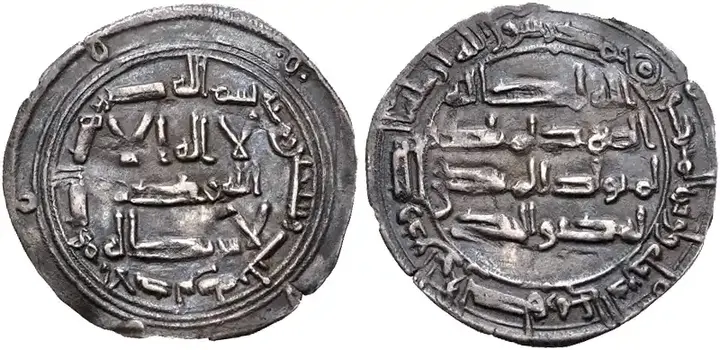
In 756, Abd al-Rahman I (al-Dakhil), a survivor of the recently overthrown Umayyad dynasty in the Levant, arrived in Andalusia and seized power in Córdoba and Seville, declaring himself emir and asserting what he considered the legitimate continuation of the Umayyad line. Abd al-Rahman I’s rule brought relative stability: he commissioned major buildings, the most famous being the Mosque of Córdoba, helped to civilize the emirate, and defended it against invaders while suppressing numerous rebellions.
Abd al-Rahman I founded an independent dynasty that endured until the eleventh century. Afterward, the region fragmented into a variety of smaller principalities, known as taifas, which could not stop the expanding northern Christian kingdoms. The last Islamic stronghold, the Emirate of Granada, fell to the armies of Castile in 1492.
ADVERTISEMENT
Impact and legacy:
Photo via Wikimedia
The influence of Andalusian Islam has been profound over the centuries and can be summarized as follows:
Cultural renaissance and intellectual exchange: The Arab-Islamic conquest of Andalusia sparked a cultural renaissance marked by a lively exchange of ideas, knowledge, and artistic expression. Scholars and thinkers from diverse backgrounds gathered in Andalusia and helped create a golden age of learning and innovation. Figures such as Ibn Rushd, Ibn Tufayl, and Ibn Khaldūn made pioneering contributions in philosophy, medicine, mathematics, history, and astronomy. A broad translation movement transmitted classical knowledge from Greek, Latin, and Sanskrit into Arabic, enriching Islamic intellectual life and preserving much of antiquity for later generations.
ADVERTISEMENT
Religious tolerance and interfaith coexistence: Islamic rule in Andalusia was notable for a significant degree of religious tolerance. Muslims, Christians, and Jews lived side by side, forming a rich tapestry of cultural diversity and mutual interaction. The dhimma system provided protection for religious minorities, allowing Christians and Jews to practice their faiths and to take part in the social, economic, and intellectual life of Andalusian society. This environment encouraged cooperation and dialogue and reflected principles of pluralism within the Islamic context.
Cultural synthesis and the Golden Age: Beyond tolerance, the conquest fostered a golden age of cultural synthesis and intellectual prosperity. Arab, Amazigh (Berber), Jewish, and Christian communities coexisted and contributed to a vibrant exchange of ideas, languages, and artistic traditions.
ADVERTISEMENT
Photo via Unsplash
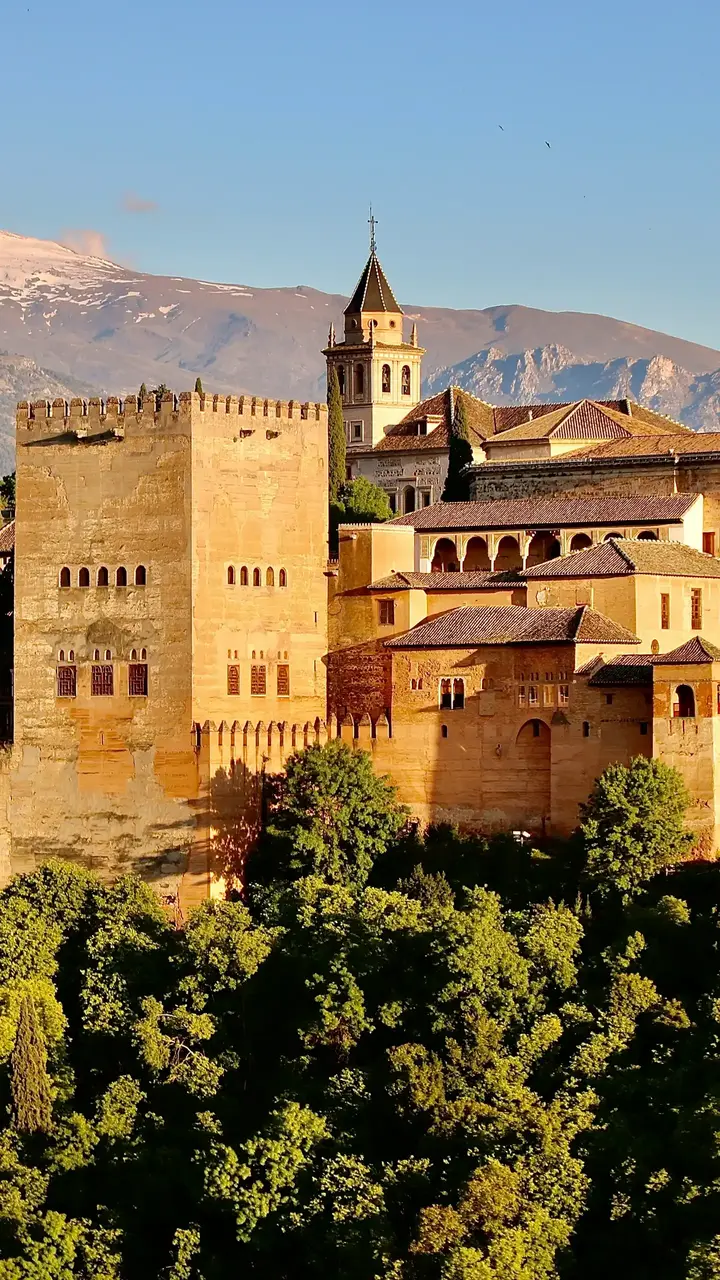
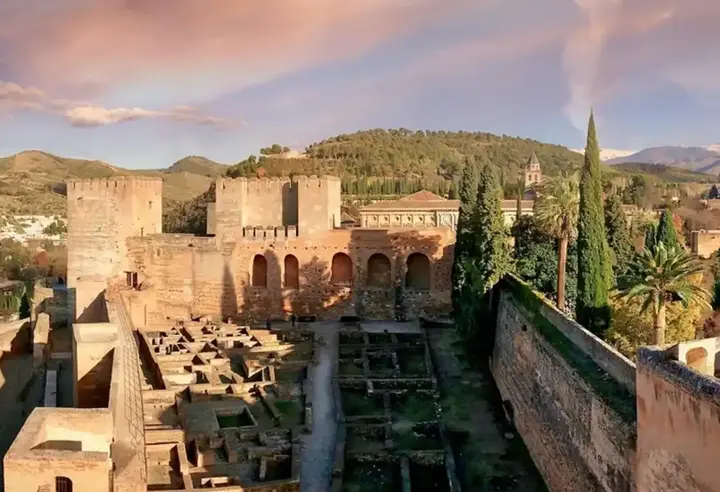
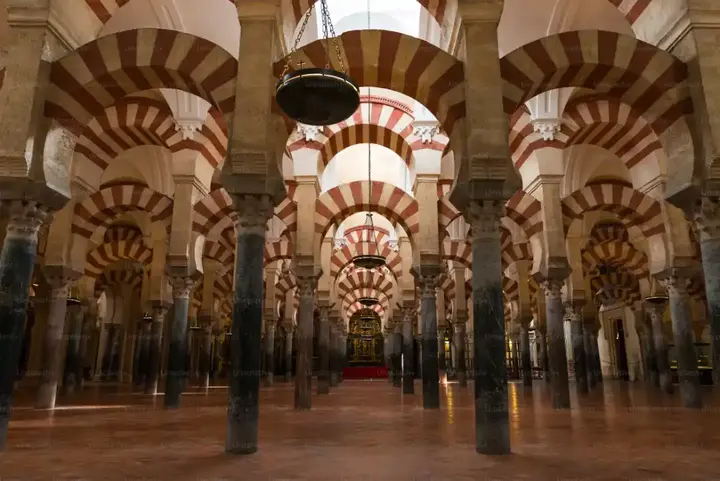
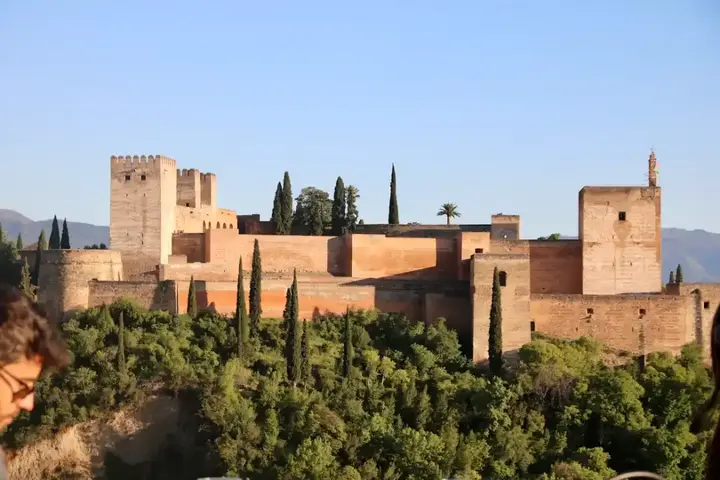
Architectural achievements and urban development: The Arab-Islamic presence in Andalusia ushered in an era of architectural innovation and urban growth. Andalusian rulers patronized architecture and city planning, producing landmarks that still draw visitors today. Grand mosques, palaces, and fortifications reflect a blend of Islamic, Byzantine, and Western Gothic influences. The Great Mosque of Córdoba, with its distinctive arches, geometric patterns, and intricate mosaics, and the Alhambra in Granada, with its stucco work, gardens, and poetic inscriptions, remain lasting testaments to Andalusian architectural skill.
Conclusion:
Photo via Unsplash
The Arab-Islamic conquest of Andalusia demonstrates the transformative power of cultural exchange, intellectual inquiry, and religious tolerance. Although Islamic rule declined in the late Middle Ages, the legacy of Andalusian civilization continues to inspire scholars, artists, and historians worldwide. The conquest of Andalusia offers a reminder of the possibilities of unity, diversity, and coexistence and provides lessons for building a more inclusive and enlightened world. Moreover, Andalusian cultural and intellectual heritage should not be viewed only through a Western lens. Andalusian Islam produced works, doctrines, and practices that influenced the broader Muslim world. After the contraction of Islamic domains in the West, many Andalusian intellectuals migrated to other regions of the Islamic world, helping to spread Andalusian achievements. A look through surviving Islamic libraries shows a long list of Andalusian “bestsellers” in religious literature, and in certain regions—such as North and Central Africa—the development of Islam cannot be understood without reference to the thought and work of Andalusian scholars.
Shaimaa Mahmoud
ADVERTISEMENT
Drifting science (drifting, drifting or drifting/slipping): How does car drift work?
ADVERTISEMENT
Since the dawn of civilization, humans have been drawn to adventure and entertainment—often so intertwined that you can’t tell one from the other. For example, hunting began as a means of food, survival, and removing threats, but over millennia it became a pastime.
What drives someone to
ADVERTISEMENT
kill an animal simply minding its own business? Thrill, entertainment, and perhaps other unsavory motives.
Human nature finds ways to squeeze excitement out of the most unlikely activities. Beyond hunting, many necessities have been transformed into novel forms of entertainment. In this article, we’ll look at one pursuit that involves moving in an unusual way on four wheels.
Yes, while we won’t be discussing the Fast and Furious films, we will talk about drifting.
ADVERTISEMENT
What is Drifting?
Photo via Unsplash
Drifting, in motorsports, is a specific driving technique.
The term suggests what the technique involves: the driver deliberately oversteers, causing the rear tires (or, in some cases, all tires) to lose traction while still maintaining control from the turn’s entry to its exit.
Technically speaking, a car is drifting when the rear slip angle—the angle between a tire’s actual path and the direction it points—is greater than the front slip angle.
Taking a Normal Turn
Photo via Unsplash
How do you make a normal turn in a car?
It’s simple: you turn the steering wheel in the desired direction and physics takes over. You have limited control beyond that. The process is so smooth you might not even notice the forces at work between the tires and the road.
ADVERTISEMENT
Friction: A Full-Fledged Force in Itself
Photo via Unsplash
Friction is essential for turning. Without it, your car would slide and feel like it was dancing on the road. To imagine driving with very little friction, picture trying to steer on a sheet of glass.
When you turn, friction provides the centripetal force that pulls the car into a circular path—the exact motion needed to negotiate a curve.
Before you steer left, for example, the car is moving straight ahead and wants to keep doing so, according to Newton’s first law. Once you steer, static friction grips the front tires and prevents the car from skidding straight, allowing it to follow the turn.
How to Achieve Car Drifting?
Photo via Unsplash
ADVERTISEMENT
The dynamics change when you drift because it’s all about managing how much traction the rear wheels lose. You want to lose traction, but not completely—you must control the amount lost. How do you manage rear-wheel traction? By controlling wheel speed.
Losing Traction on the Rear Wheels
Photo via Unsplash
While drifting, you enter a turn at speed, causing the rear tires to lose grip. As a result, the rear end over-rotates toward the turn and the rear wheels begin to spin.
To counter the rear’s excessive rotation and wheelspin, you must steer the front wheels into the opposite direction of the original turn.
In short, drifting is about balancing the traction lost at the rear by continuously matching wheel speed to the slide.
ADVERTISEMENT
Drifting Is Not Easy!
Photo via Unsplash
What may sound simple from the explanation above is actually very hard in practice. Drifting is an extremely difficult maneuver. If the car enters an uncontrolled spin, the results can be disastrous. Mastering drifting requires a deep understanding and a lot of practice, which is why drifting events are performed by trained professionals under controlled conditions.
Drifting can give drivers an edge in racing, but it’s not something to try on public roads. It’s not as easy as it looks in the movies, and losing control of your car is definitely not cool.
Tasnim Alia
ADVERTISEMENT
Indonesia’s National Mosque Was Designed by a Christian Architect
ADVERTISEMENT
Indonesia’s national mosque, Istiqlal, was designed by a Christian architect in the first decade after independence, and that fact matters because Sukarno’s new republic was using one major building to say what kind of country Indonesia meant to be.
Indonesia Travel says the architect was Friedrich Silaban, who won a
ADVERTISEMENT
design competition in 1955 under Sukarno. Historians such as Tutin Aryanti have treated Istiqlal not as a stray architectural story but as a statement of nationhood in post-independence Jakarta. That is the right way to see it. Otherwise, the building shrinks into trivia.
Why this mosque was never just a mosque
The name itself gives the first clue. Istiqlal means “independence.” So from the beginning, this was not only a place for prayer. It was also conceived as a monument to the new state that emerged after Dutch colonial rule and after the bitter struggle that followed the 1945 declaration of independence.
ADVERTISEMENT
Sukarno, Indonesia’s first president, understood buildings politically. He wanted Jakarta to look like the capital of a sovereign nation, not a city still living in a colonial shadow. A national mosque fit that project. In a Muslim-majority country, it could honor Islam, but it could also stage the republic’s confidence in stone, steel, and concrete.
That is why the 1955 competition matters so much. It fixes the mosque in a very specific moment: not ancient Islam, not timeless devotion, but early state-building. The commission belonged to the era when Indonesia was deciding how to present itself to its own citizens and to the wider world.
How the dome turned into a political sentence
Once you know the setting, the building’s major choices start to read differently. Its scale is monumental because it was meant to be national. Its position in Jakarta matters because the capital was being remade as the stage set of independence. Even the name presses the point again: this mosque was tied to freedom won in 1945, not merely to ritual use.
ADVERTISEMENT
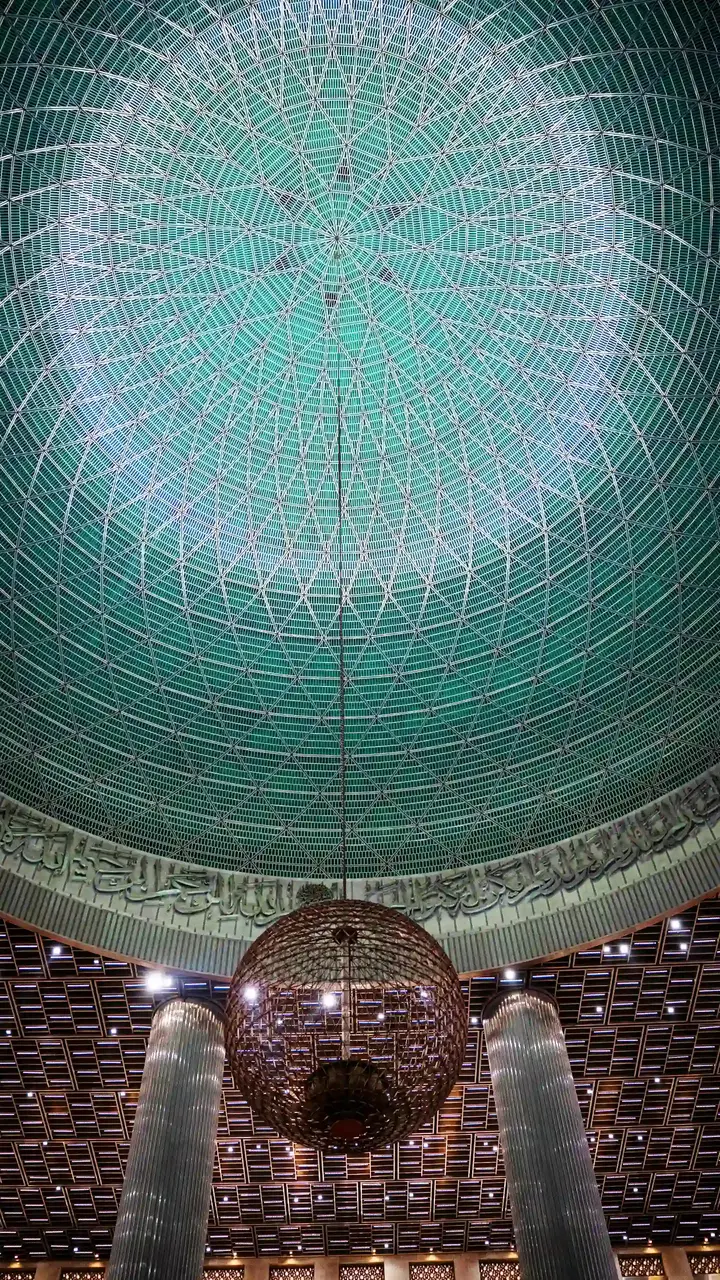
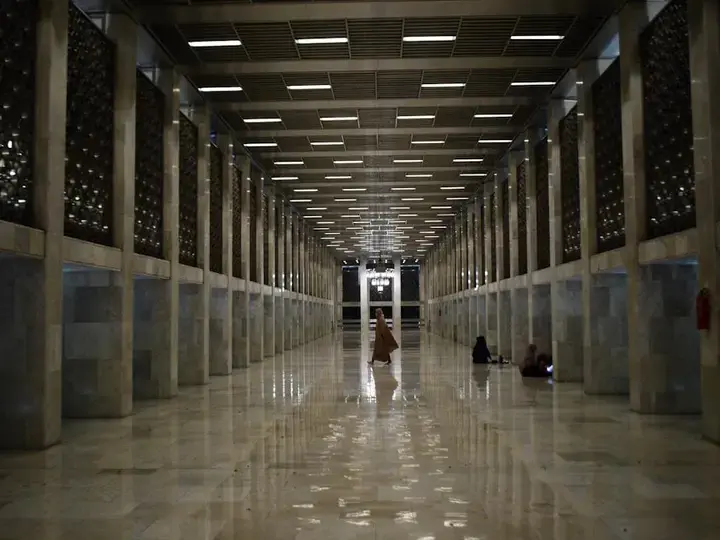
Some of the symbolism is plain enough to follow. The great dome is often read alongside the number 45, pointing back to 1945, the year of independence. The mosque’s massive prayer hall and broad structural forms do more than house worshippers. They announce that Islam belongs inside the republic’s public identity, at full civic scale.
Photo by Muhamad Husni Tamami on Unsplash
And yet Istiqlal was not tucked away as a sectarian monument. It was placed in the postcolonial capital as a national institution. That distinction matters. A local mosque serves a community. A national mosque also speaks for a state, and states rarely build on this scale unless they want to be heard.
There is another detail people often note once they learn the site: Istiqlal stands near Jakarta Cathedral. That pairing has invited many later readings about coexistence. Some of those readings are fair. But the deeper point is older and harder. The mosque belongs to a planned political center where religion, state symbolism, and national image were being arranged together.
ADVERTISEMENT
The slow moment under Sukarno that changed its meaning
Let’s slow down here, because this is where the story stops being a neat fact and becomes history. In the 1950s, Sukarno backed the idea of a grand mosque for the capital as part of a broader effort to mark independence with enduring public works. The project moved through committees, debates over site and design, and the 1955 competition that Silaban won.
Silaban proposed a monumental modern design. Sukarno, who took a close interest in architecture, supported it. Construction itself would stretch much longer, and the mosque was opened only later, in 1978, under Suharto. But the governing idea belongs to that earlier founding period: build a mosque that honors the Muslim majority while naming the republic born from independence.
ADVERTISEMENT
That is why “Istiqlal” is not decorative language. It is the key. The building was commissioned as a monument to freedom, then given the form of a national mosque. Put those two facts together and the structure begins to read like an argument: Islam is central to Indonesia’s public life, but the nation is not reducible to Islam alone.
An honest line belongs here. This story should not be flattened into a cheerful slogan about tolerance, because the building also served state power and national image-making. Grand monuments often do. They gather real ideals and political ambition into the same concrete shell.
The fact that should not matter, and then does
In one sense, an architect’s religion should be irrelevant to the meaning of a mosque. Sacred buildings are usually read through patronage, design, use, and theology, not through the private faith of the person who drew the plans. If you knew only the dome, the calligraphy, the monumental hall, and the national role of the building, you could still understand a great deal.
ADVERTISEMENT
But in post-independence Indonesia, the selection of a Christian architect for the national mosque became historically meaningful precisely because the state was trying to define the nation as larger than any one confession even while centering Islam symbolically. That is the real surprise. Silaban’s Christianity is not interesting because it is ironic. It is interesting because the commission made a public claim about who could help build the republic.
This is the pivot in how to see Istiqlal. If you had looked only at its size and ornament, would you have noticed the same building once you knew who was asked to design it, and when? Most people would not. The facts rearrange the structure.
Now the dome is not just a dome. It becomes part of a state argument. The mosque says the Muslim majority has an honored, visible place in the nation. The choice of architect says the nation was being imagined as broader than religious sameness. Those two messages sit together, not comfortably, but deliberately.
ADVERTISEMENT
What the building says about Indonesia, if you listen closely
That is why this is history rather than a clever anecdote. A random oddity does not explain a country. Istiqlal does, because it was commissioned at a founding moment, named for independence, placed in the capital, and designed on a scale meant to speak for the republic itself.
It also helps explain something true about Indonesia after independence: nationhood there had to be built across difference, not after difference had disappeared. The state could honor Islam as the faith of the majority without formally collapsing the nation into a single religious identity. Istiqlal gave that balancing act a permanent form.
So the deepest meaning of Istiqlal is almost the reverse of what a quick glance suggests: Indonesia’s national mosque was built to express Muslim-majority nationhood, but its full historical message only comes into view when you see that the nation it served was meant to be larger than one faith.